


Ants in your home can be more than just a nuisance - they can damage property, contaminate food, and spread bacteria. Here's how to stop them in their tracks:
- Identify the ants: Learn to recognize common indoor species like carpenter, odorous house, pharaoh, and pavement ants.
- Eliminate attractants: Keep your home clean, seal food in airtight containers, and fix moisture issues like leaks or standing water.
- Seal entry points: Use caulk, weather stripping, and foam to block even the tiniest gaps (as small as 1/64 inch).
- Use baits effectively: DIY ant baits with borax or baking soda can target colonies directly.
- Maintain long-term defenses: Trim plants near your house, clear gutters, and consider using natural repellents like vinegar or peppermint oil.
Taking these steps early can save you time and money while keeping your home ant-free. For persistent issues, the best DIY pest control kit can provide ongoing protection.
Get Rid of House Ants Permanently (Indoor or Outdoor)
sbb-itb-0bbb908
How to Identify Common Indoor Ant Species
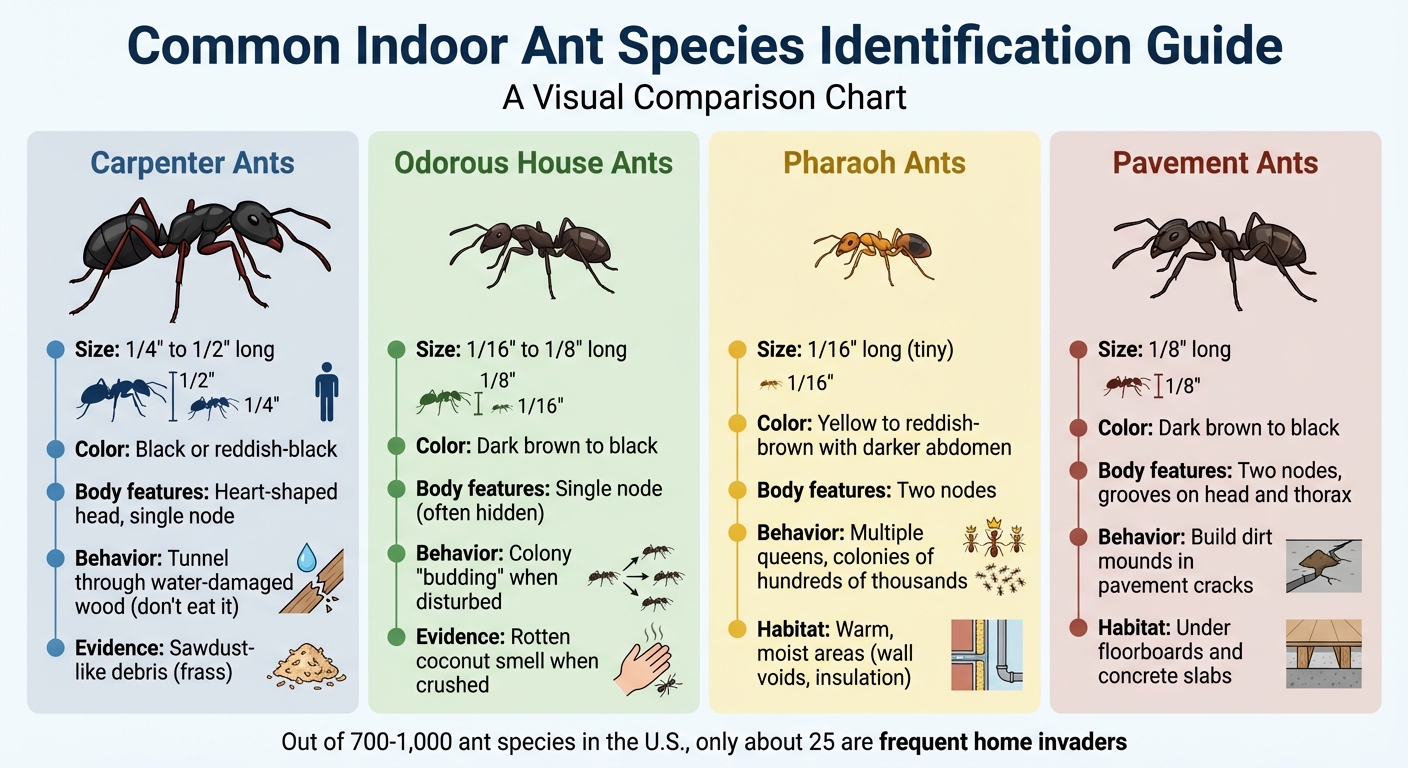
Common Indoor Ant Species Identification Guide
Identifying the ant species invading your home is the first step to effectively managing and preventing infestations with a professional-grade solution. In the United States, there are between 700 and 1,000 ant species, but only about 25 are frequent home invaders. According to the National Pest Management Association, ants rank as the top nuisance pest in the country.
To identify ants, examine their waist for one or two nodes, and note their size, color, and behavior. Comparing these traits across species can help you understand the specific risks they pose.
Carpenter Ants vs. Odorous House Ants
Carpenter ants are among the largest ants you’ll find indoors, measuring between 1/4″ and 1/2″ long. They are usually black or reddish-black, with a heart-shaped head and a single node. Unlike termites, carpenter ants don’t eat wood but tunnel through it to create nests. This activity leaves behind sawdust-like debris known as frass. As Jody Gangloff-Kaufmann from Cornell University explains:
"Unlike termites, which eat their way through new or old wood, carpenter ants will only tunnel through wood that's already been damaged by water."
These characteristics make it easier to identify and address carpenter ant infestations.
Odorous house ants, on the other hand, are much smaller, measuring only 1/16″ to 1/8″ in length. They are dark brown to black and have a single node that’s often hidden from view. The fastest way to identify them is by crushing one, as they emit a distinct rotten coconut smell. These ants are also known for "budding", where colonies split into multiple satellite colonies if disturbed by repellents, making control efforts more challenging.
Pharaoh and Pavement Ants
Smaller species like pharaoh and pavement ants can also be troublesome.
Pharaoh ants are tiny, about 1/16″ long, with yellow to reddish-brown bodies and darker abdomens. They have two nodes and prefer warm, moist indoor areas like wall voids and insulation for nesting. Colonies can grow to several hundred thousand ants and often have multiple queens. The University of Maryland Extension notes:
"Pharaoh ants can be difficult to control... Colonies can 'break apart' and establish subcolonies if they become stressed from applying repellent liquid or dust insecticides."
Pavement ants are slightly larger, around 1/8″ long, and are dark brown to black with two nodes. They are easily recognized by the grooves on their head and thorax. These ants typically build dirt mounds in pavement cracks but can also nest under floorboards and concrete slabs.
Where to Inspect for Ant Activity
To locate ant activity, check kitchens, bathrooms, and areas near sinks, cupboards, pipes, and window sills for signs of frass or entry trails. Since carpenter ants are more active after sunset, evening inspections with a flashlight can be particularly effective. Michael Hansen, a biologist and ecologist at Consumer Reports, suggests:
"The best way to find out where ants are coming into your house... is to set out a substance you know they really like - tuna fish in oil or a sugar substance can work - and then follow the trail back to where they are entering the room."
Also, inspect areas where utility lines, pipes, and wires enter your home, as these unsealed gaps can provide direct access to wall voids. Outside, look for tree branches or shrubs touching your house, as they can act as bridges for ants to reach upper levels. Identifying these entry points early can help you take targeted steps to prevent indoor infestations. For ongoing protection, consider a monthly pest remedy kit to maintain a barrier against new invaders.
Cleaning and Sanitation to Prevent Ants
Once you know what type of ants have invaded your home, the next step is to eliminate the things that attract them. As an Orkin representative explains, "Inadequate sanitation is the main factor contributing to ant infestations". Leaving dirty dishes, crumbs on the floor, or trash sitting out too long is like sending ants an open invitation to move in.
Managing Food and Spills
Sugary spills like honey, syrup, or soda need immediate attention - just a few drops can alert scout ants, who will then bring their entire colony [7,2]. The same goes for grease splatters and protein-rich spills from meat or pet food. Store pantry staples like sugar, flour, and cereal in airtight glass or plastic containers to keep ants from sniffing them out [25,27]. Don’t forget to clean hidden spots: pull out appliances to sweep crumbs and wipe grease from under your fridge and stove, and check cabinets and floor corners regularly [25,27].
If you have pets, only leave food bowls out during mealtime, and clean them right after. Store bulk pet food in sealed bins and wipe the floor around feeding areas daily [25,26]. Keep ripe fruit in the fridge instead of on the counter, and use trash bins with tight-fitting lids to dispose of garbage often, especially if it contains food scraps [7,26].
Removing Pheromone Trails
Ants navigate by following chemical scent trails, which makes removing these trails crucial. Simply wiping them with a dry paper towel won’t do the trick, as the oily pheromones linger. Instead, mix equal parts white vinegar and water in a spray bottle and wipe down areas where ants have been active [2,29]. Soapy water is another effective option - it not only kills ants on contact but also disrupts their scent trails [7,26]. For stubborn trails on porous surfaces, scrubbing with a paste of baking soda and water can help remove deeply embedded pheromones.
Controlling Moisture
Ants need water to survive. Emma Grace Crumbley, an entomologist at Mosquito Squad Plus, explains, "Water is crucial for an ant's survival, so they'll often seek out water sources where they can drink right away and bring more back to the rest of their colony". Repair any dripping faucets or leaky pipes quickly, and clear clogged drains in bathtubs and showers to eliminate standing water [24,31,34]. After showering, use a squeegee on the walls and run the exhaust fan to cut down on humidity [24,2]. Also, make it a habit to wring out wet sponges, replace damp dish towels regularly, and wipe down sinks and countertops daily to minimize moisture [25,27].
If you’re dealing with constant dampness in basements or crawl spaces, consider using a dehumidifier to manage humidity levels [34,35]. Outside, keep gutters clear and make sure downspouts direct water away from your home’s foundation to avoid pooling near walls [31,33].
Sealing Entry Points and Building Barriers
Once you've addressed food and moisture issues, the next step is to block ants from getting inside. Even a perfectly clean home won't stay ant-free if tiny gaps let them in. Ants can fit through openings as small as 1/64 of an inch, so even the smallest cracks could invite an entire colony. The goal is to locate and seal these entry points before ants find them.
Sealing Windows, Doors, and Baseboards
Start by observing where ants are entering. Follow their trails to identify where they vanish into walls, floors, or window frames, focusing on high-risk areas like kitchen windows. Once you've pinpointed the entry points, use silicone caulk to seal cracks around window frames, door jambs, and baseboards. Apply a continuous bead to ensure no gaps are left for ants to exploit.
For doors, install a door sweep at the bottom. Choose a brush or rubber style that fits snugly against the floor without dragging when the door moves. Replace worn weather stripping around doors and windows to close gaps caused by temperature changes. Pay special attention to baseboards, particularly in corners where walls meet the floor, as these are common pathways for ants traveling through wall voids. For larger gaps around plumbing, electrical lines, or HVAC units, expandable spray foam is an effective solution.
Trimming Plants and Fixing Leaks
Plants touching your home can act as bridges for ants. Trim vegetation that comes into contact with the exterior walls, and keep firewood stacked at least 20 feet away from the foundation. Mulch piled against the foundation can also create a moisture-rich pathway for ants. Pull mulch back a few inches to create a dry barrier. Additionally, address outdoor moisture problems by cleaning gutters regularly and ensuring downspouts direct water away from the foundation to prevent pooling near walls.
Natural Deterrent Options
After sealing gaps, wipe the areas with a vinegar solution to erase ant trails and discourage them from returning. To reinforce your defenses, mix 10 to 15 drops of peppermint oil with a cup of water and spray it around sealed entry points. The strong scent serves as a natural repellent. You can also sprinkle food-grade diatomaceous earth along baseboards and in dry areas. This natural substance dehydrates ants that come into contact with it, adding an extra layer of protection. While these methods won't eliminate an existing colony, they can help prevent future invasions once the physical gaps are sealed.
DIY Ant Baits to Eliminate Colonies
Once you've sealed your home's entry points, the next step is tackling the ant colony itself. Blocking entry points alone won't address the hidden colony. In fact, the ants you see are just a tiny fraction - about 1% - of the entire population. That’s why baiting is essential. The idea is simple: worker ants carry a slow-acting poison back to the nest, wiping out the colony from within.
Borax and Sugar Paste
Borax, a mineral commonly found in the laundry aisle, is a powerful ingredient for DIY ant baits. When mixed with sugar, it creates a slow-acting poison that kills ants within 24–48 hours. This delayed effect is crucial because it gives the ants enough time to return to the nest and share the bait with others.
"The key to successful borax ant control lies in understanding colony dynamics. Worker ants make up only about 1% of the total colony population at any given time." - George Schulz, Licensed Pest Control Technician
Studies suggest that a borax concentration of 0.5% to 1% works best for eliminating colonies. Here's how to make two simple baits:
- Liquid Bait: Dissolve 1 cup of warm water, 2 tablespoons of borax, and 1/2 cup of sugar. Soak cotton balls in the mixture and place them where ants are active.
- Paste Bait: Combine 2 tablespoons of borax with 1/2 cup of powdered sugar. Gradually mix in 1–2 tablespoons of water or honey until it forms a peanut butter-like consistency. This works well for vertical surfaces or tight spaces.
Other Bait Recipes
Different ant species have different tastes, so it’s important to test what works best. Not all ants are drawn to sugar; for example, carpenter ants prefer protein-based baits. Try using small amounts of jelly or peanut butter to see what the ants favor. If peanut butter is the winner, mix 1 tablespoon of borax with 3 tablespoons of peanut butter.
For homes with pets or young children, a mixture of baking soda and powdered sugar offers a safer, non-toxic alternative. While less effective than borax, it can still help with minor infestations.
| Bait Type | Target Ant Species | Primary Ingredients |
|---|---|---|
| Liquid Sugar | Pavement, Odorous House, Argentine | Borax, sugar, warm water |
| Sugar Paste | Sugar-seeking ants in cracks/crevices | Borax, powdered sugar, honey or water |
| Protein Bait | Carpenter ants, grease ants, fire ants | Borax, peanut butter (or tuna/bacon grease) |
| Pet-Safe Bait | General household ants | Baking soda, powdered sugar |
Once you've identified the bait that attracts your ants, placement becomes key. For ongoing protection, consider a quarterly pest remedy kit to maintain a barrier against future infestations.
Safe Bait Placement
Position baits along established ant trails, especially under sinks, along baseboards, and near entry points. To keep kids and pets safe, use small containers like bottle caps or straw segments to hold the bait. Place these in hidden spots, such as behind appliances or inside cabinets.
Avoid disturbing the ants at the bait stations - they need to carry the poison back to the nest. Replace the bait regularly, as ants may lose interest in dried-out or spoiled bait. Smaller infestations might clear up in 1–2 weeks, but larger colonies could take 3–8 weeks of consistent baiting.
Long-Term Ant Prevention with Remedy Kits
Once you've tackled active infestations with DIY baits, the next step is ensuring ants don’t come back. That’s where our Remedy kits come in - they’re designed to help you maintain an ant-free home with a thorough, long-term prevention strategy.
Customized Solutions
Our kits are tailored specifically to your zip code, home size, and the type of ants you’re dealing with. Why does this matter? Because the approach needed for carpenter ants in a humid climate isn’t the same as what works for pavement ants in a dry area. By sharing a few details about your home and the pests you’ve noticed, we’ll send you everything required for a professional-level treatment. These dual-action kits strengthen your home’s defenses, complementing the prevention techniques you’ve already started.
Pet- and Child-Safe Products
We prioritize safety alongside effectiveness. All products in our kits are professional-grade but labeled "No Bad Chemicals", meaning they target ants without posing risks to your family or pets. Each kit comes with clear product labels, including re-entry guidelines, so you’ll know exactly when it’s safe to return to treated areas. With easy-to-follow instructions and the necessary application tools included, you can handle the treatment process confidently - no professionals needed.
Regular Shipments and Virtual Support
Outdoor barriers naturally wear down over time due to rain and other weather conditions. To keep your home protected, we offer monthly or bi-monthly shipments based on your area’s specific needs, ensuring a consistent barrier against ants. Plus, every subscription includes access to pest control experts via chat or email. These experts can help identify ant species or guide you through any application questions.
Want to give it a try? New customers can get their first kit free by using the code "FREEKIT" at checkout. And don’t worry about extra costs - shipping is free for all subscription orders.
Conclusion
Keeping ants at bay comes down to three key actions: identifying the species, eliminating attractants, and sealing their entry points. Tackling the issue early - by cleaning up trails, sealing gaps, and repairing leaks - can stop a minor nuisance from escalating into a full-blown infestation.
DIY baits can help by targeting the colony directly, but as Michael Hansen, PhD, from Consumer Reports, explains:
Unless you solve the problem of what's attracting them to your house - and how they're getting in - you should remember that there are thousands of ants in every colony, and you'll just keep seeing them.
To turn short-term fixes into long-term solutions, we’ve designed our Remedy kits. These kits are tailored to your specific ant issue and home layout, offering products, regular shipments, and virtual support. Instead of just dealing with scout ants, you’re preventing entire colonies from settling in.
Start with the basics: clean thoroughly, seal off entry points, and use slow-acting baits wisely. Then, boost your defense with a system customized for your home. New customers can get their first kit free with code "FREEKIT" and enjoy free shipping on subscriptions.
FAQs
How can I identify the ant species in my home?
To figure out what type of ant you're dealing with, start by looking at their size, color, and distinct features. Pay attention to details like the shape of their antennae or how narrow their waist is. For instance, carpenter ants are typically black and measure about ¼ to ½ inch long. On the other hand, odorous house ants are dark brownish-black and give off a coconut-like smell when crushed.
Behavior can also be a big clue. Watch for habits like nesting in wood or sneaking into wall cracks. If you're still unsure, compare your observations with reliable guides or reach out to a professional for help.
Why do ants keep coming back after I clean?
Ants tend to come back after cleaning because the root causes - like hidden food crumbs, entry points, or their nests - often go unnoticed. Even if you clean thoroughly, it might not disrupt the entire colony, which means they can easily reappear. Simply spraying the ants you see won’t solve the problem, as it doesn’t target the nest itself. To keep them from returning, seal up any cracks or gaps in your home and use bait or other treatments designed to eliminate the colony at its source.
When should I switch from DIY baits to a Remedy kit?
If your DIY ant control methods aren’t working or the infestation keeps coming back, it might be time to switch to a Remedy kit. These kits include professional-grade products specifically designed for your home and come with ongoing support to help tackle the problem. They’re a solid choice for dealing with tough or large-scale infestations when homemade solutions just aren’t cutting it.