


Integrated Pest Management (IPM) is a smarter, safer way to deal with pests by focusing on prevention and low-risk methods before resorting to chemicals. Here’s a quick breakdown of the 5 key steps to follow:
- Identify the Pest: Know exactly what you’re dealing with to avoid ineffective solutions. Misidentifying pests can waste time and money.
- Monitor the Problem: Track pest activity over time to confirm the extent of the infestation. A single sighting doesn’t always mean there’s a major issue.
- Remove Food, Water, and Shelter: Clean up crumbs, fix leaks, and declutter to make your space less inviting for pests.
- Seal Entry Points: Close gaps, cracks, and other openings to stop pests from entering your home.
- Use Low-Risk Options First: Try safer alternatives like traps, neem oil, or diatomaceous earth before considering conventional pesticides.
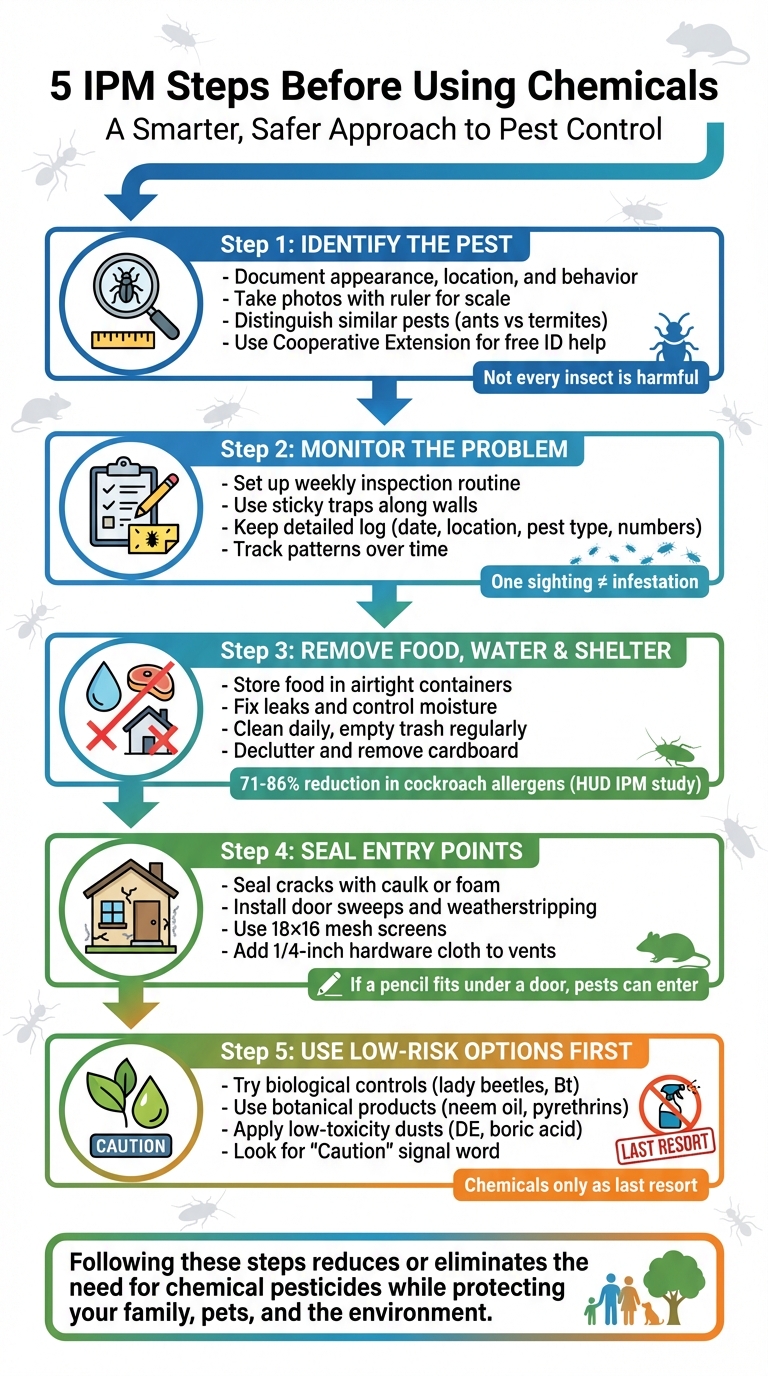
5 IPM Steps Before Using Pesticides: Integrated Pest Management Process
Integrated Pest Management: The SIX Steps
1. Identify the Pest Correctly
Integrated Pest Management (IPM) begins with one critical step: identifying the pest. Why? Because every action you take - whether it's setting traps, using baits, or applying sprays - hinges on knowing exactly what you're dealing with. Mistakes in identification can lead to wasted effort and ineffective solutions. For instance, using ant bait to tackle termites won’t get you anywhere.
Start by documenting the pest's appearance, location, and behavior. Take a clear photo of the pest, ideally with a ruler nearby to show its size. Note where you found it - was it in the kitchen, bathroom, attic, or bedroom? Also, observe when it’s active: does it show up during the day or only at night? Certain pests are seasonal, so timing can be a clue. Pay attention to how it moves - does it fly, crawl along edges, jump, or travel in trails? These details can help narrow down the species.
Distinguishing between similar pests is key to effective treatment. For example, ants have narrow waists and bent antennae, while termites have thick waists and straight antennae. Confusing the two can lead to completely wrong treatments. Bed bugs, which hide in mattress seams and leave telltale blood spots on sheets, are often mistaken for carpet beetles. However, carpet beetles are found near fabrics in closets and don’t bite. Even rodent droppings tell a story: mouse droppings are small and pointed (about 1/8–1/4 inch), while rat droppings are larger and capsule-shaped. Proper identification ensures you choose the right traps and placement.
Not every insect indoors is harmful. The Northwest Center for Alternatives to Pesticides points out that:
most species of living things are NOT pests.
This means you might not need to take action at all. For example, western conifer seed bugs are often mistaken for brown marmorated stink bugs, but they’re harmless and only require sealing cracks to keep them out - no insecticides needed.
If you’re unsure, don’t hesitate to get help. Local Cooperative Extension offices often provide free pest identification services, either through photos or samples. Virtual support is also available to confirm what pest you’re dealing with, ensuring you use the right professional-grade products that are safe for pets and children when applied correctly. Once the pest is identified, the next step is monitoring and confirming the extent of the infestation.
2. Monitor and Confirm the Infestation
Once you’ve identified the pest, the next step is to keep a close eye on their activity to understand the extent of the problem. This involves setting up a regular monitoring routine using tools like traps, visual inspections, and written records. The key here is to avoid jumping to conclusions based on a single sighting. A lone pest might just be a drifter, but consistent evidence points to a larger issue that needs action.
Make it a habit to inspect critical areas weekly. Indoors, focus on spots like under sinks, behind appliances, and around entry points. Look for telltale signs such as live pests, droppings, shed skins, or damage. Outdoors, pay attention to foundation cracks, mulch lines, and where utilities enter the building. For crawling pests, sticky traps placed along walls and behind appliances can be especially useful. Check these traps weekly to track activity.
Keep a detailed log that includes the date, location, pest type, and number of pests found. Over time, this record will help you identify patterns. For example, if you repeatedly spot roaches under the sink, you’ve likely found a hotspot. If trap counts or sightings steadily rise over weeks or spread to new areas, it’s a clear sign you’ve hit a point where action is necessary.
Monitoring doesn’t stop once you start addressing the problem. After improving sanitation or sealing potential entry points, stick to your inspection routine. A drop in trap counts or sightings is a good sign that your efforts are working. But if numbers stay the same or climb, it could mean you’ve missed a nest or another access point. In these cases, you’ll need to tweak your strategy before moving to more aggressive treatments. This methodical approach not only ensures effective pest control but also helps you avoid using pesticides unnecessarily.
3. Remove Food, Water, and Shelter
Once monitoring confirms an infestation, the next step is cutting off pests from the essentials they need to survive. Common household pests - like ants, cockroaches, mice, pantry beetles, and flies - thrive when food scraps, standing water, and safe hiding spots are readily available. By addressing these factors, you can significantly reduce pest populations without relying on pesticides.
Keep food sealed and kitchens spotless. Store dry goods such as flour, cereal, rice, pasta, and pet food in airtight containers made of glass, metal, or thick plastic. Avoid using cardboard boxes or thin bags, as pests can easily chew through them. Clean kitchen counters, vacuum floors, and check under appliances daily for crumbs. Empty trash bins regularly, use ones with tight-fitting lids, and don’t leave dirty dishes or pet food out overnight.
Control moisture to deter pests. Many pests - like cockroaches, ants, termites, and silverfish - are drawn to damp environments. Repair leaky pipes and dripping faucets as soon as possible. Use dehumidifiers in damp areas and run exhaust fans in bathrooms and kitchens to speed up drying. Avoid leaving standing water in sinks, plant saucers, pet bowls, or outdoor containers overnight.
Declutter to eliminate hiding spots. Pests like cockroaches, spiders, mice, and rats love cluttered spaces filled with cardboard boxes, paper bags, and unused items. Recycle excess cardboard, switch to plastic storage bins with lids, and keep stored items off the floor. Outside, move woodpiles away from the house, trim overgrown plants, and clear yard debris to limit shelter options for rodents and insects.
A HUD-sponsored Integrated Pest Management (IPM) project in public housing demonstrated how effective these measures can be. By improving sanitation, sealing cracks, and educating residents, cockroach allergen levels in apartments dropped by 71–86%, and pesticide use was significantly reduced.
sbb-itb-0bbb908
4. Block Entry Points and Remove Pests Physically
Once you've tackled food, water, and shelter, the next step is to stop pests from getting in. This means sealing up entry points and physically removing any pests already inside. These strategies rely on practical fixes like sealing cracks, installing door sweeps, and repairing screens - methods that work without needing chemicals. Let’s break it down.
Seal cracks and gaps around your home.
Take a flashlight and inspect the outside of your home at dusk. Look for spots where daylight sneaks through, such as door frames, utility line entry points, or areas where the foundation meets the siding. Here's a simple rule: if a pencil can fit under a door or a dime can slide into a crack, it's big enough for pests to squeeze through. For small gaps, use exterior-grade silicone or polyurethane caulk. Larger openings around pipes? Fill them with expanding foam. If rodents are a concern, combine steel wool or copper mesh with sealant - mice can get through holes as small as 1/4 inch.
Add door sweeps and weatherstripping to exterior doors.
Install a door sweep so the flexible edge just brushes the threshold. To test, have someone shine a flashlight at the bottom of the closed door from the inside - if you see any light, adjust the sweep until the gap is completely sealed. Weatherstripping along the sides and top of door frames will close off any remaining spaces. These fixes are affordable and can provide long-lasting protection, often costing less than hiring a pest control service.
Repair or upgrade window, door, and vent screens.
Use screens with at least an 18×16 mesh size to keep out insects like flies and mosquitoes. Torn screens? Patch or replace them - small gaps as tiny as 1/8 inch can let pests in. For attic, soffit, and crawlspace vents, install 1/4-inch metal hardware cloth. Secure it with screws to keep out rodents, birds, and squirrels while still allowing airflow.
Use mechanical methods to remove pests.
Vacuum up visible insects along baseboards or under appliances, and empty the vacuum contents outside. For rodents, set snap traps or multi-catch traps in areas like behind appliances or along walls. Bait them with peanut butter or nuts, and check the traps daily. These methods not only reduce pest numbers but also help pinpoint areas where additional sealing or repairs might be needed.
5. Try Low-Risk Products Before Conventional Pesticides
Once you've sealed off entry points and cleared out pests, it's time to consider low-risk alternatives before turning to conventional pesticides. These include biological controls, botanical products, and low-toxicity dusts. They effectively target pests while being gentler on people, pets, and the environment. This approach aligns perfectly with Integrated Pest Management (IPM): using the least toxic yet effective method for pest control. Let’s take a closer look at these options.
Biological controls like lady beetles and lacewings are a great starting point. Lady beetles and lacewings feed on aphids, while parasitic wasps lay their eggs inside caterpillars or whiteflies, eventually eliminating them. Microbial pesticides, such as Bacillus thuringiensis (Bt), are another option and are particularly effective against caterpillars. For lawn grubs, beneficial nematodes can be applied to the soil. These natural predators work gradually and spare helpful insects in the process. According to the US EPA, IPM prioritizes "effective, less risky pest controls … including highly targeted chemicals, such as pheromones to disrupt pest mating", with broad-spectrum pesticides reserved as a last resort.
Botanical products, like neem oil and pyrethrins, are derived from plants and break down faster than many synthetic chemicals. Neem oil is effective against soft-bodied insects and can also help combat certain fungal issues on houseplants or vegetables. Pyrethrins, extracted from chrysanthemums, quickly knock down flying insects. However, they can harm beneficial species too, so it’s best to apply them sparingly during early morning or evening hours when bees are less active. Keep in mind that even though these products are plant-based, they are regulated as pesticides and must be used according to the label.
Low-toxicity dusts provide long-lasting, targeted pest control. Diatomaceous earth (DE), a fine powder made from fossilized diatoms, works by damaging the waxy coating on insect exoskeletons, causing them to dehydrate. Use food-grade DE and apply it sparingly in cracks, wall voids, and behind appliances rather than spreading it across open areas. Boric acid, another option, poisons pests internally. It should be applied in cracks, crevices, or enclosed bait stations - never on countertops or areas within reach of children and pets. While these products act slowly, they can offer months of protection when kept dry and paired with proper sanitation.
When choosing a product, look for those with the lowest signal word, such as “Caution,” and always follow the EPA-approved label instructions. If you’re unsure which low-risk option fits your specific pest issue or home setup, our customized kits include step-by-step guidance and virtual support to help you stay on track with your IPM plan.
Comparison Table
Here’s a side-by-side look at how nonchemical IPM methods compare to conventional chemical pesticides. The table emphasizes that chemicals should only be used after following the five IPM steps. It also highlights why preventive measures are the cornerstone of effective pest management.
| Factor | Nonchemical IPM Methods (Sanitation, Exclusion, Traps, Habitat Modification) | Conventional Chemical Pesticides (Broad-Spectrum Sprays, Foggers) |
|---|---|---|
| Primary Goal | Focused on long-term prevention by eliminating food, water, shelter, and entry points. | Aims for quick elimination of visible pests without addressing underlying causes. |
| Application Time (Short Term) | Requires more initial effort: inspecting, sealing gaps, cleaning, fixing leaks, and setting traps. | Typically quicker to apply, requiring label reading and product preparation. |
| Application Time (Long Term) | Once prevention measures are in place, ongoing effort is minimal with fewer emergency treatments needed. | Often requires frequent reapplication if favorable conditions for pests persist. |
| Safety for People & Pets | Extremely safe when done correctly, with minimal exposure risks. | Safety varies; many products carry exposure risks and require strict precautions, especially around children, pets, and sensitive individuals. |
| Environmental Impact | Minimal - protects beneficial insects and pollinators while preventing chemical runoff. | Can harm non-target species, contribute to water contamination, and increase pest resistance. |
| Cost (Short Term) | Generally low to moderate, covering items like caulk, traps, door sweeps, and storage bins (labor costs may apply if hiring help). | Includes the cost of products and possible professional services; frequent use can make it more expensive over time. |
| Cost (Long Term) | Often saves money by reducing the need for repeated treatments and preventing structural damage. | Can become costly with repeated purchases and unresolved damage from untreated root causes. |
| Durability of Results | Delivers lasting control when underlying issues are addressed, cutting down on reinfestations. | Results tend to be temporary; pests often return if root problems remain or resistance develops. |
| Resistance Risk | Very low, as diverse nonchemical methods don’t encourage resistance. | High risk due to repeated use of single-mode products, which can lead to resistance. |
| When to Use | Best used from the beginning and maintained as the first line of defense. | Should only be considered after identifying the pest, confirming infestation, removing food/water/shelter, blocking entry points, physically removing pests, and trying lower-risk options. |
This comparison makes a strong case for the long-term advantages of IPM. Studies show that focusing on sanitation, exclusion, and monitoring can significantly reduce or even eliminate the need for routine chemical treatments. If chemical intervention becomes unavoidable, our customized kits provide targeted, lower-risk products with clear instructions, ensuring their use is precise, minimal, and always a last resort.
Conclusion
Integrated Pest Management (IPM) is more than just a method - it's a proactive way to ensure the safety of your family and the environment. By following the five steps outlined earlier, you can take a smarter, safer approach to pest control. These aren't mere "home remedies"; they’re proven techniques endorsed by professionals, the EPA, and university extension programs. With simple, consistent maintenance, you can significantly cut down on pest problems without relying heavily on chemical sprays.
Think of IPM as a routine part of home care rather than a last-minute fix. Regular practices - like sealing gaps around doors, cleaning up crumbs, storing food in airtight containers, and checking for leaks under sinks - help prevent pests from becoming a major issue. These habits not only reduce the need for pesticides but also save you time, money, and unnecessary stress. Plus, they protect beneficial insects, lower risks for your family and pets, and keep the environment healthier.
If pests persist despite these efforts, consider using targeted pesticides as a last resort. Be sure to select products designed for the specific pest, prioritize those with lower toxicity levels (look for labels marked "Caution"), and always follow the instructions carefully, including wearing protective gear. For serious infestations, like termites or severe rodent problems, turning to a professional who follows IPM principles might be the best option. This ensures effective treatment while maintaining a sustainable and low-risk approach.
To make pest control even easier, we provide customized pest control kits tailored to specific pests and regions across the U.S. These kits feature professional-grade products that are safer for homes with kids and pets. Each kit comes with clear, step-by-step instructions and virtual support to help you identify pests and plan treatments effectively. Remember, using fewer chemicals isn’t just safer - it’s a smarter way to tackle pests at their source.
FAQs
What’s the best way to figure out which pest is causing the problem?
To figure out what pest you're dealing with, pay close attention to its size, shape, color, and behavior, as well as the location where you spotted it. Check for telltale signs like droppings, damage to materials, or nests. You can match your findings with pest identification charts or trusted online resources. If you're still unsure, consulting a local pest expert can help clear up any confusion.
For those tackling the problem on their own, we provide pest control kits that come with straightforward instructions and support to help you correctly identify and handle the issue.
What are safer alternatives to using traditional pesticides?
Safer options to replace traditional pesticides include DIY pest control kits that use products safe for pets and children, installing physical barriers like screens or sealing gaps with caulk to keep pests out, and applying non-toxic sprays to tackle specific trouble spots. These approaches are effective while being kinder to the environment, minimizing the use of harsh chemicals in your home.
What steps can I take to keep pests out of my home?
To keep pests from invading your home, start by sealing up any cracks, gaps, or openings around windows, doors, and the foundation. Check that weather stripping and window screens are intact and in good shape to block entry points. Also, make it a habit to clean up food crumbs, spills, and clutter regularly - these are magnets for pests.
For extra defense, consider using pest control products around your home’s exterior. Choose options that are safe and suited to your specific needs. Pairing these precautions with regular upkeep can go a long way in keeping pests out.