


Ants in your home office? Here's what you need to know:
Ants are drawn to food crumbs, spilled drinks, moisture, and warmth from electronics. They enter through tiny cracks around windows, doors, and cables. Once inside, they leave chemical trails that attract more ants, quickly turning a few into an overwhelming problem.
Quick Solutions:
- Clean up: Wipe surfaces with soapy water or vinegar to disrupt trails.
- Use baits: Place slow-acting ant baits near entry points and along walls to target the colony.
- Seal entry points: Use caulk or foam to close gaps around windows, doors, and pipes.
Long-Term Prevention:
- Store food properly: Keep snacks in airtight containers and clean up crumbs immediately.
- Fix leaks: Address moisture issues and use a dehumidifier if necessary.
- Declutter: Organize your workspace to eliminate hiding spots.
By addressing the root causes - food, moisture, and entry points - you can keep your office ant-free. Follow these steps, and you'll create a workspace that's far less appealing to ants.
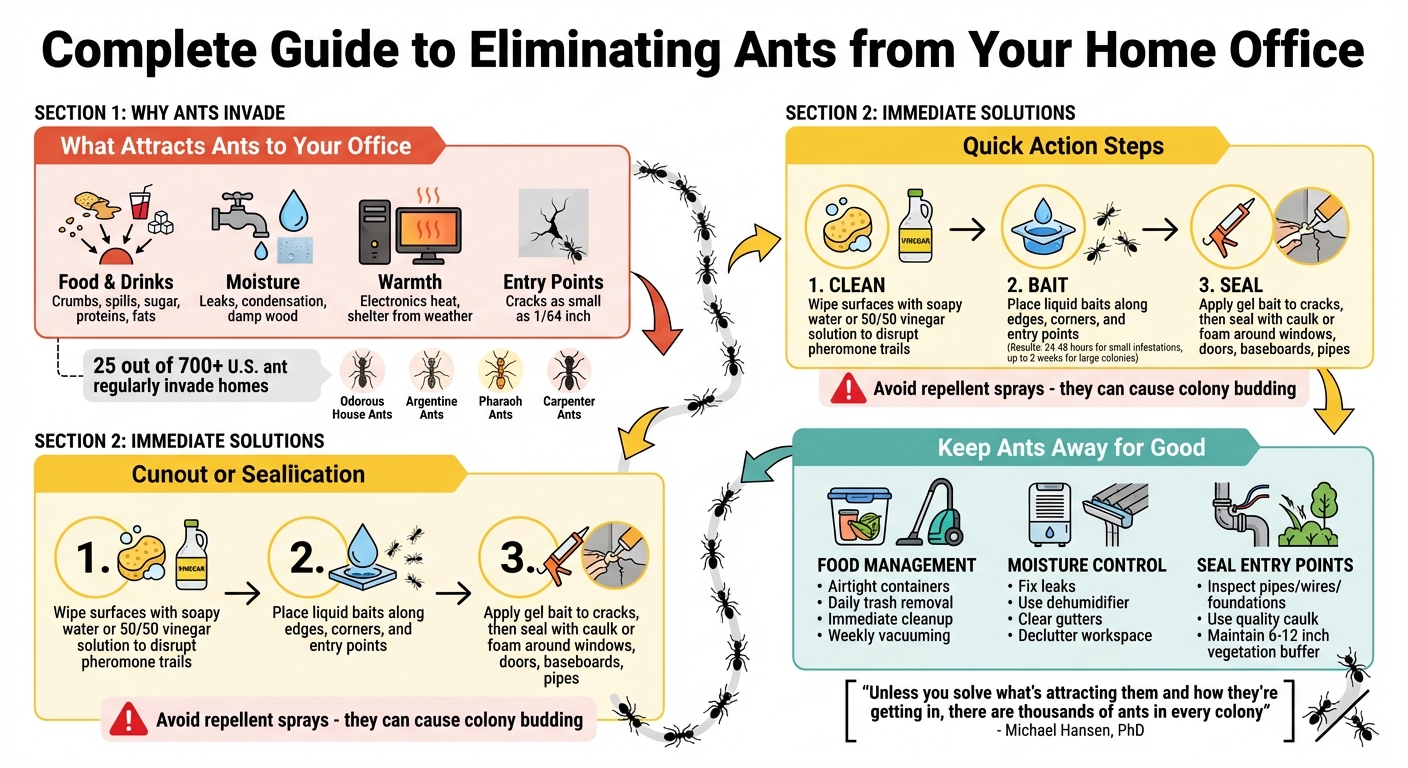
Complete Guide to Eliminating Ants from Your Home Office
STOP ANTS From Getting Inside Your Home
Why Ants Enter Home Offices
Your home office offers ants exactly what they’re looking for: food, water, and a cozy place to settle. Understanding which species have moved in - and what attracts them - is key to getting rid of them effectively.
Common Indoor Ant Species
Ants behave differently depending on the species. Out of the more than 700 species found in the U.S., about 25 are known to invade homes regularly. For instance, odorous house ants are frequent visitors. When crushed, they emit a smell reminiscent of rotten coconut. These ants are flexible in their nesting habits, often relocating every few weeks as conditions change. Argentine ants, on the other hand, are notorious for forming sprawling "super colonies" with multiple queens working together, enabling them to spread quickly. Then there are pharaoh ants, which thrive in the warmth near heating systems or inside wall voids in temperate climates. If you’re spotting ants at night, you might be dealing with carpenter ants, which are attracted to moisture-damaged wood and are mostly nocturnal. Their feeding habits are another clue to why they’re drawn to your workspace.
Food and Drink Attractants
Ants are opportunistic feeders, meaning they’ll eat just about anything. Sweet treats like sugar and honey are big draws, but they’re also happy to snack on proteins, fats, and greasy foods. Even the smallest spills or crumbs can attract scout ants. Something as simple as an unrinsed soda can in your recycling bin is enough to bring them in. Once scouts find food, they leave a trail for others to follow. To reduce these temptations, store snacks in airtight containers and make wiping down your desk part of your daily routine. But food isn’t the only thing luring ants into your office.
Warmth, Moisture, and Shelter
The heat generated by electronics creates warm spots that ants find appealing. As the University of California IPM explains:
"Ants often enter buildings seeking food and water, warmth and shelter, or refuge from dry, hot weather or flooded conditions."
Moisture is another big attraction. Condensation, leaky pipes, and even tangled cables can create the perfect pathways or nesting spots for ants. For example, acrobat ants are drawn to damp wood or areas with water leaks. Common hiding spots include wall voids, behind baseboards, window frames, and even inside Styrofoam insulation panels. To make your office less inviting, fix plumbing issues, use a dehumidifier if needed, and keep cables neat and organized. These small changes can go a long way in keeping ants out of your workspace.
Immediate Solutions for Ant Problems
Spotted ants in your space? Take action right away with these focused steps to disrupt their activity and eliminate the colony.
Cleaning and Removing Ant Trails
Ants communicate through pheromone trails. When a scout finds food, it leaves a chemical marker to guide others to the source. To disrupt this, clean surfaces like desks, floors, and baseboards with soapy water. A mix of 50/50 vinegar and water works well, and diluted essential oils like peppermint or tea tree are also effective. Avoid using repellent sprays directly on ant trails, as some insecticides can trigger "budding", where stressed ants split into multiple colonies, making the problem worse. Cleaning alone isn’t enough - it must be combined with other methods to fully address the colony. Next, focus on using baits to target the source.
Placing Ant Baits
Baits are the most effective way to eliminate the entire colony, not just the ants you see. As Michael Hansen, PhD, a biologist and ecologist, explains:
"Ant poison may make you feel like you're accomplishing something, but you're not. Unless you solve the problem of what's attracting them to your house - and how they're getting in - you should remember that there are thousands of ants in every colony."
Liquid baits are especially effective because worker ants consume the bait and share it with the larvae and queen. Place baits along edges, corners, and baseboards, as ants tend to follow structural lines. Position them near entry points like windows, doors, and cracks. Small infestations can clear up within 24 to 48 hours, but larger colonies may take up to two weeks. It’s normal to see increased activity at first as the bait attracts foragers. Be sure to remove other food sources to keep the ants focused on the bait, and check bait stations daily to refill as needed. Once the colony is under control, it’s time to secure entry points to prevent future problems.
Treating Cracks and Crevices
Ants can slip through the tiniest gaps - think window sills, door frames, baseboards, and utility entry points. Apply gel baits directly into cracks and crevices where ants are active. For areas like wall voids or behind baseboards, silica aerogel dust offers long-term protection before sealing. After treatment, use silicone or acrylic caulk to seal small cracks, and expandable foam for larger gaps. Adding door sweeps and repairing window seals can further block their pathways. Stick with professional-grade products that are safe for pets and children, and always follow the instructions carefully. Finally, wipe down sealed areas with soapy water or vinegar to remove any lingering pheromone trails.
sbb-itb-0bbb908
Preventing Future Ant Infestations
Getting rid of ants is just the first step. The real challenge lies in making sure they don’t return. Long-term prevention means tackling the root causes - those environmental and structural factors that made your space inviting to ants in the first place.
Managing Food and Waste
Once the ants are gone, keeping your space spotless is key. Ants have an uncanny ability to sniff out even the tiniest crumbs. A single scout can discover a food source and signal the rest of the colony with a chemical trail. To stop this, here’s what you can do:
- Store food in airtight containers.
- Wipe up spills and crumbs immediately using soapy water.
- Empty trash bins daily and rinse out soda cans or food wrappers before throwing them away.
- Remove pet food dishes after feeding.
- Vacuum floors weekly, paying extra attention to corners and under furniture.
By keeping food and waste under control, you’re cutting off their primary reason for invading.
Controlling Moisture and Clutter
Food isn’t the only thing that attracts ants - moisture and clutter can be just as appealing. Addressing these elements is critical for keeping ants at bay.
- Repair any leaks as soon as they’re spotted.
- Use a dehumidifier in areas prone to dampness.
- Clear out gutters to prevent water from pooling near your building’s foundation.
- Declutter regularly by cleaning desks, shelves, and the spaces behind furniture.
- Organize cables and wipe down equipment to remove any residue.
- If you have potted plants, soak the pots in a mix of insecticidal soap and water for 20 minutes to eliminate potential pests.
These steps not only make your space less attractive to ants but also create a cleaner, healthier environment overall.
Sealing Entry Points
Ants are tiny and can squeeze through gaps as small as 1/64 of an inch. To keep them out, you’ll need to seal up any potential entry points.
- Inspect areas around pipes, electrical wires, foundations, windows, and door frames for cracks or gaps.
- Use high-quality caulk or expandable foam to seal these openings.
- Apply petroleum jelly as a temporary fix if needed.
- Ensure windows have intact screens and trim any tree branches that touch the building.
- Keep mulch or vegetation at least 6–12 inches away from the foundation.
- Wipe down sealed areas with soapy water or vinegar to erase ant pheromone trails.
These efforts create a strong barrier, making it much harder for ants to find their way back inside.
At Remedy, we believe a clean, well-maintained workspace is the best defense against pests. That’s why our DIY pest control kits are designed with you in mind. They include professional-grade, pet- and child-safe solutions, along with clear instructions tailored for your home office. With ongoing support and regular shipments, we’re here to help you keep your workspace ant-free for the long haul.
Conclusion
Get rid of current ant infestations and keep them from coming back with a mix of quick fixes and long-term solutions. Start by disrupting their trails with soapy water, use slow-acting baits to wipe out the entire colony (including the queen), and address the underlying causes like food crumbs, moisture, and entry points. As Michael Hansen, PhD, points out:
Unless you solve the problem of what's attracting them to your house - and how they're getting in - you should remember that there are thousands of ants in every colony, and you'll just keep seeing them.
Using baits consistently for 5 to 10 days can significantly reduce their numbers. By sticking to these practical steps, you can keep your home office pest-free.
For an easier solution, our specially designed kits offer professional-grade products that are safe for pets and kids. With clear instructions and ongoing support, you can eliminate ants without the hassle and enjoy a workspace free of unwelcome guests.
FAQs
How can I tell what kind of ants are in my home office?
Identifying the ants invading your home office might be simpler than you'd think. Start by examining their size and color - most ants found indoors are small, typically between 1–5 mm, and vary in shades from light brown to black. Next, take a look at their waist. Ants with a single node (the narrow section between the thorax and abdomen) could be odorous house ants or Argentine ants, while a double node might point to carpenter ants. If you spot winged ants, they could be swarmers from an indoor nest. Keep in mind, ants have a narrow waist and uneven wings, which sets them apart from termites.
For a quirky but effective method, try the smell test: crush one ant and take a whiff. Odorous house ants give off a scent similar to rotten coconut, while Argentine ants have a musty odor. Also, pay attention to their location. Ants gravitating toward sugary foods are often odorous or Argentine ants, whereas those found near moisture-rich spots, like under sinks, might be pavement or carpenter ants. If you're still puzzled, snap a close-up photo and compare it to an ant identification guide or reach out to a local expert. Identifying the species is key to selecting the right solution to eliminate them for good.
How can I effectively seal off entry points to keep ants out of my home office?
To keep ants out of your home office, start by finding and sealing their entry points. Check for tiny cracks or gaps around baseboards, window and door frames, utility lines, or where pipes and vents connect to the walls. Use a high-quality sealant, such as silicone or acrylic-latex caulk, to close these openings. Make sure to apply it smoothly to block any potential pathways. For larger gaps, expanding foam can be a great solution - just remember to trim it down once it cures to prevent creating new hiding spots. Adding weatherstripping to doors and windows is another effective step, particularly in older homes where gaps are more common.
After sealing, focus on keeping your workspace clean and dry. Ants are drawn to crumbs, spills, and moisture, so make it a habit to wipe surfaces regularly and address any leaks or damp areas. Periodically check your seals, especially after changes in the weather, and reapply as needed to maintain your barrier. By following these steps, you can protect your workspace and keep it ant-free.
How can I stop ants from coming back after getting rid of them?
To keep ants from coming back, start by sealing up any cracks or gaps around windows, doors, and walls. Store your food in airtight containers, clean up crumbs and spills right away, and repair any leaks or damp spots that could attract them. Make it a habit to check for signs of new ant activity and set out bait or traps if needed to catch any wandering ants before they can form another colony. Staying on top of these steps will help keep your home office ant-free.