


AI-powered smart home systems are transforming pest control by detecting issues early, reducing costs, and minimizing health risks. Here's how these systems work and why they’re effective:
- Early Detection: Motion sensors, cameras, and acoustic devices identify pests like rodents, cockroaches, and termites before infestations grow.
- High Accuracy: Machine learning algorithms distinguish pests from harmless objects with 96–99% precision.
- 24/7 Monitoring: Devices continuously track pest activity, even in hidden spaces like walls or attics.
- DIY Solutions: Real-time alerts guide homeowners to act quickly using targeted, pet-safe pest control methods.
- Cost Savings: By addressing problems early, you avoid expensive damage and emergency fees.
AI systems integrate seamlessly with smart home hubs, offering automated responses and precise pest management. These tools make pest control faster, safer, and more efficient.
How AI Detects Pests in Smart Homes
Technologies Used for Pest Detection
Smart homes rely on an array of sensors and cameras to keep a vigilant eye out for pests, 24/7. Passive Infrared (PIR) sensors, commonly used in security systems, are a key player here. These sensors pick up on heat signatures and movement, sensitive enough to detect even the smallest disturbances - like a cockroach skittering across or a mouse darting by.
Acoustic sensors bring another layer of detection by identifying the distinct sounds pests make. These microphones can pick up the wingbeat frequencies of flying insects or the telltale scratching noises of rodents burrowing in walls. Meanwhile, smart cameras equipped with Convolutional Neural Networks (CNNs) analyze images in real time, distinguishing pests from pets or humans. For instance, the YOLOv5 AI model has been fine-tuned to identify greenhouse pests like whiteflies and thrips with an impressive 96% accuracy.
Then there are smart traps, which elevate detection to the next level. These traps use sensors to monitor when a pest is caught and can even release pheromones to attract specific insects. Together, these various tools gather critical data, which AI systems analyze to pinpoint pest species with precision.
How AI and Machine Learning Work
AI systems don’t just react - they think. By pulling data from multiple sensors, they create a detailed map of pest activity. For example, when a motion sensor is triggered, the AI doesn’t simply send out a notification. Instead, it evaluates patterns. Machine learning algorithms dive deep, analyzing behaviors like feeding habits, movement speeds, and nesting tendencies to identify specific species. Acoustic sensor systems, powered by Multilayer Perceptron (MLP) models, have achieved a staggering 99.78% accuracy in recognizing pest sounds.
AI also excels at processing visual data. Supervised machine learning systems can sift through thousands of images daily, refining their detection capabilities and cutting down on false alarms. In field tests, AI-powered bait dispensers have reached 90% accuracy, only activating for target species. This means fewer unnecessary alerts about harmless bugs and more precise warnings about actual threats. Such proactive analysis plays a crucial role in preventing infestations before they spiral out of control.
Modern systems also address privacy concerns. They come equipped with privacy engines that automatically blur human faces or sensitive details in images before processing, ensuring in-home surveillance remains secure. Once the data is processed, these alerts integrate seamlessly with your smart home system, enabling targeted responses.
Connecting to Your Smart Home System
Pest detection devices are designed to sync effortlessly with smart home hubs like Amazon Alexa, Google Home, or Apple HomeKit. Many devices use Zigbee or Z-Wave protocols instead of Wi-Fi, as these options consume less power, helping battery-operated sensors last longer between charges.
Setup is straightforward through dedicated apps, where you can customize features like "motion detection zones" to avoid false alarms from things like swaying tree branches or passing cars. Pairing sensors with cameras allows you to verify alerts instantly, giving you the confidence to act only when necessary.
Advanced systems take it a step further by automating responses. For example, they can activate bait dispensers when specific pest activity is detected. These automated responses can be paired with a quarterly pest remedy kit to ensure consistent protection. You can also schedule pest-monitoring sensors to operate during peak nocturnal hours - when pests like rodents and cockroaches are most active - minimizing disruptions during the day. This seamless integration empowers homeowners to tackle pest problems quickly and efficiently with AI-driven solutions.
sbb-itb-0bbb908
AI Detection for Common Household Pests
Rodents in Walls and Attics
Using PIR sensors, which detect heat signatures, and acoustic sensors that pick up scratching and chewing sounds, modern systems can identify rodent activity even in hidden spaces like walls and attics. These sensors are so precise that they can detect the presence of just one rodent.
Small, strategically placed sensors at entry points transmit data via GSM around the clock, creating trend analyses that predict infestations before visible signs - like droppings or damage - become evident. If unusual activity is detected, the system can automatically trigger smart cameras to capture footage, providing clear visual evidence of the issue.
Another effective approach involves upgrading traditional traps with vibration sensors. These sensors detect movement inside the traps and send instant alerts to your phone, saving you from manually checking hard-to-reach areas. For the best results, place these sensors near common rodent pathways, such as wall openings, cabinets, and windowsills.
Now, let’s look at how these smart systems handle pests in the kitchen.
Cockroaches and Kitchen Pests
In moisture-heavy kitchen environments, advanced sensors and smart cameras can differentiate between cockroaches and ordinary debris, ensuring timely alerts.
Some systems even combine non-toxic pheromones with glue boards to attract and monitor cockroach activity while simultaneously tracking temperature changes that indicate pest presence. To maximize effectiveness, place sensors in areas prone to moisture, like under sinks, behind refrigerators, and in pantries. These AI-powered systems send immediate alerts, enabling you to take quick, targeted action before the problem escalates.
The same technology extends to monitoring structural pests like termites.
Termites and Structural Pests
AI-driven sensors are designed to monitor conditions that encourage termite breeding, providing warnings long before any structural damage becomes apparent. Unlike traditional inspections, these systems offer continuous monitoring in areas that are hard to access.
Some solutions use infrared sensors and motion detectors to track termite activity in real time. By analyzing historical data and weather patterns, they can alert homeowners weeks or even months before visible damage occurs. Impressively, these systems have shown over 90% accuracy in identifying invasive pests. When abnormal conditions - such as increased moisture - are detected, you’ll receive instant notifications on your phone, giving you the chance to address the issue and seal entry points before termites cause significant harm.
Emitter Cam – the new AI camera for pest control
Using AI Data for DIY Pest Control
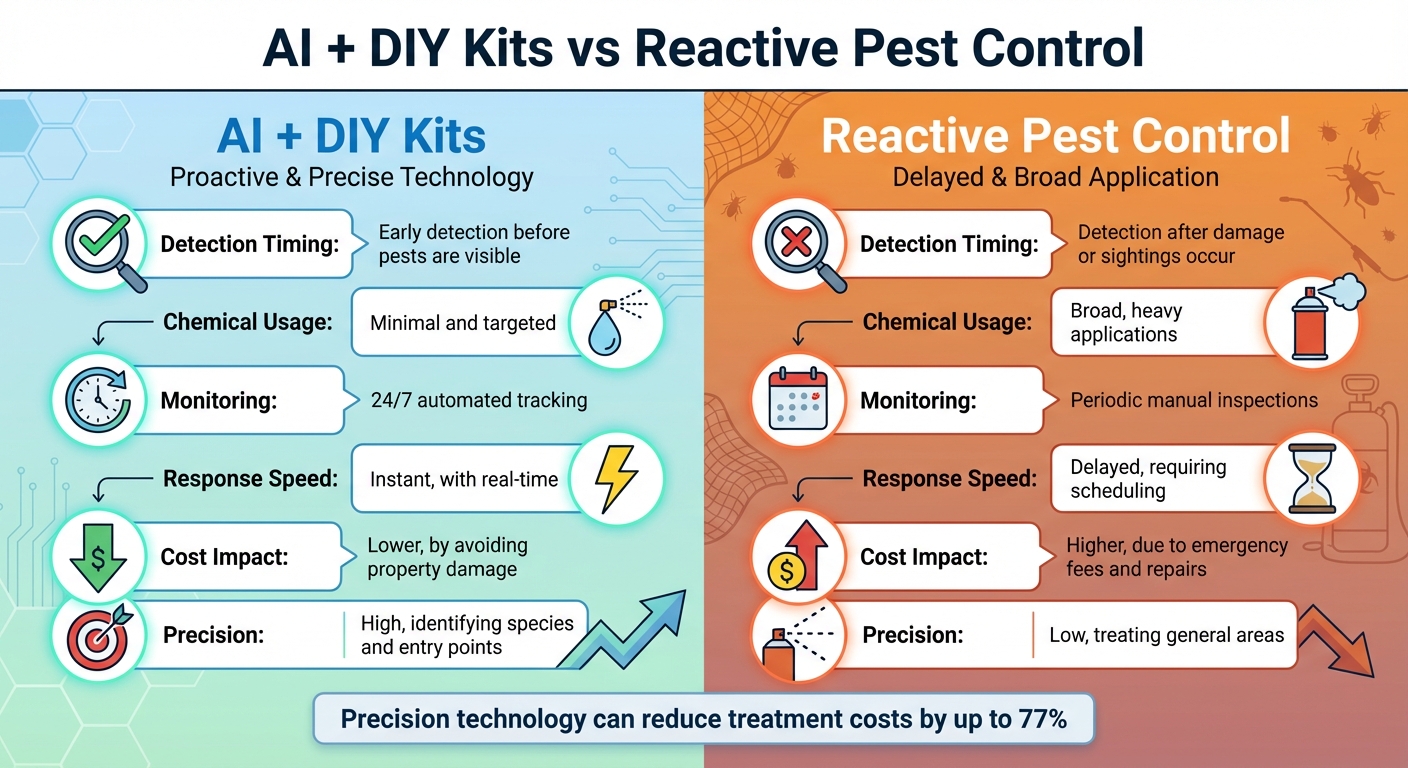
AI-Powered DIY Pest Control vs Traditional Reactive Methods Comparison
Acting Quickly on AI Alerts
When your smart home system detects pest activity, timing is everything. AI sensors send real-time alerts directly to your smartphone, pinpointing the exact location of the problem - whether it's behind a kitchen cabinet or inside an attic wall. These instant notifications mean you can step in before a minor issue turns into a major infestation.
For instance, if your sensors pick up movement near a wall opening during peak activity hours, you’ll know exactly where to focus your efforts. This quick detection allows for a precise and effective DIY response.
How Remedy Works with AI Detection
Once you’re alerted, acting with a targeted solution is key. After your AI system identifies the pest, we provide customized kits tailored to your specific problem and home environment. These kits include professional-grade products that are safe for pets and children, along with step-by-step instructions for accurate application. This approach ensures you treat only the affected areas, cutting down chemical use by up to 90%.
To keep your home protected, we offer regular shipments and virtual support to assist with pest identification and application questions. This seamless combination of AI detection and DIY treatment eliminates the need to wait for service calls while pests multiply. As Cassie Krejci, Science and Innovations Director at Rentokil Initial, explains:
"It's being able to place less chemicals, less rodenticides into the environment to keep our public health safer, keep our environment safer and that's the biggest advantage of this technology".
AI + DIY Kits vs Reactive Pest Control
Here’s how proactive, AI-driven pest control stacks up against traditional reactive methods:
| Feature | AI + DIY Kits | Reactive Pest Control |
|---|---|---|
| Detection Timing | Early detection before pests are visible | Detection after damage or sightings occur |
| Chemical Usage | Minimal and targeted | Broad, heavy applications |
| Monitoring | 24/7 automated tracking | Periodic manual inspections |
| Response Speed | Instant, with real-time alerts | Delayed, requiring scheduling |
| Cost Impact | Lower, by avoiding property damage | Higher, due to emergency fees and repairs |
| Precision | High, identifying species and entry points | Low, treating general areas |
This comparison highlights the clear benefits of proactive AI-driven DIY solutions over traditional reactive methods. For example, in February 2024, Semios partnered with Google to use AI predictive modeling to analyze weather and pest life cycles, successfully reducing a specific moth population by 1.5 billion. The same principle applies to your home - leveraging AI data for precise action can help you prevent infestations and avoid contributing to the staggering $220 billion in annual pest damage.
Conclusion
Smart home AI is revolutionizing pest control, turning it into a precise and efficient system that safeguards your home around the clock. By identifying pests in their earliest stages - long before they become noticeable - these technologies help prevent small problems from snowballing into expensive infestations that could damage your home or pose health risks.
With 24/7 monitoring and targeted DIY solutions, your pest control efforts become more focused and safer for your household. Instead of blanket treatments, AI sensors pinpoint problem areas, allowing you to treat only where it's necessary. This approach not only protects your family and pets from unnecessary pesticide exposure but also ensures that pests are dealt with effectively.
To complement these detection technologies, our DIY pest control kits are designed to seamlessly integrate with AI alerts, enabling fast and localized treatment. When your sensors detect an issue, you'll have professional-grade, family-safe products on hand, ready to be applied exactly where needed. With straightforward instructions and real-time virtual support, you can act immediately and precisely, stopping infestations before they spread.
Catching pest problems early also helps you avoid the financial burden of costly repairs and emergency services. Addressing issues while they’re still small eliminates the need for repeated treatments often associated with reactive pest control. In fact, research shows that using precision technology can reduce treatment costs by up to 77% by focusing only on specific problem areas.
FAQs
How do AI-powered smart home systems identify pests without mistaking them for everyday objects?
AI-powered smart home systems use a mix of cameras, motion detectors, heat sensors, and acoustic technology to keep an eye out for pests. These devices gather real-time data, which is then processed by machine learning algorithms trained on vast databases of pest images. This enables the system to identify the distinct shapes, movements, and thermal signatures of pests while filtering out irrelevant objects.
With these technologies in place, smart homes can catch pest activity early, stopping infestations before they escalate into bigger issues.
How do smart homes protect your privacy while using AI for pest control?
Modern AI-driven pest detection systems for smart homes place a strong emphasis on protecting your privacy. These systems rely on encrypted channels to handle sensor data - such as heat, motion, and sound. To enhance security, much of this data is processed locally within your home, ensuring that only anonymized alerts or summaries are sent to you. This approach minimizes the amount of raw data leaving your home.
Trusted manufacturers go a step further by offering clear opt-in options, being upfront about what data is collected, and providing simple tools to delete stored information. These safeguards mean you can enjoy an efficient, AI-powered pest monitoring system without worrying about compromising your personal privacy.
How does AI help reduce the need for chemical pest control in smart homes?
AI-powered systems in smart homes are changing the game when it comes to pest control, offering safer and more precise methods. Using sensors and cameras, these systems analyze heat, motion, and sound data to detect pests in real time. This enables homeowners to take targeted actions, like sealing off entry points or setting traps, rather than resorting to widespread use of chemicals. The result? A safer environment for both children and pets.
On top of that, AI leverages predictive analytics to anticipate pest activity. By monitoring variables such as temperature, humidity, and past infestation patterns, these systems can pinpoint potential problem areas before pests even become an issue. This allows for preventative measures to be taken in specific spots, cutting down on unnecessary chemical treatments. When combined with practical steps like eliminating food sources and repairing leaks, AI-driven pest management helps maintain a pest-free home while drastically reducing reliance on harmful substances.