


AI is changing how pests are identified, making it faster, easier, and more precise. Tools like Iowa State University's InsectNet, launched in February 2025, use massive image databases and advanced AI models to identify over 2,500 insect species instantly from photos. No expertise or physical samples are needed - just snap a picture, upload it, and get results in seconds. These systems help you determine whether an insect is harmful or helpful, reducing unnecessary pesticide use and promoting safer pest management.
Key highlights:
- InsectNet uses a database of 12 million images to identify pests with 96% accuracy.
- AI technologies like CNNs and YOLO models excel in detecting pests, even in poor conditions.
- Tools provide instant results, classify pests by ecological roles, and suggest targeted actions.
- Homeowners can use these tools with connected cameras or smartphones for DIY pest control.
AI-powered pest identification combines speed, accuracy, and convenience, transforming pest management into a smarter, more efficient process.
How does AI pest detection work?
How AI Identifies Pests Remotely
AI has transformed the way pests are identified remotely, offering not only precise detection but also a faster and more efficient diagnostic process.
Technologies Behind AI Pest Identification
At the core of AI-powered pest identification are Convolutional Neural Networks (CNNs). These systems rely on layers of filters to analyze visual details like edges, textures, and patterns. By processing thousands of visual cues, CNNs can distinguish between harmless insects and those that pose a threat.
For real-time monitoring, YOLO (You Only Look Once) models are particularly effective. These frameworks excel at detecting small objects - like a single insect on a leaf - even in complex environments. This makes them ideal for applications such as drone-based scans of agricultural fields or smart traps . Meanwhile, Transformers take things a step further by combining image analysis with environmental data, providing a more comprehensive and precise identification.
Another key tool is transfer learning, which speeds up model development. Instead of building AI systems from scratch, developers fine-tune pre-trained models like ResNet50 or Xception using specific pest-related datasets. This approach delivers high accuracy, even with limited data. In fact, CNN-based classifiers consistently outperform older methods based on texture or color analysis by 10–20%.
These technologies create the foundation for a seamless image submission process.
How to Submit Images for Identification
Leveraging these advanced AI models, submitting images for pest identification is quick and user-friendly. Simply take a photo with your smartphone, upload it through a web-based app - often accessible via a QR code - and let the system do the rest. Within seconds, the AI analyzes the image and provides a taxonomic classification, along with the insect's ecological role, such as pest, pollinator, or predator.
Photo quality matters. To get accurate results, ensure your images are well-lit and taken from multiple angles to highlight features like wing veins or body segmentation. Use a plain background to help the AI focus on the insect. Additionally, capturing the pest at different life stages - larva, pupa, or adult - can improve identification, as modern models are trained to recognize these stages .
"The app identifies the insect and returns a prediction of its taxonomic classification and role in the ecosystem as a pest, predator, pollinator, parasitoid, decomposer, herbivore, indicator and invasive species." - Scientific paper authors, PNAS Nexus
Advanced systems also indicate their uncertainty when results are inconclusive, which helps build user trust. Some platforms rely on cloud computing for intensive analysis, while others use edge devices - like smart traps or specialized cameras - to provide instant results, even in areas with poor internet connectivity.
Next, we’ll dive into how accurate and reliable these AI systems are.
Accuracy and Reliability of AI Systems
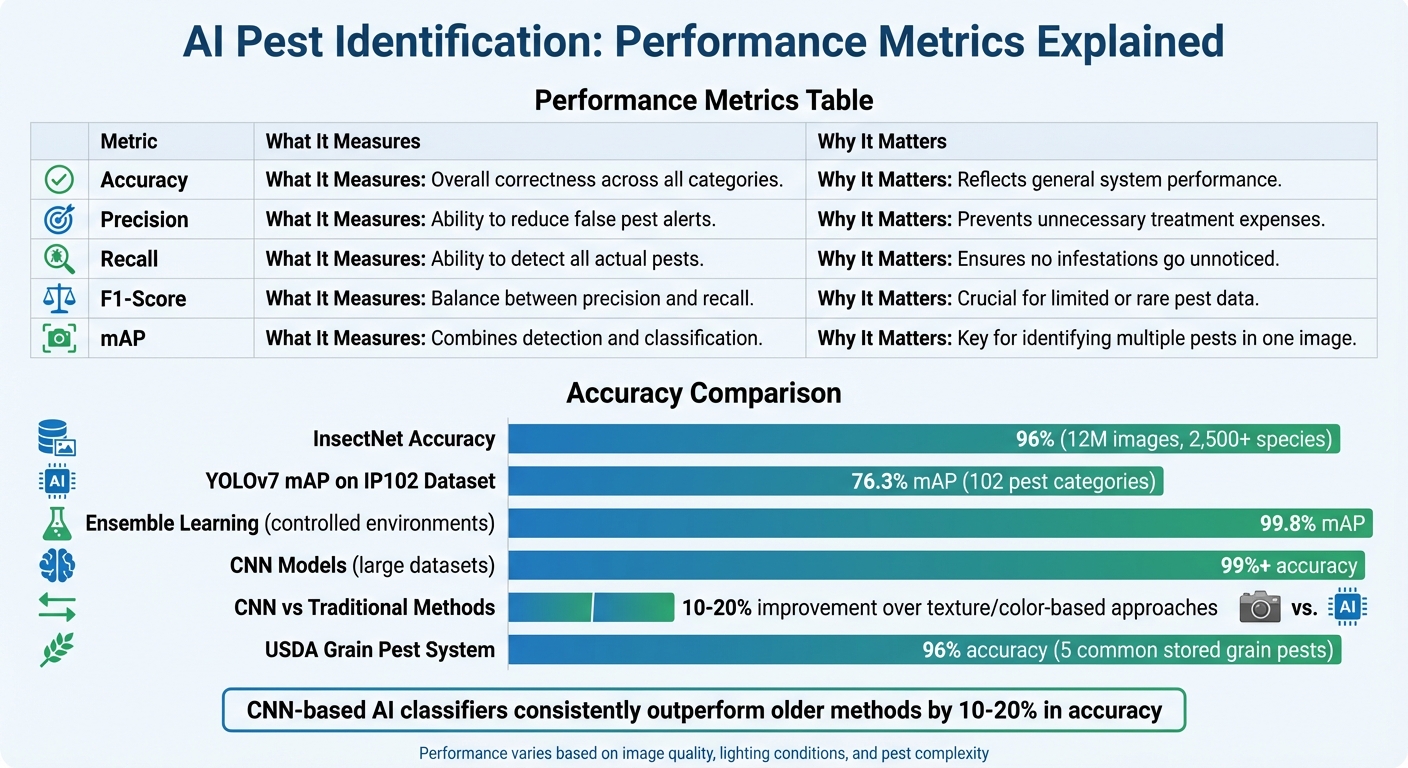
AI Pest Identification Performance Metrics and Accuracy Comparison
Understanding how AI performs in pest identification is crucial for knowing when to trust its results and when to seek additional confirmation.
Understanding Performance Metrics
AI systems are evaluated using several important metrics, each shedding light on different aspects of performance. Metrics like accuracy, precision, recall, and the F1-score help measure overall correctness, the likelihood of false positives, the ability to detect all pests, and the balance between precision and recall, respectively.
- Precision minimizes false alarms, which is especially useful for avoiding unnecessary pest control actions.
- Recall ensures that no actual infestations are missed.
- The F1-score becomes particularly relevant when dealing with rare pest species, where balancing precision and recall is critical.
For systems that handle both detection and classification, mAP (Mean Average Precision) is the go-to metric. For instance, on the IP102 dataset, which includes 102 pest categories, top-performing models like YOLOv7 have achieved a mAP of 76.3%. In controlled environments with smaller datasets, ensemble learning techniques have reached nearly perfect mAP scores of 99.8%. Meanwhile, InsectNet has shown strong real-world results, delivering over 96% accuracy.
| Metric | What It Measures | Why It Matters |
|---|---|---|
| Accuracy | Overall correctness across all categories | Reflects general system performance |
| Precision | Ability to reduce false pest alerts | Prevents unnecessary treatment expenses |
| Recall | Ability to detect all actual pests | Ensures no infestations go unnoticed |
| F1-Score | Balance between precision and recall | Crucial for limited or rare pest data |
| mAP | Combines detection and classification | Key for identifying multiple pests in one image |
These metrics provide a clear picture of AI systems' capabilities, highlighting both their strengths and areas where they might need improvement.
What AI Does Well and Where It Struggles
AI systems have demonstrated remarkable accuracy and efficiency, often surpassing traditional methods by 10–20% in accuracy when compared to texture- or color-based approaches. CNN models, trained on large datasets, have achieved accuracies exceeding 99%. They perform exceptionally well when working with clear images where pests are in typical positions.
However, challenges arise in real-world conditions. Poor lighting, shadows, and cluttered backgrounds can significantly reduce performance. AI also struggles with two specific issues:
- Intra-species dissimilarity: Variations in a pest's appearance across different life stages.
- Inter-species similarity: When different pests look almost identical.
Detecting very small insects remains a hurdle with standard methods.
To address these challenges, modern systems are incorporating smarter designs. For example, InsectNet includes an "abstention" feature that avoids making predictions when confidence is low, encouraging human intervention. As Shivani Chiranjeevi et al. explain:
"InsectNet can identify invasive species, provide fine-grained insect species identification, and work effectively in challenging backgrounds. It also can abstain from making predictions when uncertain, facilitating seamless human intervention".
These advancements show how AI is evolving to meet the demands of real-world pest identification while acknowledging its current limitations.
Benefits of AI for Remote Monitoring and Early Detection
AI doesn't just bring speed and accuracy to the table; it also shifts pest management from a reactive process to a proactive strategy. By continuously monitoring environments and analyzing trends, AI helps identify threats before they cause visible damage.
Preventing Problems Before They Start
Traditional pest control often relies on manual inspections - someone physically checking traps, spotting damage, or waiting until pests are already a noticeable issue. By then, the damage is done. AI flips this model on its head by offering real-time surveillance through IoT-connected traps and cameras that transmit data instantly.
These systems go beyond just spotting pests after they've arrived. Advanced sensors can detect volatile organic compounds (VOCs) released by plants under stress, long before you’d notice yellowing leaves or chewed stems. This allows for intervention at the earliest stages, well before the problem escalates.
For example, USDA researchers have developed an AI system capable of identifying five common stored grain pests with an impressive 96% accuracy. This precision enables grain producers to act quickly, applying targeted treatments that prevent minor infestations from turning into major problems. By automating image analysis, these systems remove the need for constant manual checks, speeding up the response time.
AI also incorporates predictive modeling, combining data like weather patterns, soil moisture, and historical trends to forecast potential outbreaks. This approach transforms pest management from "reacting to what you see" to "anticipating what's coming." As highlighted in the Smart Agricultural Technology Journal:
"AI offers a transformative approach by utilizing advanced algorithms to analyse intricate data patterns from numerous sources like sensors and imagery. This enables accurate pest identification, early detection, and predictive modelling".
By pinpointing exact pest locations, AI also reduces the need for blanket pesticide applications. Instead, treatments can be applied selectively. Cassie Krejci, Science and Innovations Director at Rentokil Initial, explains:
"It's being able to place less chemicals, less rodenticides into the environment to keep our public health safer, keep our environment safer and that's the biggest advantage of this technology".
This proactive approach not only prevents damage but also sets the stage for long-term monitoring and trend analysis.
Tracking Pest Activity Over Time
AI doesn't stop at early detection - it also tracks pest behavior over time. Using Long Short-Term Memory (LSTM) networks, these systems analyze weather patterns and pest dynamics to predict when and where specific pests are likely to emerge or migrate. This kind of historical tracking offers insights into pest activity, helping you understand when pests are most active and where they’re likely to appear next.
These systems are particularly useful in hard-to-reach areas like crawl spaces, attics, or high canopies where manual inspections are rare or impractical. By continuously collecting data, AI can monitor pest populations against economic thresholds - the point where the cost of damage outweighs the cost of control - so you can time interventions effectively.
Real-world applications demonstrate the effectiveness of this approach. In apple orchards, researchers used a system combining pheromone traps, automated imaging, and AI to monitor Codling moth (Cydia pomonella). This setup provided detailed data on insect migration and life cycle stages, enabling precise timing for pesticide applications or the release of natural predators. Such precision ensures interventions are both timely and effective.
Over time, these systems create a feedback loop. Each detection refines the AI's understanding of pest behavior in a specific environment, improving predictions and making future interventions even more targeted. This ongoing refinement is what makes AI a game-changer in pest management.
sbb-itb-0bbb908
How to Use AI Pest Identification at Home
AI-powered pest identification tools make it easier than ever to tackle pest problems right from your home. By following a few simple steps, you can quickly identify pests and decide on the best course of action. Here’s how you can make the most of these tools.
Steps to Get Your Pest Identified
The accuracy of AI pest identification starts with a good photo. Most tools deliver results in under 10 seconds. Here’s how you can capture images that help the AI perform its best:
- Use the right equipment: For tiny pests like ants, a high-resolution macro lens is ideal for capturing fine details.
- Choose a clean background: Place the pest on a plain, contrasting surface to eliminate distractions in the image.
- Provide size context: Include an object like a coin or ruler in the shot so the AI can determine the pest’s actual dimensions.
- Get multiple angles: Take pictures from the top, side, and front to give the AI a full view.
Once you’ve taken your photos, upload them to the app or web platform. The AI will analyze the pest’s shape, color, size, and texture, comparing it to a massive database. In seconds, you’ll receive an identification that includes the species name, a confidence level, and insights about its role in the ecosystem.
As Baskar Ganapathysubramanian explains:
"The app identifies the insect and returns a prediction of its taxonomic classification and role in the ecosystem as a pest, predator, pollinator, parasitoid, decomposer, herbivore, indicator and invasive species."
Another helpful feature is the app’s transparency. If the AI is unsure about an identification, it will indicate its uncertainty, allowing you to decide whether to consult an expert for further advice.
Pairing AI Results with Expert Support
Once you’ve identified the pest, the next step is to confirm the results and plan your approach. AI provides a quick and reliable starting point, but expert input can guide the final decision.
After receiving your AI results, you can share them with pest control professionals for virtual consultations or tailored treatment plans. This saves time and money since the expert already has critical information about the pest before the conversation begins.
For homeowners interested in DIY pest control, this combination is especially useful. Our service is designed to help you every step of the way - AI identifies the pest, and we offer customized treatment kits with professional-grade, pet- and child-safe products. We’ll review your AI results and help you decide whether DIY treatment is suitable or if professional help is necessary.
Knowing when to go DIY is crucial. AI tools can assess the risk level of a pest - whether it’s a minor issue you can handle yourself or a more serious problem requiring professional intervention. For occasional indoor sightings or garden pests, AI-guided DIY solutions are often enough. However, repeated sightings, nests, or pests in sensitive areas like kitchens or bedrooms usually call for expert help.
Using Remedy for DIY Pest Control
Transforming pest problems into manageable solutions just got easier. With Remedy, we take your AI-generated pest identification and turn it into a precise treatment plan, bridging the gap between technology and professional-grade pest management. Our service builds on your AI results to create a kit tailored specifically to your situation.
Here’s how we customize your pest control kit using three key factors:
- Your zip code: We use your location to determine how often you’ll need shipments, factoring in the local climate.
- Your home size: The size of your home helps us calculate exactly how much product you’ll need for full coverage.
- Your pest identification results: Whether you’ve used an AI tool or consulted with our virtual support team, we ensure the kit targets the specific pests causing trouble.
With over 30 years of experience, we’ve designed these DIY kits to deliver expert-level results. The products we include are the same trusted formulas professionals use, but they’re safe for pets and kids, and come with simple, easy-to-follow instructions. Not sure about your AI results or hesitant about the DIY approach? Our virtual support team is ready to confirm your pest identification and guide you through the process.
We also offer flexibility to fit your needs. Choose between pay-per-shipment or prepaying for savings. Plus, new customers can use the code "FREEKIT" to get their first kit free. Say goodbye to guesswork - our tailored approach ensures your pest control plan is based on your zip code, home size, and AI-identified pest problem.
Conclusion
AI has reshaped the way we approach pest identification and control. By offering 24/7 monitoring in even the most inaccessible areas, it enables early detection of pests, simplifying interventions and making them far more precise. For instance, AI-powered solutions can cut chemical use by up to 90% by focusing treatments exactly where they’re needed. What once required expensive professional visits can now be achieved with smarter, targeted tools.
When combined with human expertise, AI becomes even more powerful. As Cascade Pest Control explains:
"AI is more an augmentation to human labor than a replacement of it. The human brain is needed for determining final treatment plans, weeding out false positives, and interacting with customers".
This partnership between automated technology and human insight allows for faster responses and more accurate pest management. Instead of relying on reactive measures like indiscriminate spraying, data-driven prevention eliminates guesswork. Real-time alerts can guide immediate actions, such as sealing entry points or using non-chemical solutions. And when chemical treatment is necessary, AI ensures we know exactly what pest we’re dealing with and where it’s located.
For homeowners, this advanced technology provides a whole new level of control. With our AI identification tools, managing pests yourself is safer and more effective than ever. Just snap a photo with your smartphone to get instant results. Pair these insights with our professional-grade, family-safe kits and virtual support, and you’ll be equipped to protect your home efficiently - without overusing chemicals or relying on trial and error.
At Remedy, we combine advanced AI with expert oversight to deliver year-round protection and peace of mind, keeping your home pest-free with precision and care.
FAQs
How does AI enhance the accuracy of pest identification compared to traditional methods?
AI uses cutting-edge technologies such as deep learning and computer vision to process massive image datasets, allowing it to pinpoint pests with exceptional accuracy. In fact, this automated system often achieves precision rates above 96%, far outpacing traditional methods that depend on manual identification - which can be slow and prone to errors.
By simplifying the pest identification process, AI not only saves time but also empowers homeowners to tackle pest problems more efficiently. When combined with customized solutions like DIY pest control kits, it becomes an even more practical tool for addressing these issues.
How do AI technologies like CNNs and YOLO help identify pests remotely?
AI technologies like Convolutional Neural Networks (CNNs) and YOLO (You Only Look Once) have become essential tools in remote pest identification. CNNs excel at analyzing visual features, making it possible to classify various insects based on their distinct traits with impressive accuracy.
Meanwhile, YOLO - a CNN-based object detection framework - takes things a step further by enabling real-time pest detection. It quickly identifies and pinpoints pests within images, making the process both efficient and practical. Together, these technologies streamline pest identification, offering faster and more precise results, which are particularly useful for DIY pest control efforts.
How can homeowners use AI to identify pests and manage them effectively?
AI tools are transforming DIY pest control by making it simpler and more precise. Here's how it works: snap a clear, well-lit photo of the pest and upload it to an AI-driven pest identification app. The app then analyzes the image, matches it against a database, and provides a likely identification along with a confidence score.
Once you know what you're dealing with, you can opt for a tailored DIY pest control kit, like those offered by Remedy. These kits are customized based on the specific pest and your location, containing professional-grade products that are safe for both pets and children. They also come with straightforward instructions to help you tackle the problem effectively. For added convenience, you can monitor treated areas and access virtual support if adjustments are needed or if you need to restock supplies. Combining AI with personalized kits takes the hassle out of pest control, making it both efficient and easy to manage.