


Understanding pest life cycles is critical for effective pest control. Pests like cockroaches, ants, and bed bugs reproduce quickly, with hidden eggs and immature stages fueling sudden infestations. Simply targeting visible adults often fails, as eggs and pupae remain untouched, leading to recurring problems. By learning how pests develop and applying treatments at the right time, you can disrupt their reproduction, reduce infestations, and minimize chemical use.
Key Takeaways:
- Life Stages Matter: Eggs, larvae/nymphs, pupae, and adults each require different control methods.
- Timing Is Crucial: Treat pests during their most vulnerable stages, such as when eggs hatch or larvae are feeding.
- Integrated Pest Management (IPM): Combine inspections, sanitation, exclusion, and targeted treatments for long-term results.
- DIY Solutions: Use baits, traps, and heat treatments to address different pest stages effectively.
By understanding pest biology and using simple strategies, you can stop infestations before they grow out of control.
Why Is Understanding Pest Life Cycles Crucial For Control?
How Pest Life Cycles Work and Why They Matter
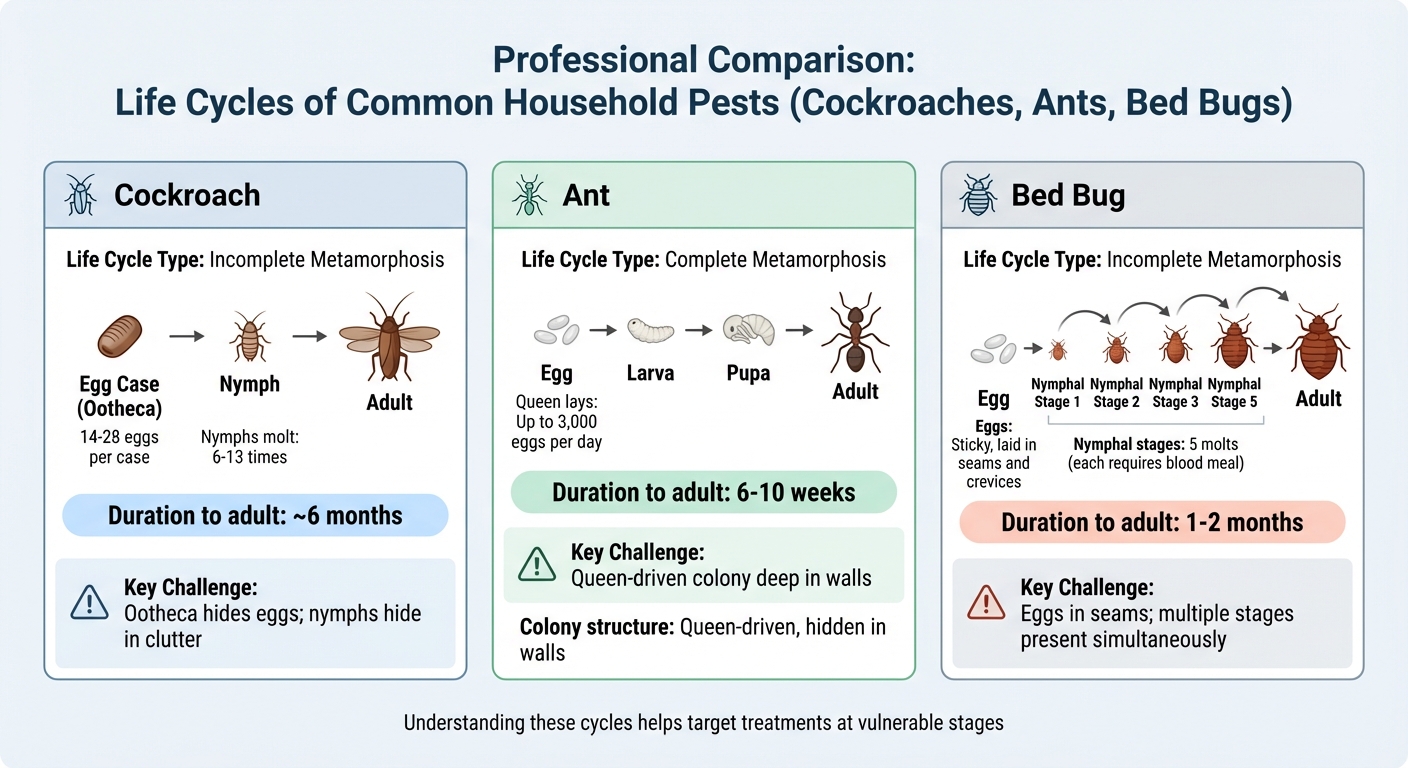
Common Household Pest Life Cycles and Control Challenges
The 4 Main Life Cycle Stages: Egg, Larva, Pupa, and Adult
Most household pests go through distinct developmental stages, and understanding these stages sheds light on how infestations grow so quickly. Insects typically develop through either complete metamorphosis (egg → larva → pupa → adult) or incomplete metamorphosis (egg → nymph → adult). Each stage plays a unique role in sustaining and expanding an infestation.
The egg stage is crucial for population growth. For instance, a single female cockroach can produce an ootheca containing 14–28 eggs, while ant queens in mature colonies can lay up to 3,000 eggs per day. These eggs are often hidden in hard-to-reach places like cracks, wall voids, and furniture seams, where surface sprays can’t reach. Their tough shells make them resistant to common insecticides, which is why disrupting the hatching cycle is a key part of pest control.
Larvae (in complete metamorphosis) or nymphs (in incomplete metamorphosis) are the primary feeders during an infestation. These immature pests consume significant amounts of food for their size, often damaging kitchens, bathrooms, and storage areas. Cockroach nymphs, for example, molt 6–13 times over about six months before becoming adults. Since they are actively feeding and moving, larvae and nymphs are more likely to encounter treated surfaces and baits, but their feeding habits can also intensify the damage within a home.
The pupal stage (exclusive to complete metamorphosis) is a resting phase where larvae transform into adults. Pupae don’t feed and are usually hidden in cocoons, soil, or crevices, making them hard to target with treatments. This explains why adult pests may continue to emerge long after an initial treatment - pupae remain undisturbed as they complete their development.
Adults handle reproduction and spreading the infestation. They search for food, water, shelter, and mates, which allows them to expand into new areas of your home or even neighboring units in multi-family buildings. Female adults are especially important since they determine how quickly an infestation grows. Focusing only on visible adults without addressing eggs and immature stages leaves future generations intact, making comprehensive treatment essential.
Understanding these developmental stages helps shape effective pest control strategies, which are detailed in the following sections.
Life Cycle Examples: Cockroaches, Ants, and Bed Bugs
Each pest species has its own twist on these general life cycle stages.
Cockroaches follow incomplete metamorphosis: egg → nymph → adult. Female cockroaches produce oothecae (egg cases) containing 14–28 eggs, which they either carry until hatching or hide in protected spots like behind appliances or inside cabinets. Nymphs are small and can survive on crumbs, grease, and other food residues, making them hard to detect. Egg cases are particularly challenging to treat, as they’re well-hidden, while nymphs thrive in cluttered areas. Adults, on the other hand, may adapt to avoid certain baits over time. For U.S. homes, controlling cockroaches effectively requires a combination of sanitation, crack-and-crevice treatments, and baits to target all life stages simultaneously.
Ants undergo complete metamorphosis, with colonies often housing one or more queens. Eggs and larvae are tucked away deep within nests located in walls, foundations, or under flooring - places homeowners rarely see. The ants you encounter on countertops and floors are typically foraging workers, not the hidden reproductive or developing stages that sustain the infestation. Since pupae and brood are protected inside the nest, spraying visible trails often has little impact. In some cases, disturbing the nest can even lead to new colonies forming. Effective ant control relies on slow-acting baits that workers carry back to feed the larvae, pupae, and queens. Timing treatments during peak foraging activity is key, as it ensures the bait reaches all stages of the colony.
Bed bugs also follow incomplete metamorphosis: egg → five nymphal stages → adult. Each stage requires a blood meal to molt or reproduce. Females lay sticky eggs in hard-to-spot areas like mattress seams, bed frames, baseboards, and furniture joints. These eggs are difficult to detect and may not be affected by contact insecticides unless treatments are extremely thorough. Nymphs can hide in narrow crevices and survive for weeks without feeding, while adults can hitchhike on luggage, clothing, or used furniture, spreading infestations to new locations. Because multiple life stages coexist at any given time, breaking the bed bug cycle often requires multi-visit treatments, detailed preparation, and sometimes professional intervention.
| Pest | Life Cycle Type | Duration to Adult | Key Challenge |
|---|---|---|---|
| Cockroach | Incomplete (egg → nymph → adult) | ~6 months | Ootheca hides eggs; nymphs hide in clutter |
| Ant | Complete (egg → larva → pupa → adult) | 6–10 weeks | Queen-driven colony deep in walls |
| Bed Bug | Incomplete (egg → 5 nymphal stages → adult) | 1–2 months | Eggs in seams; multiple stages present |
Why Ignoring Life Cycles Makes Infestations Worse
How Fast Reproduction Leads to Population Explosions
Treating only the visible adult pests while ignoring eggs, larvae, or pupae can lead to a frustrating cycle: as soon as the treatment wears off, a new generation emerges. This rapid reproduction can quickly turn a minor pest issue into a full-scale infestation.
Here’s why: the warm, stable conditions inside U.S. homes speed up pest development, allowing species like cockroaches and bed bugs to produce multiple generations in a single year. What might start as a small problem can spiral into a major infestation in just a matter of weeks or months. This highlights why focusing solely on adult pests isn’t enough to stop the infestation from growing.
Why Certain Life Stages Are Easier to Control
Not all life stages of pests are equally vulnerable to treatments, and understanding these differences can make pest control efforts far more effective.
Eggs and dormant stages, for example, are well-protected. They’re often shielded by tough coverings and hidden in hard-to-reach places, making them much harder to eliminate than actively feeding larvae or foraging adults. Cockroach oothecae and bed bug eggs, for instance, can withstand routine cleaning, chemical sprays, and even brief temperature changes. Similarly, some beetle or moth pupae can hide in wall voids or cluttered areas, avoiding contact with treatments. These hidden stages act as a backup population, ready to re-establish the infestation even after adult pests are removed.
On the other hand, actively feeding larvae and nymphs are more exposed and vulnerable to baits, biological controls, and insecticides. Newly emerged adults, as they search for food, mates, or nesting sites, are also easier to target with traps, baits, or barrier treatments. Timing pest control efforts to align with these more vulnerable stages - like applying treatments just as eggs hatch - can dramatically slow population growth and reduce the need for repeated interventions. Conversely, trying to eliminate pests during their resistant stages, such as when they’re sealed in eggs or dormant forms, often leads to wasted effort and resources.
sbb-itb-0bbb908
How to Disrupt Pest Life Cycles and Stop Infestations
Using Integrated Pest Management (IPM) Principles
Breaking a pest’s life cycle takes more than just spraying the ones you can see. That’s where Integrated Pest Management (IPM) comes in. This method combines regular inspections, proper pest identification, understanding their biology, and applying treatments at the right time to target their most vulnerable stages.
Start with frequent inspections to uncover where pests - and their various life stages - might be hiding. Check dark, damp areas like under sinks, behind appliances, and inside cabinets for signs like egg cases, droppings, or nymphs. Look for trails that lead back to hidden nests, and carefully inspect mattresses and furniture seams for bed bug activity. Sticky traps placed near walls and entry points can help reveal active adults and pinpoint problem areas.
Sanitation plays a massive role in disrupting pest cycles. Clean up spills immediately, store food in sealed containers, and keep trash in tightly closed bins. This starves pests at every stage of their life cycle. Fixing leaky pipes and eliminating standing water also cuts off breeding grounds for pests like mosquitoes and cockroaches. Decluttering is another must - getting rid of cardboard piles and stored paper eliminates hiding spots where pests like cockroaches breed and lay eggs.
To keep new pests from entering your home, focus on exclusion measures. Seal gaps around your home’s foundation, utility lines, and pipe entry points with caulk or expanding foam. Install door sweeps and weather-stripping to block pests at floor level, and add screens to windows, vents, and attic openings to keep flying insects out.
Timing is everything. Scheduling treatments and follow-up inspections during vulnerable stages, such as when cockroach nymphs are maturing, can stop infestations from growing. For example, treating wasps or hornets early in the season - before colonies grow large - can prevent their population from exploding. For pests with egg and larval stages, repeating treatments every 7–14 days can catch newly hatched nymphs before they reproduce.
With these strategies in place, let’s explore some DIY methods to target pests at every stage of their life cycle.
DIY Methods for Targeting Different Life Stages
Each stage of a pest’s life cycle requires a different approach. Here’s how to tackle them:
- Eggs: While many pest eggs are protected by tough coverings, vacuuming visible egg cases from cracks and sealing those gaps can reduce egg-laying opportunities. For bed bugs, laundering bedding in hot water and drying it on high heat (above 120°F) kills eggs effectively. Encasing mattresses also keeps pests from finding hidden spots to lay eggs. Keeping surfaces clean, removing standing water, and reducing clutter can make your home less appealing for egg-laying.
- Larvae and Nymphs: These younger stages are often less mobile and easier to target. Vacuum cracks, crevices, and areas under appliances to remove larvae and nymphs. Soapy water can also be used to clean pest-prone areas. Sticky traps placed near baseboards and behind appliances are great for capturing smaller nymphs.
- Adult Pests: Gel baits and bait stations work well for adult pests like ants and cockroaches. Place them along foraging trails, in corners, and in dark, protected areas. These baits not only kill the adults but also impact the entire colony by reaching queens and their brood. Sticky traps near entry points and along walls can catch adults, while residual sprays or dusts applied in cracks and crevices create barriers that kill pests as they move through treated areas.
For an easier way to manage these treatments at home, we’ve developed pest control kits that align with IPM principles. These kits include professional-grade, pet- and child-safe products, along with simple instructions. They’re designed to create a barrier around your home’s foundation while targeting indoor problem spots. The process starts with spraying the foundation - focusing on doors, windows, and other entry points - to stop pests at every stage of their life cycle. Any leftover product can be used for spot treatments indoors. Starting at under $30, these kits also come with ongoing support to help you time treatments and adapt your approach as needed.
Preventing Future Infestations with Life Cycle Knowledge
Understanding pest life cycles isn't just helpful - it's essential for effective prevention. By timing treatments and conducting regular inspections, you can stay ahead of infestations and keep your home pest-free.
Timing Treatments to Match Reproduction Cycles
Treatments are most effective when aligned with pests' peak reproduction periods. Every pest has predictable breeding seasons, and intervening during these times can stop their populations from spiraling out of control.
- Cockroaches: These pests thrive in warm, humid months, with females laying up to 50 eggs per ootheca. Spring is the ideal time to apply baits or growth regulators to disrupt their cycle before populations explode.
- Ants: Spring and summer mark the seasons when queens establish new colonies. Early spring perimeter treatments can prevent colonies from forming.
- Termites: Swarming occurs in spring and summer, making these seasons critical for inspections and treatments to stop colonies before they cause structural damage.
- Wasps and Hornets: Queens emerge in spring to build small nests. Removing these nests early, before colonies expand, can save you from dealing with larger infestations later in the season.
- Bed Bugs: These pests reproduce year-round but become more active in warmer conditions. Peak travel seasons are prime times for inspections. Use encasements and wash infested items in hot water (above 120°F) to eliminate eggs.
- Rodents: As temperatures drop in fall and winter, rodents seek warmth indoors. Strengthen exclusion measures and set traps before their breeding peaks to control their numbers effectively.
Research supports this proactive approach. Studies reveal that Integrated Pest Management (IPM) programs, which align treatments with pest life cycles, can cut infestations by 70% compared to reactive methods. These strategies also reduce chemical use by 50–90%, making them both effective and environmentally conscious.
Regular Inspections and Maintenance
Routine inspections are the backbone of pest prevention. Weekly visual checks in kitchens, bathrooms, and attics can help you spot early signs like droppings, egg clusters, or larvae. Use tools like flashlights and sticky traps to uncover hidden pests. Monthly deep inspections - under appliances and inside wall voids - target concealed stages like cockroach egg cases or bed bug eggs.
Why is this so effective? Early life stages, such as eggs and larvae, are immobile and vulnerable. Removing them before they mature prevents the next generation from taking over. For rodents, focus inspections during fall and winter, when juveniles are most active, and use bait stations before breeding begins for maximum impact.
Seasonal maintenance also plays a key role. In spring, clear your yard of overwintering sites. In fall, seal cracks and entry points to block pests from laying eggs indoors. This proactive approach is a core principle of IPM, helping you anticipate and prevent infestations before they occur.
To make this process easier, our pest control kits are here to help. Starting at under $30, these kits include professional-grade products that are safe for pets and children. Clear instructions guide you through both foundation and spot treatments. Plus, our service offers reminders for reapplication (typically every few months) and virtual support to identify pests and time treatments effectively. With these tools, you can maintain control without waiting for problems to arise.
Conclusion
Understanding pest life cycles is a game-changer when it comes to pest control. Knowing which stages pests are most vulnerable and when they reproduce allows you to stop infestations before they grow out of hand. By focusing on eggs and larvae before they develop into adults, you can prevent sudden population spikes. Plus, timing treatments around breeding seasons ensures your home stays protected year-round.
To make the most of this knowledge, pair it with Integrated Pest Management (IPM) strategies. Regular inspections, accurate pest identification, and targeted treatments are the backbone of this approach. This method not only reduces the need for broad-spectrum chemicals but also promotes long-term control.
Our pest control kits are designed with this in mind. Starting at under $30, they include professional-grade products that are safe for both pets and children. Each kit comes with a battery-powered sprayer and simple, step-by-step instructions tailored to your specific pest issue and location. To make things even easier, we provide reminders for reapplication and virtual support to help you identify pests and time your treatments perfectly.
Don’t let infestations grow or resort to costly professional services. With the right tools and a little know-how, you can break pest life cycles and take control on your own terms. Our kits make it simple to apply these proven strategies, giving you peace of mind and lasting protection without the guesswork.
FAQs
How can I recognize the different stages of pests in my home?
Identifying the stages of pests in your home starts with closely observing their size, appearance, and behavior. Eggs are usually tiny, well-hidden, and tricky to find. Larvae or nymphs often look like smaller versions of the adult pest, though they might differ in color or certain features. Adults, on the other hand, are the easiest to recognize due to their distinct traits.
By noting these details, you can figure out the pest's current life stage and select the most suitable treatment. For precise identification and effective solutions, refer to the detailed instructions provided in your Remedy pest control kit.
How can I effectively target pest eggs and larvae at home?
To tackle pest eggs and larvae effectively, concentrate on areas where pests are most likely to breed. Indoors, use sprays that are safe for pets and children to treat specific spots, focusing on cracks, crevices, and other hidden spaces where pests might settle. For outdoor protection, apply treatments around your home's foundation and entry points to prevent pests from laying eggs or allowing larvae to develop. Be sure to carefully follow the product instructions to achieve optimal results.
What is Integrated Pest Management (IPM) and how does it help control pests?
Integrated Pest Management (IPM) is a thoughtful and environmentally conscious way to handle pest problems. Instead of relying heavily on chemicals, it combines several strategies to manage infestations in a targeted and effective manner. By studying how pests behave and understanding their life cycles, IPM focuses on tackling them at their weakest points.
This approach involves keeping a close eye on pest activity, applying treatments selectively, and taking preventive steps like sealing cracks and removing food sources. The benefits go beyond just protecting your home - it also reduces risks to the environment and other living creatures. IPM offers a safer, smarter, and more eco-friendly way to deal with pests over the long haul.