


Trail pheromones are chemical signals insects use to communicate and navigate. By mimicking these natural behaviors, pest control strategies can guide or disrupt ants, termites, and cockroaches. Here's how pheromone-based methods work:
- Ants: Synthetic pheromones can attract ants to bait or create false trails, disrupting their foraging patterns. DIY options like vinegar or essential oils can erase trails.
- Termites: Pheromones interfere with termite recruitment, making bait stations more effective. Simple solutions like ammonia-based cleaners can neutralize trails.
- Cockroaches: Pheromone traps identify hiding spots and reduce populations. Cleaning fecal deposits removes aggregation signals.
These methods are precise, safer for non-target species, and reduce reliance on harmful chemicals. Combining pheromone disruption with cleanliness and physical barriers ensures better results. Start by observing pest trails, use targeted lures, and maintain regular monitoring for long-term control.
How to use PHEROMONE TRAPS: A Natural Solution to Pest Control
How Trail Pheromones Work in Pest Control
Trail pheromones act as chemical guides, leading colony members to food sources. Here's how it works: when a scout ant discovers food, it takes a small sample and leaves a pheromone trail on its return trip to the nest. This trail signals other ants to follow the path to the food, a process triggered by brief contact with the pheromone.
As more workers follow the trail, they add their own pheromones, creating a feedback loop that strengthens the signal. The richer the food source, the stronger the trail becomes, drawing more ants. For instance, the leaf-cutting ant Atta texana can detect pheromone trails at incredibly low concentrations - just 80 femtograms (8 x 10⁻¹⁴ g) per centimeter.
What makes this system so efficient is its temporary nature. Once the food supply is depleted, ants stop reinforcing the trail, and the pheromone naturally evaporates. This prevents the colony from wasting energy on a now-useless path. Biologist Edward O. Wilson captured its brilliance, stating:
"The odor trail system is the most elaborate of all known forms of chemical communication".
This self-regulating system has practical applications in pest control. By mimicking these natural behaviors, we can lure pests to bait or disrupt their foraging patterns with synthetic pheromones. It’s a clever way to redirect pests using their own instincts.
Different pests rely on various glands to produce their trail pheromones, allowing for targeted control strategies. For example:
- Myrmicine ants (like Myrmica and Atta) produce pheromones in their venom gland.
- Formicine ants (such as Lasius and Camponotus) use pheromones from the hindgut or anal sac.
- Termites rely on pheromones secreted by their abdominal sternal glands.
- Argentine ants (Linepithema humile) use a specific chemical, (Z)-9-hexadecenal, for their trails.
1. Using Trail Pheromones Against Ants
Pheromone Composition
Ant trail pheromones are as diverse as the species themselves. For instance, Argentine ants rely on (Z)-9-hexadecenal as their main trail marker, while leaf-cutting ants use methyl 4-methylpyrrole-2-carboxylate. Some ants stick to a single compound, but others, like Leptogenys peuqueti, use a blend of 14 different alcohols and acetates to coordinate their foraging efforts. This variety in chemical signals means you can target specific ant species while leaving others in your yard unaffected. Let’s explore how synthetic pheromones can disrupt these chemical trails.
Effectiveness in Disruption
Trail disruption works by playing on ants' natural behaviors - either attracting them or causing confusion. Synthetic pheromones can be added to bait stations to mimic the ants' recruitment signals, helping spread slow-acting insecticides throughout the colony. Alternatively, flooding an area with synthetic pheromones creates false trails, sending ants in the wrong direction.
A noteworthy experiment at Hawai'i Volcanoes National Park in January 2010 tested a micro-encapsulated spray of (Z)-9-hexadecenal on 400 m² (about 4,300 ft²) plots infested with Argentine ants. The results? Visible ant trails decreased for up to 14 days after a single treatment, and the pheromone's effects lasted as long as 59 days. This study shows how synthetic pheromones can effectively disrupt invasive ant populations in practical settings.
Environmental Impact
Pheromone-based control methods align well with eco-friendly pest management. These strategies specifically target invasive ants while sparing native species. As Lloyd D. Stringer explained in Scientific Reports:
"Pheromone-based pest management offers the advantages of low-hazard and high target specificity, avoiding many unwanted off-target effects".
By weakening invasive species like Argentine ants, native ants can regain access to resources, potentially helping to restore ecological balance.
Cost and Accessibility
You don’t need expensive synthetic pheromones to disrupt ant trails at home. Everyday materials can be surprisingly effective. For instance, undiluted vinegar (priced around $1–$3 per bottle) or a simple 50/50 vinegar-water mix can erase pheromone trails. Essential oils like peppermint, cinnamon, or tea tree oil can mask scent trails, confusing foraging ants. Even a baking soda paste, costing about $1–$2, works to deodorize surfaces and interrupt the ants' chemical communication.
For tougher infestations, combining DIY methods with professional-grade solutions often yields better results. At Remedy, we recommend pairing household disruptors with specialized bait stations that use the ants’ natural recruitment behaviors. This dual approach can effectively break existing trails while targeting the colony at its core.
2. Using Trail Pheromones Against Termites
Pheromone Composition
Termite trail pheromones are quite different from those used by other pests. Most insects rely on fixed pheromone ratios, but termites take a more flexible approach. They adjust their chemical signals depending on their activity. For instance, species like Odontotermes formosanus shift the ratios of compounds such as (3Z)-dodec-3-en-1-ol and (3Z,6Z)-dodeca-3,6-dien-1-ol when exploring new areas versus recruiting others to a food source.
These pheromones are largely made up of fatty-acyl derived alcohols, aldehydes, and terpenoids. One compound, (Z,Z,E)-3,6,8-dodecatrien-1-ol, is particularly notable. It’s found in at least 36 termite species and plays dual roles in trail-following and mating behavior. These chemical subtleties make it possible to develop precise disruption techniques.
Effectiveness in Disruption
Termites are incredibly sensitive to pheromones, detecting concentrations as low as 1 femtogram per centimeter. This sensitivity means that even small disruptions can throw off their navigation. For example, when a worker termite finds a bait station, synthetic pheromones can interfere with its ability to recruit others.
If you're looking for DIY solutions, common household items can neutralize pheromone trails. Ammonia-based glass cleaners or a simple 50/50 vinegar-water mix can erase trails from surfaces. Another option is a baking soda and water paste, which works as a mechanical deodorizer when scrubbed onto suspected termite paths.
These methods not only disrupt termite activity but also come with added environmental benefits.
Environmental Impact
Using pheromones for termite control offers a much cleaner alternative to traditional insecticides. As Ed Cahoon, a Biochemistry Professor at the University of Nebraska-Lincoln, explains:
"Unlike conventional insecticides, pheromone controls affect only the targeted pest species, leaving beneficial pollinators and other wildlife unharmed".
Pheromone treatments are biodegradable, don’t leave harmful residues, and avoid contaminating soil and water. Plus, since these methods manipulate termite behavior rather than killing them outright, termites are less likely to develop resistance compared to standard neuroactive insecticides.
Cost and Accessibility
The cost of traditional pheromone active ingredients has historically ranged between $1,000 and $3,500 per kilogram. However, newer plant-based production techniques have significantly reduced costs, bringing them down to just $10 to $25 per kilogram. For homeowners, the most practical options remain everyday household cleaners and natural deterrents. Identifying termite trails can help pinpoint entry points for treatment.
Combining these accessible solutions with professional-grade tools creates a well-rounded approach. At Remedy, we integrate these DIY methods with professional baiting systems designed to exploit termites' natural recruitment behavior. Keeping bait stations stocked with fresh bait ensures that slow-acting toxins can spread throughout the colony, ultimately leading to its collapse.
sbb-itb-0bbb908
3. Using Trail Pheromones Against Cockroaches
Pheromone Composition
Cockroaches may not rely on trail pheromones like some insects, but they use chemical signals - specifically aggregation pheromones - to locate and settle in harborages. Found in their feces, these pheromones have two key roles: attracting cockroaches to a specific spot and encouraging them to stay there. While these pheromones don't increase movement speed, they guide cockroaches’ orientation effectively. The musty odor often associated with infestations comes from these pheromone-laden deposits. As F. M. Oi from the University of Florida explains:
"If you cannot see them, you might be able to smell their distinctive odor, due to the presence of their feces and pheromones".
Cockroaches detect these chemical gradients using their antennae, which helps them navigate along walls, corners, and structural lines. By understanding this behavior, we can develop strategies to interrupt their aggregation patterns and reduce infestations.
Effectiveness in Disruption
Pheromone-baited sticky traps play a dual role: they help identify hiding spots and reduce cockroach populations. These traps showed an 80% population reduction in low-level infestations over four weeks. However, in heavy infestations, despite trapping 7,500 cockroaches over two months, the reduction was only 27%. This highlights their strength as monitoring tools rather than standalone solutions. Once harborages are identified, targeted gel baits can be applied for more effective control.
Cockroaches’ behavior of coprophagy - eating feces containing pheromones - further enhances bait effectiveness. First-stage nymphs, which rarely leave harborages, consume these pheromone-laden feces, allowing insecticide baits to spread through the population. For best results, place baits close to harborages and clean fecal deposits with soapy water to eliminate pheromone trails that attract additional cockroaches.
Environmental Impact
In the past, cockroach control often relied on broad-spectrum sprays with chemicals like organophosphates, carbamates, and pyrethroids. These methods raised health and environmental concerns. Pheromone-based monitoring offers a safer alternative, significantly reducing insecticide residue and minimizing risks to non-target organisms. Unlike "bug bombs" or total-release foggers - which scatter cockroaches and leave harmful residues - pheromone traps are non-toxic and safe for use in kitchens, hospitals, and homes with children or pets. By using trap data to guide targeted bait placement, you can drastically cut down on the volume of chemicals used.
Cost and Accessibility
Pheromone-baited traps are easy to find, with options available at hardware stores (like Combat and Raid) and in professional-grade versions (such as Maxforce and Advion). While Integrated Pest Management (IPM) programs using pheromone monitoring may initially cost more, they save money over time by reducing wasted products and minimizing callbacks.
At Remedy, we combine pheromone monitoring with gel baits for a focused approach. Place monitors in high-activity areas like behind refrigerators, under sinks, and near heat-generating appliances to track cockroach movements. If traps capture only adults, it likely signals a new introduction. However, finding all life stages points to an established infestation requiring more aggressive treatment. Once traps remain empty for two to four weeks, you can safely stop treatments in that area.
Advantages and Disadvantages
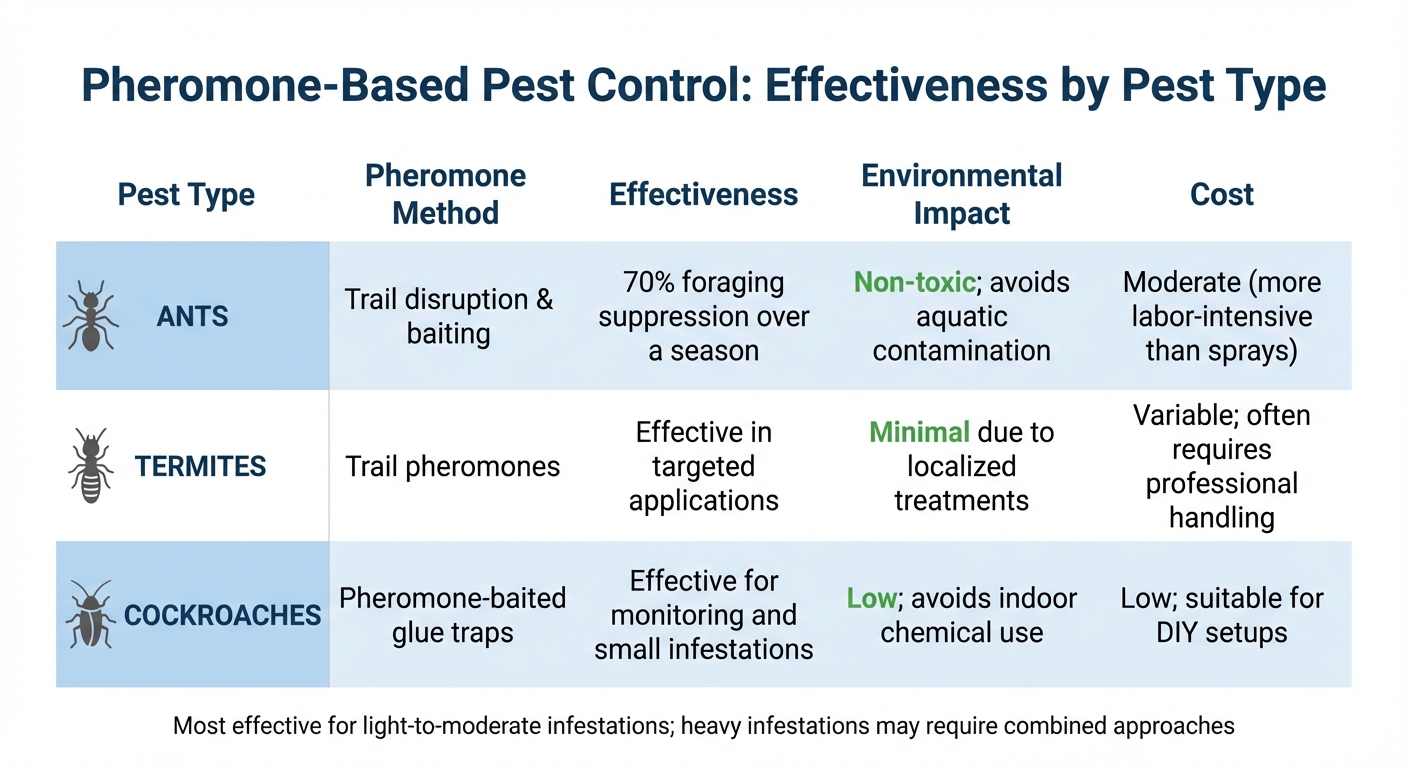
Pheromone-Based Pest Control Effectiveness Comparison by Pest Type
Let’s dive into the strengths and challenges of using pheromone-based pest control methods, building on the earlier discussion about their mechanisms.
One of the biggest advantages of pheromone-based pest control is its precision. Unlike broad-spectrum insecticides that can harm beneficial insects and natural predators, pheromones target only specific pests. For example, field trials demonstrated that adding (Z)-9-hexadecenal to thiamethoxam gel bait reduced ant activity by 74% within four weeks, compared to just 42% with standard bait. It also led to a 2–3x increase in bait consumption.
The environmental perks are just as noteworthy. Conventional insecticides like pyrethroids and fipronil can linger in water systems for up to a week, posing risks to aquatic life. In contrast, pheromones break down quickly and don’t leave harmful residues. As highlighted in the Journal of Chemical Ecology:
"Pheromones are increasingly efficient at low population densities, they do not adversely affect natural enemies, and they can, therefore, bring about a long-term reduction in insect populations that cannot be accomplished with conventional insecticides".
That said, pheromone methods aren’t without their challenges. They’re most effective at low pest densities. In cases of severe infestations, initial pesticide treatments may be required to bring pest numbers down to a manageable level where pheromones can work effectively. Another limitation is that pheromones don’t address secondary pests that might emerge once broad-spectrum insecticides are phased out, making consistent monitoring a necessity. While professional-grade pheromone treatments can cost more upfront compared to traditional sprays, the long-term savings from reduced chemical use and fewer service callbacks often balance out the initial investment.
Here’s a quick comparison of how pheromone methods stack up for different pests:
| Pest Type | Pheromone Method | Effectiveness | Environmental Impact | Cost |
|---|---|---|---|---|
| Ants | Trail disruption & baiting | 70% foraging suppression over a season | Non-toxic; avoids aquatic contamination | Moderate (more labor-intensive than sprays) |
| Termites | Trail pheromones | Effective in targeted applications | Minimal due to localized treatments | Variable; often requires professional handling |
| Cockroaches | Pheromone-baited glue traps | Effective for monitoring and small infestations | Low; avoids indoor chemical use | Low; suitable for DIY setups |
Pheromones are ideal for monitoring and managing light-to-moderate infestations while minimizing harm to your home and the environment. For heavier infestations, combining pheromone use with targeted insecticides ensures better results without over-relying on chemicals.
DIY Tips for Pheromone-Based Pest Control
Starting with pheromone-based pest control at home doesn’t require specialized training - just a thoughtful approach and a bit of patience. The first step might surprise you: hold off on cleaning. When you see ants or cockroaches making their way through your space, resist the urge to immediately mop or wipe. Instead, take a moment to observe and map their routes. Laurel D. Hansen, an instructor in the Biology Department at Spokane Falls Community College, emphasizes:
"Ants will not find baits that are placed at random locations; therefore, you must place the bait where you know it will be discovered by ants".
To pinpoint these pathways, set up sticky traps along baseboards, under sinks, or near suspected entry points for a couple of days. This will help you identify the invisible "highways" pests use before you take action.
Once you’ve mapped their trails, it’s time to disrupt them. A 50/50 vinegar solution or ammonia-based cleaner is excellent for breaking down pheromone trails on hard surfaces. For porous surfaces, enzyme-based cleaners are more effective. After cleaning, apply strong-smelling deterrents like peppermint oil or cinnamon near entry points to confuse pests and mask any remaining chemical signals.
Trap placement matters. Pheromone traps are designed for specific pests, so using a cockroach trap won’t help with ants. Place traps close to the trails you’ve identified - along edges of counters, carpet borders, fences, or utility wires where pests naturally travel. Keep traps away from areas with high human activity to avoid attracting pests to unwanted spots. The National Pesticide Information Center advises:
"Pheromone traps attract pests. Do not place them in high traffic areas near people or gardens, especially for wasps, hornets, or crop-damaging insects".
For DIY solutions, cockroach traps can be made by placing duct tape sticky-side up on cardboard with a small dab of peanut butter in the center. For ants, a simple bait station using a 2% mixture of boric acid and sugar water in shallow lids works well.
Maintenance is key. Store unused lures in the refrigerator to keep them fresh, replace trap bases monthly, and check outdoor traps weekly. Always wash your hands after handling pheromone products. Keep in mind that pheromone lures lose their effectiveness quickly, especially in warm areas. Dispose of old lures far from active traps to avoid disrupting their effectiveness.
To strengthen your pest control efforts, combine pheromone disruption with physical barriers and cleanliness. Seal cracks and crevices with a caulking gun, focusing on windows, doors, and baseboards - no gap is too small. Store food in airtight containers, and scrub surfaces with a baking soda paste to eliminate food residues and lingering scent trails. At Remedy, we incorporate this layered approach into our kits, pairing professional-grade pheromone lures with detailed placement instructions. This mix of monitoring, disruption, and prevention offers a solid strategy for long-term pest control without over-reliance on chemical sprays.
Conclusion
Different pest species react in specific ways to pheromone-based control, making tailored strategies essential for success. For example, ants show a strong response to pheromone treatments. Combining attractants with non-repellent insecticides like fipronil has been shown to boost effectiveness by up to 57% in controlled studies. Their natural behavior of following shared trails means a single lure can often attract multiple ant species at once. In contrast, termites use trail pheromones for both exploration and recruitment, while cockroaches rely on simpler aggregation signals rather than complex trail systems.
Timing and integration are key to maximizing results. Pheromone-based methods are most effective when pest populations are still small, offering long-term control while minimizing harm to beneficial insects. For best results, combine these methods with physical barriers and proper sanitation. Regularly replace pheromone lures - ideally every 90 days - to maintain their potency. Be mindful of temperature ranges, as extreme conditions (below 65°F or above 95°F) can reduce their effectiveness. A coordinated approach ensures no single tactic is over-relied upon.
Emerging research also highlights the need to rethink bait strategies. A study in Communications Biology found that ants can develop aversive memories of toxic bait sites, leading to a 70–80% drop in foraging activity within 6–8 hours as they actively avoid those areas. Rotating bait placement and using delayed-action toxicants can help prevent this avoidance and improve treatment outcomes.
At Remedy, we’ve embraced these science-backed methods. Our kits include professional-grade pheromone products and detailed placement guides tailored to specific pest behaviors and environmental conditions. Homeowners who combine pheromone monitoring with trail disruption and exclusion tactics consistently achieve better results - addressing the root causes of infestations rather than just providing temporary relief.
While pheromone-based pest control isn’t a one-size-fits-all solution, it excels as part of a layered defense. Start by observing pest activity, disrupt established trails, use species-specific lures along active pathways, and maintain your defenses with regular monitoring and lure replacement. By combining precise pheromone applications with physical barriers and sanitation, pests can be managed more effectively and with less reliance on broad-spectrum pesticides. This approach offers a more sustainable and targeted way to combat infestations.
FAQs
How do trail pheromones affect pest behavior and control efforts?
Trail pheromones are essential for how pests, such as ants, communicate and find their way. These chemical signals guide them to food sources and nesting areas, enabling efficient navigation and resource gathering.
By interfering with these pheromones, pests can become confused and lose their sense of direction. Whether through oversaturation or other forms of interference, disrupting these signals makes it harder for pests to locate resources. This confusion disrupts their foraging behavior and hampers the colony's overall efficiency, offering a practical approach to pest control.
What are the environmental advantages of using pheromone-based pest control?
Pheromone-based pest control stands out as a precise and environmentally friendly method for managing pest populations. Unlike traditional chemical pesticides, which often affect a wide range of organisms, pheromones specifically target the behavior of certain pests. This approach minimizes the impact on beneficial insects and other non-target species, helping to preserve the natural balance of ecosystems while reducing the risk of environmental pollution.
Techniques like mating disruption and attract-and-kill rely on biodegradable synthetic pheromones. These compounds naturally break down, leaving behind no harmful residues. Such methods not only lower the reliance on broad-spectrum pesticides but also help combat issues like pesticide resistance and the decline of biodiversity. By aligning with integrated pest management (IPM) principles, pheromone-based strategies offer a sustainable way to achieve effective pest control while safeguarding ecosystems and human health.
Can DIY pest control work alongside pheromone treatments?
Yes, DIY pest control can work hand-in-hand with pheromone treatments when applied thoughtfully. For example, using synthetic trail pheromones can direct pests like ants toward bait stations, boosting their effectiveness. On the flip side, cleaning or wiping away pheromone trails can disrupt pests' established routes - a simple yet impactful DIY tactic.
While professional pheromone treatments deliver accurate and lasting results, pairing them with DIY methods like bait placement or trail removal can strengthen pest control efforts and help keep pests in check between professional visits.