


Houseplant pests can be a headache, but natural pest control methods are safer for your home, plants, pets, and family. Instead of relying on synthetic pesticides, which can linger indoors and harm your plants or loved ones, you can use effective and eco-friendly alternatives. Here's what you need to know:
- Why Go Natural? Synthetic pesticides may cause leaf damage, harm beneficial insects, and leave toxic residues. Natural options are safer and promote healthier plant growth.
- Spot Problems Early: Regularly inspect leaves for sticky residue, webbing, yellow spots, or distorted growth - common signs of pests like aphids, spider mites, or mealybugs.
- Prevention Tips: Healthy plants resist pests better. Water properly, avoid over-fertilizing, clean leaves, and quarantine new plants before adding them to your collection.
- Treatment Options: Use homemade sprays like insecticidal soap, neem oil, or diluted alcohol for common pests. Beneficial insects like predatory mites can also help.
- Long-Term Care: Inspect plants regularly, remove debris, and maintain proper humidity and soil moisture to keep pests away.
DIY Pest Control Spray: Organic pest control for plants that WORKS!
Prevention: Keeping Pests Away from Your Plants
When it comes to pests, stopping them before they start is always the best approach. Healthy, well-maintained plants are naturally better equipped to fend off infestations, making prevention much easier than dealing with a full-blown problem later. Amy Dreves from Oregon State University's Master Gardener Program sums it up perfectly:
Know your plants' needs and keep them healthy with adequate light, water and fertilizer. Stressed plants encourage pest problems. For example, high nitrogen favors aphids, while dry and dusty conditions promote mite outbreaks.
Basic Plant Care to Prevent Pests
Your daily plant care routine plays a huge role in keeping pests at bay. Watering correctly is key. Overwatering can lead to fungus gnats, while ensuring proper drainage helps prevent their spread. Water plants at their base and let the top layer of soil dry out between waterings to avoid fungal diseases and discourage gnats.
Fertilizing is just as important. Skip high-nitrogen fertilizers, as they encourage soft, new growth that attracts pests like aphids, mealybugs, and scale insects. Instead, opt for slow-release fertilizers that promote steady, balanced growth.
Regular maintenance also makes a big difference. Clear away dead leaves, spent flowers, and any debris from the soil surface - they provide perfect hiding spots for pests. Wipe leaves occasionally with a damp cloth to remove dust and grime, which can harbor spider mites and reduce your plant's ability to photosynthesize. And when repotting, always use fresh, sterile potting soil - old garden soil or bags left outside can introduce pests and diseases.
These small but essential steps ensure your plants stay healthy and make it easier to spot any pest problems early.
Checking New Plants Before Bringing Them Home
Every new plant you bring home could be carrying pests, even if it looks healthy at first glance. Before purchasing, inspect plants thoroughly. Turn over the leaves to check their undersides, look at the spots where stems meet, and even examine the roots for signs of trouble like insects, webbing, or discoloration.
Once home, quarantine new plants for one to two weeks in a separate room away from your other plants. This isolation period gives any hidden pests time to show themselves before they can spread. Make sure the quarantine area has bright light and good airflow to keep the plants healthy during this time. If you’ve had plants outdoors for the summer, treat them as though they’re infested when bringing them back inside and quarantine them immediately.
Taking these precautions helps protect your entire collection from potential pest outbreaks.
Setting Up Your Space to Discourage Pests
The environment you create for your plants plays a big role in discouraging pests. For example, spider mites thrive in hot, dry conditions, so increasing humidity through misting or grouping plants together can make your space less appealing to them. On the other hand, fungus gnats love overly moist soil, so proper watering practices are essential to keep them under control.
Strategic plant placement also helps. Group moisture-loving plants in naturally humid areas like kitchens or bathrooms to reduce stress and make them less prone to pests. Keep plants away from cold drafts caused by air conditioners, open windows, or doors, as these can weaken them and make them more vulnerable. Adding screens to windows and doors provides a simple barrier against flying pests like aphids. For an extra trick, try placing aluminum foil around the base of your plants - its reflective surface can confuse pests like thrips and aphids, making it harder for them to land.
| Environmental Factor | How to Adjust | Pests Discouraged |
|---|---|---|
| Humidity | Mist plants or group them together | Spider mites, Thrips |
| Soil Moisture | Allow surface to dry between waterings | Fungus gnats |
| Fertilizer | Use slow-release; limit nitrogen | Aphids, Mealybugs, Scale |
| Cleanliness | Remove dead leaves and debris daily | Mealybugs, Fungus gnats |
| Air Movement | Avoid cold drafts from AC/windows | General plant stress |
Identifying Common Houseplant Pests
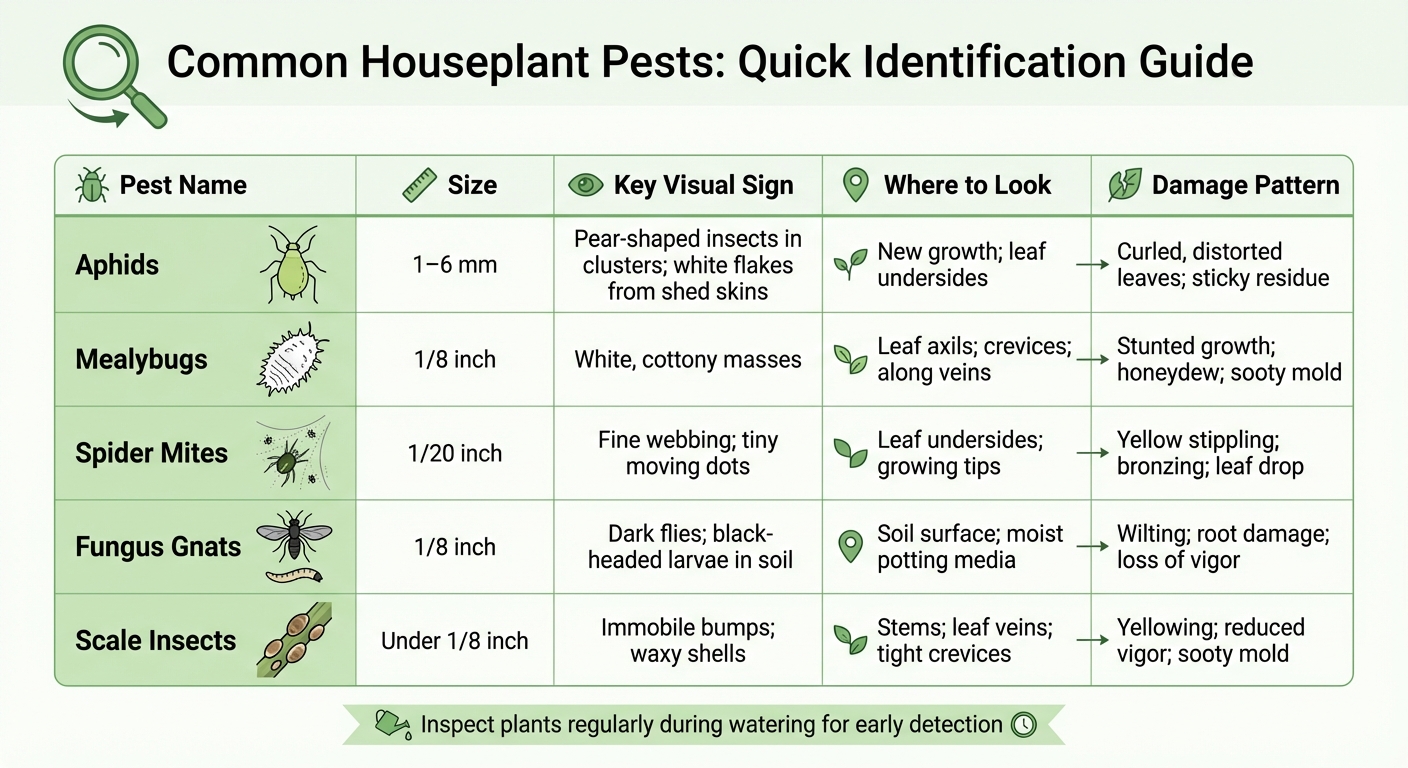
Common Houseplant Pests Identification Guide
Spotting houseplant pests early is key to managing them effectively. Knowing what to look for helps you take action using natural methods to protect your plants.
Aphids, Mealybugs, and Spider Mites
Aphids are tiny (1–6 mm) and often gather on new growth or the undersides of leaves. They come in various colors - green, black, red, yellow, or brown - and are recognizable by their "cornicles", small tailpipe-like projections. If you see leaves curling, yellowing, or becoming misshapen, aphids might be feeding on your plant. You may also notice white flakes from their shed skins.
Mealybugs are small (1/8 inch), wingless insects covered in a white, waxy substance that resembles cotton. They hide in leaf axils and crevices, where they excrete sticky honeydew that can lead to black sooty mold. Female mealybugs are prolific, laying 200–600 eggs in fluffy, white sacs.
Spider mites are minuscule arachnids (about 1/20 inch or smaller) that look like tiny moving dots. They feed by sucking chlorophyll from leaves, leaving behind yellow or white speckles known as stippling. In warm, dry conditions (around 75°F), their population can explode within 7–14 days. A simple way to check for spider mites is to tap a leaf over a white sheet - if you see tiny moving specks, you’ve found them.
Fungus Gnats and Scale Insects
Not all pests chew leaves - some cause damage in other ways.
Fungus gnats are small, mosquito-like flies (about 1/8 inch long) that hover near soil or appear when watering plants. Their larvae, slender white worms with black heads, feed on roots and organic material in moist soil. With a life cycle of just 12 days, their numbers can grow quickly. Kelley Hamby, an Entomology Professor at the University of Maryland, explains:
Fungus gnats are often a symptom of overwatering.
Scale insects are stationary pests that look like small bumps, disks, or warts on stems and leaf veins. They fall into two categories: soft scales, which produce sticky honeydew and have a waxy coating, and armored scales, which have a hard shell and don’t excrete honeydew. These insects start as mobile "crawlers", but once they settle and molt, they lose their legs and remain in place. Their camouflage can make them tricky to spot - on ferns, for instance, they can resemble natural spore clusters.
| Pest | Size | Key Visual Sign | Where to Look | Damage Pattern |
|---|---|---|---|---|
| Aphids | 1–6 mm | Pear-shaped; clusters; white flakes | New growth; leaf undersides | Curled, distorted leaves; sticky residue |
| Mealybugs | 1/8 inch | White, cottony masses | Leaf axils; crevices; along veins | Stunted growth; honeydew; sooty mold |
| Spider Mites | 1/20 inch | Fine webbing; tiny moving dots | Leaf undersides; growing tips | Yellow stippling; bronzing; leaf drop |
| Fungus Gnats | 1/8 inch | Dark flies; black-headed larvae | Soil surface; moist potting media | Wilting; root damage; loss of vigor |
| Scale Insects | Under 1/8 inch | Immobile bumps; waxy shells | Stems; leaf veins; tight crevices | Yellowing; reduced vigor; sooty mold |
sbb-itb-0bbb908
Natural Treatment Options for Houseplant Pests
Once you’ve identified the pest troubling your houseplants, it’s time to take action. Natural treatments offer an effective way to tackle pests by either killing them on contact or disrupting their ability to feed and reproduce - all without relying on synthetic chemicals.
Homemade Pest Control Sprays
One of the most effective first steps is creating your own pest control sprays. For soft-bodied pests like aphids, mealybugs, and spider mites, insecticidal soap is a go-to solution. To make it, mix 1 tablespoon of pure, fragrance-free Castile soap (avoid products with degreasers or bleach) with 1 quart of distilled water - hard water minerals can reduce its effectiveness. According to Ryan McEnaney, a Garden Designer:
The soap contains fatty acids that remove a protective layer from the outside of the insect and then damage the interior cells, causing a quick death.
Insecticidal soap works while it’s wet, so reapply every 4–7 days as needed.
For longer-lasting protection, neem oil is another excellent choice. Mix 1.5 teaspoons of neem concentrate with 1 teaspoon of soap and 1 liter of water. Neem oil not only kills pests but also disrupts their hormones, as Amy Andrychowicz, Founder of Get Busy Gardening, explains:
Neem oil messes with the bugs’ hormones and brains so they stop eating and reproducing.
Unlike soap sprays, neem oil continues to work after drying, offering protection for up to 10 days. For tougher pests like mealybugs or scale, rubbing alcohol applied with a cotton swab - or diluted 1:1 with water for larger infestations - can be highly effective.
Before using any spray, test it on a small section of the plant and wait 24–48 hours to ensure there’s no damage. Apply treatments in the early morning or evening to avoid burning the leaves, and always target the undersides of leaves where pests often hide.
| Spray Type | Recipe | Best For |
|---|---|---|
| Insecticidal Soap | 1 tbsp Castile soap per 1 quart water | Aphids, mealybugs, mites, whiteflies |
| Neem Oil Spray | 1.5 tsp neem oil, 1 tsp soap, 1 liter water | Broad range of pests, longer-lasting |
| Alcohol Spray | 1 part rubbing alcohol, 1 part water | Mealybugs, scale, aphids |
If sprays don’t fully resolve the issue, you can turn to another ally: beneficial insects.
Using Beneficial Insects for Pest Control
Sometimes, nature’s own pest hunters are the answer. Beneficial insects like predatory mites, parasitic wasps, and nematodes can help restore balance to your plants without chemicals. For example, a single predatory mite can consume up to 20 spider mites in a day. To manage fungus gnats, introduce Steinernema feltiae nematodes as a soil drench and keep the soil moist for 7–10 days.
For specific pests, consider these options:
- Phytoseiulus persimilis: Targets spider mites but thrives in high humidity.
- Cryptolaemus montrouzieri (the "mealybug destroyer"): Feeds on all stages of mealybugs.
To maximize their effectiveness:
- Stop using chemical sprays at least two weeks before releasing beneficial insects.
- Maintain humidity levels between 50–70% and temperatures between 68–79°F.
- Release your allies at dusk to prevent them from flying away.
It usually takes 3–6 weeks for these natural systems to stabilize, but the results are worth the wait.
How Remedy DIY Pest Control Kits Can Help

If managing homemade solutions and beneficial insects feels overwhelming, Remedy DIY Pest Control Kits simplify the process. These kits combine professional-grade natural ingredients like neem oil, insecticidal soap, and pyrethrins (which break down quickly to stay safe for kids and pets) . Neem oil in the kits can eliminate up to 90% of soft-bodied pests on contact.
What makes these kits stand out is the support they provide. Accurate pest identification ensures you’re using the right treatment for your specific problem. Each kit includes clear, step-by-step instructions to guide you through the critical 3–4 week application cycle, ensuring you catch pests that hatch after the initial treatment. Plus, with regular shipments and virtual support, you’ll always know how to keep your plants thriving.
Long-Term Maintenance and Monitoring
Regular Plant Inspections and Care
Spotting pests early is the best way to keep them under control. A good habit is to inspect your plants every time you water, fertilize, or clean them [12, 13]. Pay close attention to the underside of leaves - pests love to hide there. Also, check where stems meet leaves, any tender new growth, and even the rims, edges, and bottoms of pots and saucers for signs of eggs or insects.
Look for warning signs like discolored or speckled leaves and sticky honeydew left by pests [12, 3]. Tiny pests, like spider mites, can be as small as 1/50th of an inch, so a magnifying lens can be helpful. A simple trick: tap or gently brush plant leaves over a white sheet of paper and watch for tiny moving specks [12, 13].
"Finding pests before they become a problem is the best way to keep insects at bay." – University of Minnesota Extension
To prevent spreading pests, always clean your tools between plants. Remove debris from the soil surface regularly to get rid of potential hiding spots [12, 4, 13]. Wiping plant leaves with a damp cloth not only keeps them clean but also makes spotting pests easier. For flying pests, sticky traps are your friend - yellow traps work well for fungus gnats and whiteflies, while blue traps are effective for thrips [12, 1, 13].
These small steps form the backbone of effective pest prevention and set the stage for more advanced strategies.
Preventative Measures for Future Protection
Beyond basic pest control, keeping plants healthy and stress-free is key to long-term protection. Amy Dreves, a Master Gardener at Oregon State University, emphasizes:
"Know your plants' needs and keep them healthy with adequate light, water and fertilizer. Stressed plants encourage pest problems." – Amy Dreves, Master Gardener at Oregon State University
Be cautious with high-nitrogen fertilizers, as they promote tender growth that pests find irresistible [1, 13]. For fungus gnats, allow the top layer of soil to dry out between waterings, as their larvae thrive in moist conditions [3, 7].
Quarantining new plants for one to three weeks before introducing them to your existing collection is another effective practice. This gives any hidden pests or eggs time to surface [12, 2, 34]. If you’re moving outdoor plants indoors after summer, consider soaking their pots in diluted insecticidal soap to get rid of unwelcome guests like earwigs or ants. Adjusting environmental factors can also make a big difference - increasing humidity can discourage spider mites, while letting soil dry out helps control fungus gnats [6, 7].
Conclusion
Keeping your houseplants free from pests boils down to three main steps: prevention, early detection, and using safe treatments. Start by quarantining new plants to reduce the risk of infestations. Healthy plants are naturally more resistant to pests, so focus on providing the right amount of light, water, and balanced fertilization instead of immediately reaching for sprays.
Make it a habit to inspect your plants every time you water them, paying close attention to the undersides of leaves and new growth. Spotting issues early often allows you to manage them with simple solutions, like a strong water spray or a cotton swab dipped in rubbing alcohol. As Iowa State University experts emphasize, tackling pests requires patience and persistence.
Natural remedies such as insecticidal soaps, neem oil, and horticultural oils are effective without the lingering risks of synthetic pesticides indoors. For more stubborn issues, biological controls - like Bacillus thuringiensis israelensis (Bti) for fungus gnats or introducing beneficial insects - can offer lasting relief. These natural approaches not only protect your plants but also create a safer indoor environment.
Consistency is key. Regularly remove plant debris, adjust watering practices to suit each plant, and avoid over-fertilizing with high-nitrogen products, which can attract sap-sucking pests. With around 75% of American households keeping houseplants, maintaining a chemical-free, pest-free home benefits everyone - pets, kids, and adults alike.
FAQs
How can I spot common houseplant pests early?
To spot common houseplant pests before they become a problem, make it a habit to inspect your plants regularly. Focus on areas like the undersides of leaves and new growth, as pests such as aphids, mealybugs, whiteflies, thrips, scales, and mites tend to hide there. Watch for telltale signs like sticky residue (known as honeydew), black mold, discolored leaves, or clusters of tiny insects.
Regular check-ins are your best defense. By knowing what your plants usually look like, you'll be able to catch any unusual changes early and take quick action to keep them healthy and pest-free.
What are the best natural ways to control pests on houseplants?
The best ways to naturally manage pests on houseplants involve a mix of simple and eco-friendly strategies. Start by giving your plants a gentle rinse with water to knock off pests like aphids or spider mites. Make it a habit to inspect your plants regularly, especially before bringing them indoors, and quarantine any new additions for a few weeks to avoid introducing pests like mealybugs or whiteflies.
Other effective methods include handpicking larger pests, setting up sticky traps to catch flying insects, and adjusting your watering routine to discourage pest-friendly conditions. If the problem persists, insecticidal soaps and horticultural oils offer safe, natural solutions. By staying consistent and combining these techniques, you can keep your houseplants thriving and pest-free.
How can I keep pests out when bringing new houseplants home?
To keep pests at bay when introducing new houseplants to your home, start by quarantining the plant for at least three weeks in a separate area. This precaution gives you time to observe the plant for any signs of pests or diseases without putting your other plants at risk.
During the quarantine, give the plant a close inspection. Look at the leaves - both on top and underneath - as well as the stems and soil for any signs of pests or damage. To be extra cautious, you can rinse the plant with water or use a natural pest control option like neem oil to tackle any hidden issues.
If you're buying a plant, check it carefully at the store or nursery for any signs of infestation before bringing it home. These straightforward steps can make a big difference in keeping your houseplants pest-free and thriving.