


If you're tired of chemical sprays and want a natural pest deterrents, certain herbs can help. Plants like basil, mint, rosemary, lavender, and more release oils that confuse and deter bugs like mosquitoes, flies, and ants. Plus, they’re easy to grow and double as flavorful additions to your meals. Here’s a quick look at how these herbs work and how to grow them successfully:
- Basil: Repels mosquitoes, flies, and aphids. Grows best in warm weather with 6+ hours of sun.
- Mint: Effective against mosquitoes, ants, and flies. Thrives in containers to prevent spreading.
- Rosemary: Deters mosquitoes and cabbage moths. Needs well-draining soil and full sun.
- Lavender: Keeps mosquitoes and moths away. Prefers dry, sunny conditions.
- Lemon Balm: High in citronellal, repels mosquitoes. Grows aggressively, best in containers.
- Peppermint: Menthol-rich, repels ants and fleas. Needs moist soil and partial sun.
- Catnip: Contains nepetalactone, highly effective against mosquitoes. Hardy and easy to grow.
- Garlic: Keeps aphids and ants at bay. Plant in the fall for best results.
- Sage: Repels flies and cabbage moths. Needs well-draining soil and full sun.
- Bay Leaves: Protects pantry items from beetles and moths. Grows well in warm climates.
These herbs not only repel bugs but also attract helpful insects like bees and butterflies. Crush leaves to release oils for stronger effects, or use them in DIY sprays. Whether in your garden or indoors, these plants offer a safe, natural way to keep pests away while enhancing your home and meals.
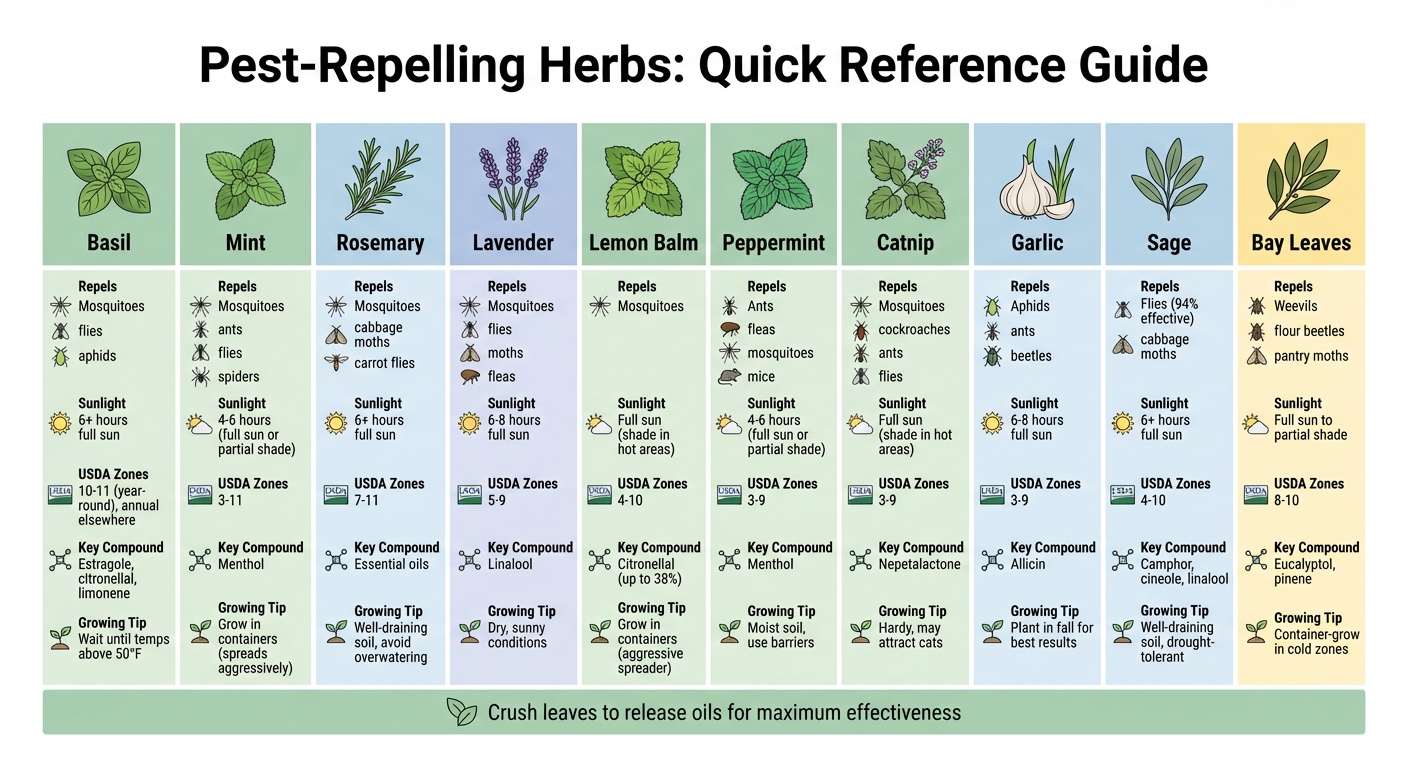
10 Pest-Repelling Herbs: Growing Conditions and Effectiveness Guide
1. Basil
Effectiveness in Repelling Pests
Basil is a natural deterrent for mosquitoes, houseflies, aphids, whiteflies, and tomato hornworms. Its repellent power comes from four key compounds: estragole, citronellal, limonene, and nerolidol. Crushing basil leaves releases more of these essential oils, boosting their effectiveness. To use, crush fresh leaves and apply a small amount to your skin or clothing, but test first to ensure no irritation occurs. If you're dealing with bug bites, basil oil can also help soothe the itch.
Debra Knapke, Horticulturist and Author, notes: "Basil attracts parasitoid wasps which then lay their eggs in the cabbage white caterpillar... [growing basil] is an instance of supporting biological controls in the garden".
Let’s explore how to grow basil successfully across different U.S. climates.
Ease of Growing in US Climates
Basil thrives in warm weather, needing at least 6 hours of full sun daily and well-drained, nutrient-rich soil. While it's an annual in most U.S. regions, it can grow year-round in USDA zones 10 and 11. Since basil is sensitive to frost, wait until nighttime temperatures consistently stay above 50°F before planting it outdoors. To get a head start, start seeds indoors 4–5 weeks before the last frost, keeping the temperature around 75°F. In humid areas, opt for Downy Mildew Resistant varieties like Prospera, Amazel, or Rutgers Devotion, and water the plant at its base to minimize disease risk. With these tips, you can enjoy basil's pest-repelling benefits while enhancing your garden's natural defenses.
Additional Uses Beyond Pest Control
Basil's benefits go beyond keeping bugs at bay - it's a beloved ingredient in the kitchen, perfect for making pesto, pasta sauces, and even cocktails.
Carrie Spoonemore, Co-creator of From Seed to Spoon, advises: "Plant it near doors and windows to discourage pests from entering".
For a simple DIY repellent spray, steep 4 to 6 ounces of fresh basil leaves in 4 ounces of boiling water for several hours. Strain the mixture, add 4 ounces of vodka, and store it in the refrigerator for on-the-go outdoor use. With its culinary versatility and pest-repelling properties, basil is a must-have for any garden.
sbb-itb-0bbb908
2. Mint
Effectiveness in Repelling Pests
Mint owes its pest-repelling powers to menthol, the compound responsible for its signature cooling scent. Peppermint, which contains more menthol than spearmint, is especially effective at keeping bugs at bay . Its strong aroma confuses insects by masking human scents and interfering with their sensory receptors, making it harder for them to land or feed . Mint is known to deter a wide range of pests, including mosquitoes, ants, flies, spiders, aphids, cockroaches, mites, moths, fleas, and even rodents .
Studies suggest that certain peppermint oil extracts can repel mosquitoes for 9 to 11.5 hours, and the oil is potent enough to kill house fly larvae.
Kait Chapman, Extension Educator of Urban Entomology at the University of Nebraska-Lincoln, explains, "Peppermint oil can be an effective bug repellent, but not without limitations".
However, mint oils degrade quickly when exposed to sunlight and heat, limiting their effectiveness outdoors . Simply growing mint in your garden isn’t enough - you need to crush or bruise the leaves to release its essential oils . A simple DIY spray can be made by mixing 10 to 20 drops of peppermint essential oil with 1 cup of water and a few drops of dish soap. Be cautious, though, as high concentrations can harm nearby plants in direct sunlight. Like basil, mint not only repels pests but also supports your garden as a companion plant.
Now, let’s look at how you can grow mint successfully across different U.S. climates.
Ease of Growing in US Climates
Mint is incredibly flexible, thriving in USDA hardiness zones 3 to 11 and enduring temperatures as low as -20°F . It grows well in full sun or partial shade, ideally getting 4 to 6 hours of sunlight each day . Mint prefers nutrient-rich, moist, and well-drained soil with a slightly acidic pH (6.0 to 6.5) . To keep the plant healthy, aim for 1 to 2 inches of water per week, ensuring the soil remains moist but not waterlogged .
Because mint spreads aggressively, it’s best to grow it in containers that are 12 to 16 inches wide. If you plant it directly in the ground, use physical barriers inserted 10–15 inches deep to keep it from taking over your garden .
Chuck Pavlich, Director of New Product Development at Terra Nova Nurseries, remarks, "Mint repels cabbage moths, ants, mice, and fleas".
To grow mint from seeds, start them indoors 8 to 10 weeks before the last spring frost. Transplant the seedlings outdoors after the frost danger has passed . For a bushy, flavorful plant, pinch back blossoms as they appear and trim the plant back to within 1 inch of the ground up to three times a season . Placing mint containers near doorways, windows, or outdoor seating areas can create a natural scent barrier .
Additional Uses Beyond Pest Control
Mint isn’t just a pest repellent - it’s also a culinary favorite and a natural antimicrobial agent. With over 600 varieties, mint adds a refreshing touch to teas, salads, and even pesto . It has antimicrobial and antiviral properties that can inhibit fungi, bacteria, parasites, and some viruses. For indoor pest management, placing shallow bowls of dried mint leaves on pantry shelves helps deter mice. If you’re outdoors, rubbing fresh mint leaves on your skin can act as a quick, natural bug repellent.
Mint’s versatility makes it a valuable addition to any home or garden.
3. Rosemary
Effectiveness in Repelling Pests
Rosemary's leaves are packed with essential oils that naturally keep pests like mosquitoes, cabbage moths, carrot flies, Japanese beetles, slugs, and snails at bay. When planted near vegetable gardens, its scent can act as a barrier, confusing and deterring harmful insects. However, the fragrance of a standing rosemary plant alone doesn’t last long enough to be highly effective against mosquitoes unless the oils are actively released. Crushing the leaves or burning rosemary sprigs on a grill or campfire can temporarily repel mosquitoes.
For a simple DIY repellent spray, boil 1 quart of dried rosemary in 1 quart of water for 20 minutes, strain the liquid, and mix it with another quart of cool water. Store this mixture in the refrigerator and use it until the scent fades. Rosemary oil, when applied directly, offers a short-term solution for repelling mosquitoes.
Sharon Kong Perring from Hunker states, "Rosemary's strong aroma wards off pests and discourages bugs from nesting on it, particularly those that are more attracted to sweet-smelling plants".
For a quick natural remedy while gardening, crush a few rosemary leaves in your hands and rub the oils on your skin. Now, let’s explore how to grow rosemary successfully across various U.S. climates.
Ease of Growing in US Climates
Rosemary thrives in USDA zones 7 through 11, with varieties like "Arp" being more tolerant of cold and "Salem" performing well in humid areas. The plant typically grows 3–6 feet tall and 2–4 feet wide, requiring at least 6 hours of direct sunlight and well-draining soil. In colder regions, rosemary is often grown as an annual or brought indoors to overwinter. A key tip: avoid overwatering, as rosemary is prone to root rot in poorly draining soil. Only water when the top inch of soil feels dry, and consider adding grit or sand to heavy soils for better drainage.
Evangelia Koutsovoulou, Founder of Daphnis and Chloe, advises, "Rosemary is quite sturdy and will grow in many places, but it won't always taste the same. For a higher rate of success, you should pick a local variety or at least one that prospers in climates similar to yours".
If growing indoors, use a pot with drainage holes and a gritty potting mix. Place the plant in a south-facing window, and keep in mind that rosemary seeds take 14–21 days to sprout and need 10–12 hours of full-spectrum light daily. Following these tips will help you enjoy rosemary’s culinary and pest-repelling benefits year-round.
Additional Uses Beyond Pest Control
Rosemary isn’t just for keeping pests away - it’s also a fantastic culinary herb. It adds depth to roasted vegetables, meats, and potatoes, and its scent attracts beneficial insects. As a companion plant, rosemary can help mask the aroma of crops like carrots and brassicas, making them less appealing to pests. Beyond the garden, dried rosemary works well in sachets or as stovetop potpourri, filling your home with a warm, savory aroma. For the best flavor and oil content, harvest rosemary stems just as the plant begins to flower - ideally on cool mornings during spring or summer when the essential oils are most concentrated.
4. Lavender
Effectiveness in Repelling Pests
Lavender is more than just a fragrant addition to your garden - its linalool-rich oils are a natural deterrent for mosquitoes, flies, moths, and fleas. While the scent is soothing to humans, it works as a powerful repellent for these pests. However, simply growing lavender in your yard isn’t enough. To release the oils that make it effective, you need to crush the leaves or flowers.
Alexandra Jones, Master Gardener, explains: "Crushing the leaves releases oils - planting alone won't do the trick".
For those seeking a more concentrated solution, a 20% lavender oil mix in water or lotion can repel mosquitoes for up to 8 hours. While lavender is great for flying insects, it won't help with garden nuisances like aphids or slugs. For a quick fix outdoors, you can crush fresh lavender flowers and rub the oils directly onto your skin or clothing before stepping outside.
Ease of Growing in US Climates
Lavender thrives in USDA zones 5 through 9, making it a practical choice for many gardeners in the United States. Among the varieties, English lavender (Lavandula angustifolia) stands out for its hardiness. This herb loves full sun - about 6 to 8 hours daily - and requires well-draining soil. Be cautious of overwatering, as lavender is prone to root rot in heavy clay or standing water.
In regions with intense heat and humidity, the hybrid variety "Phenomenal" is a better option, as it resists common foliar and root diseases. To ensure healthy growth, space plants 2–3 feet apart for good air circulation and use rock or pea gravel as mulch to keep moisture away from the base. Young plants need watering once or twice a week until they’re established, while mature plants only need water every 2–3 weeks. If you live in colder climates, protect your lavender during winter with evergreen boughs or straw - or grow it in pots and move it indoors to a sunny window.
Additional Uses Beyond Pest Control
Lavender’s benefits go well beyond pest control. Known for its calming properties, it’s widely used in aromatherapy and found in products like soaps, detergents, and household cleaners. Dried lavender is perfect for making sachets that not only keep stored clothes smelling fresh but also deter moths.
In your garden, lavender has another role: attracting pollinators. Bees, wasps, and butterflies are drawn to its nectar-rich blooms.
Mary Marlowe Leverette, Master Gardener, points out: "Lavender shines in the garden to attract pollinators such as bees, wasps, and butterflies. Because it blooms for a long period during the summer, the insects rely on it as a source of food".
To preserve lavender, harvest the flowers when the buds start to open and hang them upside down in a warm, well-ventilated area. Beyond gardening, lavender adds a unique flavor to culinary dishes and is processed into dietary supplements for therapeutic purposes. Its versatility makes it a key player in natural pest control and so much more. Up next, we’ll dive into another herb with its own special abilities to keep pests at bay.
5. Lemon Balm
Effectiveness in Repelling Pests
Lemon balm is a natural mosquito repellent, thanks to its high citronellal content. Some northern European varieties of the plant boast nearly 38% citronellal - the same compound found in citronella oil. Arthur Tucker, an ethnobotanist at Delaware State University, explains:
"Some northern European forms of lemon balm are high in citronellal, a compound which mimics the well-known herbal repellent citronella oil".
But just planting lemon balm in your garden won't keep mosquitoes at bay. To activate its repellent properties, you need to crush the leaves to release the essential oils and apply them directly to your skin or clothing. According to Gary Bachman, MSU Extension Horticulture Specialist, lemon balm is one of the top herbs backed by science for repelling mosquitoes. If you're looking for maximum effectiveness, consider the "Quedlinburger Niederliegende" variety, which is specifically bred for its higher essential oil content.
Ease of Growing in US Climates
Lemon balm is a hardy and adaptable herb that grows well in USDA Zones 4 through 10, making it a great choice for most U.S. gardeners. It thrives in full sun in cooler regions but benefits from some afternoon shade in hotter areas to prevent stress. For optimal growth, plant it in rich, moist, well-drained soil with a pH between 4.5 and 7.6, spacing plants 18 to 24 inches apart.
However, as a member of the mint family, lemon balm is known for its aggressive growth habits. It spreads through rhizomes and self-seeding, which can quickly take over a garden. To keep it under control, grow it in containers or regularly deadhead the flowers before they go to seed. If your lemon balm becomes leggy or develops powdery mildew, simply cut it back to encourage fresh growth. For gardeners in colder zones (3–4), adding mulch in the fall can protect the roots through winter.
Additional Uses Beyond Pest Control
Lemon balm isn’t just useful for keeping mosquitoes away - it’s also a versatile herb in the kitchen and for home remedies. Fresh leaves add a burst of flavor to teas, salads, pasta, fish dishes, and marinades when tossed in at the end of cooking. Medicinally, it’s often used to alleviate anxiety, promote better sleep, and ease digestive discomforts like indigestion and gas. In one German study, 43% of patients with functional dyspepsia experienced complete relief after using a lemon balm preparation for eight weeks.
Herbal expert James Duke highlights its practicality:
"Weedy lemon balm, which any old brown thumb can grow, would be one of the herbs you should try before resorting to pharmaceuticals. It's cheap, easy, efficacious, pleasing and safe".
With its dual role as a mosquito repellent and a culinary and medicinal powerhouse, lemon balm earns its place as a must-have in any home garden, especially when used alongside a quarterly pest remedy kit.
6. Peppermint
Effectiveness in Repelling Pests
Peppermint is a handy natural pest repellent when used the right way. The secret lies in menthol, a compound that irritates pests' senses. For instance, it disrupts ants' ability to follow their pheromone trails and keeps mosquitoes at bay. However, just planting peppermint won’t do the trick. Crushing the leaves releases menthol-rich oils, which can repel pests for a few hours - typically 2 to 3, or even up to 8–11.5 hours with specific formulations. Chuck Pavlich, Director of New Product Development at Terra Nova Nurseries, confirms:
"Mint repels cabbage moths, ants, mice, and fleas".
Since the scent from a standing plant fades quickly, peppermint oil is often a better choice for indoor pest control. Kait Chapman, Extension Educator at the University of Nebraska-Lincoln, emphasizes:
"It's important to take into consideration many things that influence its effectiveness, including the formulation, concentration, how it's applied, and what specific insects or arthropods you're hoping it repels".
Now, let’s look at how easy it is to grow peppermint across various US climates.
Ease of Growing in US Climates
Peppermint is a hardy plant that flourishes in USDA Zones 3–9, tolerating temperatures as low as –20°F. However, it grows best in conditions ranging from 55°F to 70°F. While it can thrive in both full sun and partial shade, full sun is ideal for maximizing the production of essential oils, which are key to its pest-repelling properties. Les Engels, a Master Gardener, explains:
"Full sun will promote the most robust flavor and fragrance to the herb because it aids in the production of oils".
One potential drawback is peppermint’s aggressive growth. It spreads rapidly through underground rhizomes, which can overtake a garden if left unchecked. To manage this, consider planting it in containers or using barriers like bottomless buckets buried 10 to 15 inches deep. Keep the soil moist but avoid standing water to prevent root rot. Regular trimming - cutting stems back to about an inch above the soil two or three times a season - helps maintain its shape while encouraging fresh growth.
With the right care and containment, peppermint can thrive and offer a range of benefits beyond pest control.
Additional Uses Beyond Pest Control
Peppermint isn’t just for keeping bugs away - it’s also a versatile herb in the kitchen. Its refreshing, cooling flavor works well in salads, drinks, and desserts. Plus, its leaves make a calming tea that can help with digestion.
For home pest control, you can whip up a DIY peppermint spray. Boil dried peppermint leaves in water, let the mixture cool, strain it, and mix it with a half cup of rubbing alcohol. Another trick? Place shallow bowls of dried peppermint leaves in your pantry to deter mice from raiding your food supplies.
7. Catnip
Effectiveness in Repelling Pests
Catnip contains a compound called nepetalactone, which irritates insect receptors and helps ward off a variety of pests, including mosquitoes, cockroaches, ants, flies, deer ticks, termites, aphids, squash bugs, weevils, and even mice.
Carrie Spoonemore, Co-Creator of Park Seed's From Seed to Spoon app, notes: "The fragrance is a deterrent to pests, including mosquitoes, cockroaches, and termites."
Research shows that nepetalactone can sometimes outperform DEET in repelling mosquitoes during laboratory tests. While the plant itself offers moderate protection, crushing the leaves releases potent oils that enhance its effectiveness significantly.
Ease of Growing in US Climates
Much like basil or mint, catnip thrives when grown under the right conditions, which also enhances its pest-repelling abilities. This hardy perennial grows well in USDA Zones 3 through 9, covering most of the United States. In northern areas, it flourishes in full sun, while in hotter southern regions, morning sun combined with afternoon shade helps prevent heat stress. Catnip prefers well-drained, fertile soil with a slightly acidic pH of around 6.6.
Be mindful that catnip can spread aggressively by self-seeding. To control its growth, consider planting it in containers or raised beds. For in-ground plants, water deeply once a week, ensuring moisture reaches about 8 inches into the soil. Container-grown plants may need daily watering during hot summers. Use a low-nitrogen organic fertilizer to avoid over-fertilizing, which can reduce the production of its essential oils. Once the plant reaches 3–4 inches in height, pinching it back encourages bushier growth.
Additional Uses Beyond Pest Control
Catnip isn’t typically used in cooking. Its most well-known use is its effect on cats, making it a popular ingredient in cat toys and essential oils. However, keep in mind that growing catnip might attract neighborhood cats, which could be a drawback if you're trying to deter animals from your yard.
Beyond its feline appeal, dried catnip leaves can be used to make an herbal tea that promotes relaxation and better sleep. If you're considering using catnip topically, test it on a small area of skin first, as its oils can sometimes cause irritation. Next, we’ll dive into more herbs that can naturally repel pests.
8. Garlic
How Garlic Keeps Pests Away
Garlic’s strong aroma, thanks to a sulfur compound called allicin, is what makes it effective against certain pests. Shannon Harlow-Ellis, an Associate Certified Entomologist at Mosquito Joe, notes:
"Garlic can help repel bugs like aphids, ants, spider mites, beetles, caterpillars, snails, slugs, and mosquitoes".
Garlic is particularly effective at deterring aphids and ants. Studies show that intercropping with garlic can repel green peach aphids, and garlic extracts can significantly reduce root-knot nematodes. For ants, the smell of garlic disrupts their pheromone trails, making it harder for them to navigate. However, when it comes to mosquitoes, the effectiveness is debatable. While some experts recommend garlic as a repellent, scientific research doesn’t fully support its use.
To create a garlic spray, blend one head of garlic with two cups of water, strain it, and apply it to plant leaves every two weeks or after rainfall. Before using it widely, test the spray on a small section of a leaf and wait 24 hours to ensure it doesn’t harm the plant.
Now that we know how garlic helps with pests, let’s look at how simple it is to grow.
Growing Garlic in the U.S.
Garlic grows well across most U.S. climates, thriving in USDA zones 3–9. It’s a hardy perennial that prefers full sun (6–8 hours daily) and well-drained, nutrient-rich soil with a pH of 6.0 to 7.0. For colder regions, hardneck varieties are ideal, while softneck varieties do better in warmer southern climates.
Plant garlic cloves in the fall, typically from October to November, or about one to two weeks after the first killing frost. Avoid using garlic from grocery stores, as it’s often treated with anti-sprouting agents. Instead, buy seed garlic from trusted nurseries that cater to your local growing conditions. In colder areas, protect your garlic beds during winter by covering them with 4 to 6 inches of straw or leaf mulch.
More Than Just a Pest Repellent
Garlic isn’t only useful for keeping pests at bay - it’s also a kitchen staple and a medicinal powerhouse. It enhances countless recipes, from pasta sauces to roasted vegetables. Historically, garlic has been prized for its health benefits and is often processed into dietary supplements. Beyond its culinary and medicinal uses, garlic’s fungicidal properties make it a great companion plant for roses and tomatoes, helping to prevent soil-borne diseases.
That said, garlic isn’t compatible with every plant. Avoid planting it near beans, peas, lettuce, or asparagus, as it can hinder their growth. Additionally, garlic is toxic to dogs and cats, so be cautious if you have pets that may access your garden.
9. Sage
Effectiveness in Repelling Pests
Sage is a natural powerhouse for keeping pests at bay. This Mediterranean herb contains oils like camphor, cineole, linalool, and estragole, which interfere with an insect's ability to locate food and breeding spots. A 2025 study in the journal Insects revealed that sage oil could repel up to 94% of houseflies.
Sage is particularly effective against flies, creating a natural barrier with its earthy aroma when planted near patios, doorways, or compost areas. While the live plant offers limited mosquito deterrence, burning dried sage produces smoke that helps keep mosquitoes away.
Robin Sweetser from The Old Farmer's Almanac remarks, "Who knew that you could clear negative energy and repel mosquitoes at the same time with a smudge stick!"
In the garden, sage is a useful ally against cabbage moths, carrot flies, and some butterflies. Clary sage oil, in particular, contains compounds toxic to insects and can even be used indoors to manage boxelder bug infestations. Crushing fresh or dried sage leaves releases these potent oils, making them even more effective.
Ease of Growing in US Climates
Sage is a low-maintenance herb that grows well in USDA hardiness zones 4 through 10. It’s a perennial in most parts of the U.S., surviving winter and returning each spring. However, in the humid southern regions of Zone 9 and beyond, sage often acts as an annual because it struggles with extreme heat and humidity.
This herb thrives in full sun (at least six hours daily) and requires well-draining soil. As a Mediterranean native, sage cannot tolerate soggy conditions - standing water can kill it. To prevent issues like powdery mildew, plant sage 12 to 24 inches apart to promote good airflow. While young plants need regular watering, mature sage is drought-tolerant and only needs water when the soil is completely dry. In moderate climates, sage remains evergreen, allowing for light harvesting even in winter.
Additional Uses Beyond Pest Control
Sage isn’t just for pest control - it’s a versatile herb in the kitchen. It enhances the flavor of roasts, stuffing, sausages, and stews. The leaves can be used fresh, dried, or frozen, and even the flowers are edible, often used as a garnish for desserts or soups. Just one teaspoon of ground sage contains 12 mcg of Vitamin K, which is important for blood clotting.
Historically, sage has been valued for treating gastrointestinal issues and mental health concerns. Modern studies suggest it may support cognitive function in Alzheimer’s patients and help regulate blood sugar and cholesterol levels. In one clinical trial, participants taking 500 mg of sage extract every eight hours saw improvements in total cholesterol and blood glucose levels, particularly those with type 2 diabetes or hyperlipidemia. The botanical name Salvia is derived from the Latin word salvere, meaning "to heal" or "to save".
10. Bay Leaves
How They Help Keep Pests Away
Bay leaves are known to repel pests that infest grains, such as maize and wheat weevils, as well as red flour beetles. A study published in the Iran Red Crescent Medical Journal in February 2016 confirmed their effectiveness against these insects. The secret lies in their essential oils - eucalyptol, pinene, and linalool - which give off a strong aroma that interferes with insect scent trails.
To use bay leaves as a natural pest deterrent, place one or two dried leaves in containers of flour, rice, cereal, or pasta. You can also scatter them along windowsills and doorways to keep ants, pantry moths, silverfish, and flies at bay. While some people believe bay leaves repel cockroaches, there isn’t much scientific evidence to back this up - it might just be a popular myth.
"Bay leaves are effective at repelling various insects that infest grains, including flour beetles and mealworms", says Shelley Hoose, an expert on natural pest control.
For the best results, replace bay leaves every 1–2 weeks in open areas or every 3–4 weeks in sealed containers to keep their scent strong. Crushing the leaves can release more of their oils, making them even more effective. Interestingly, a December 2006 study in Fitoterapia found that fresh bay leaves can also repel mosquitoes, though they aren’t as potent as basil or eucalyptus.
Growing Bay Laurel in the U.S.
Bay laurel (Laurus nobilis) grows well in USDA hardiness zones 8–10, where it can thrive year-round as a shrub or tree. In these zones, it can grow up to 25–60 feet tall, although most gardeners prune it to a manageable 8 feet or less. It does best in full sun to partial shade and prefers well-draining, slightly sandy soil with a pH range of 4.5 to 8.2.
If you live in a region cooler than zone 8, consider planting bay laurel in a container so you can bring it indoors when temperatures drop below 50°F. The plant cannot survive temperatures below 20°F. Indoors, it thrives in bright, indirect sunlight and benefits from regular misting to maintain humidity. To increase indoor humidity, place the pot on a tray filled with wet pebbles or use a humidifier.
The ideal time for planting bay laurel is late spring or early summer, once frost is no longer a concern. Water the plant deeply once or twice a week, allowing the topsoil to dry slightly between waterings to prevent root rot. Since bay laurel grows slowly and prefers being slightly rootbound, it typically only needs repotting every five years. Keep in mind, however, that the plant is toxic to dogs, cats, and horses, so place it out of their reach.
Beyond Pest Control: Other Uses for Bay Leaves
Bay leaves are a must-have in Mediterranean, Greek, and Creole cooking. They add a distinct aroma with hints of menthol, eucalyptus, and pine to dishes like soups, stews, roasts, and sauces. For the best flavor, harvest mature leaves and dry them in the shade for two to three days before storing them in an airtight container.
Bay leaves also have a long history of medicinal use. In some cultures, they’re brewed into tea to help with digestion, respiratory congestion, and sore throats. To make the tea, steep two bay leaves in a cup of boiling water for five minutes, then add honey, lemon, or cinnamon for extra flavor. Thanks to their eucalyptol content, bay leaves offer anti-inflammatory benefits.
"Bay leaf is full of antioxidants and compounds that may have health benefits. It is steeped as a tea in some cultures and used to treat stomachaches, congestion, and sore throats", explains Brandee Gruener, Digital Editor at Southern Living.
The essential oil derived from bay leaves is a common ingredient in skin and hair care products. Its anti-viral and anti-microbial properties make it useful for treating skin rashes and improving scalp health, including reducing dandruff. Dried bay leaves can also be used in potpourri sachets to freshen up closets and drawers, or you can weave fresh laurel branches into decorative, aromatic wreaths for your home.
Plant These Herbs to Protect Your Garden from Pests
How to Grow and Use Pest-Repelling Herbs
Let’s dive into how to grow and make the most of pest-repelling herbs. Many of these herbs, like basil, rosemary, sage, and thyme, thrive in full sunlight. Others, such as catnip and citronella, can handle partial shade. The key is to use well-draining soil - if water tends to pool after watering, mix in materials like peat, horticultural sand, or compost to improve drainage in the top 12 inches of soil.
"Herbs are some of the easiest plants to grow because they tolerate a variety of soil types and have relatively few insect and disease pests", says Elsa Sánchez, Professor of Horticultural Systems Management at Penn State University.
Watering is another crucial step. Only water when the top 6–8 inches of soil feel dry. Overwatering can dilute the essential oils that give these herbs their pest-repelling properties. Fertilizer isn’t a major requirement either - in fact, too much can weaken their effectiveness.
Placement matters too. Positioning your herbs strategically can amplify their natural defenses. For example:
- Plant basil near doorways to keep flies and mosquitoes at bay.
- Pair rosemary with brassicas to fend off cabbage moths.
- Grow garlic under roses to deter Japanese beetles.
For outdoor gatherings, pots of citronella, lemongrass, and lemon thyme around patios or decks create a natural, pest-free barrier. If you’re growing aggressive herbs like mint, keep them in containers to prevent them from overtaking your garden. Crushing or bruising the leaves of herbs like basil or lemon thyme releases their oils, boosting their insect-repellent properties as you pass by.
In colder regions, Mediterranean herbs do well in containers so you can bring them indoors during winter. For perennial herbs that stay outside, add a 4-inch layer of mulch - bark chips, straw, or leaves - around the base to protect their roots in winter. To keep perennials like mint, lavender, and thyme healthy and under control, divide them every 2–4 years in early spring or fall.
Combining Herbs with Our DIY Pest Control Kits
Herbs like basil, mint, and rosemary are great for offering quick, localized protection. These fragrant plants act as natural barriers, especially when placed at key entry points like windowsills and doorways. But when you're dealing with larger infestations or need ongoing protection, that's where our DIY pest control kits come in - they're designed to deliver professional-grade results.
"While natural remedies can be great for minor issues and short-term repelling, they're not enough to handle bigger pest problems", explains Western Pest Services.
The combination of herbs and our kits provides a dual-layer defense. For instance, you could plant peppermint near your back door to keep ants and spiders at bay, while using our treatments to tackle the more extensive pest populations around your home's foundation. This way, pests won't just move to another area when they hit your herb barrier - they'll be fully managed.
Timing also plays a role in keeping pests at bay. Between scheduled treatments, herbs can help maintain a repellent barrier. Replace bay leaves monthly or bruise thyme near problem areas to release their oils and boost their effectiveness. Meanwhile, our kits ensure that pests don’t get the chance to establish colonies.
Conclusion
Pest-repelling herbs provide a safe and effective way to protect your home and garden while adding flavor to your meals. These plants release essential oils that disrupt insect sensory systems, making your space less inviting to pests like mosquitoes, flies, and ants. Unlike chemical alternatives, these herbs are gentle on humans, pets, and beneficial insects, all while promoting a healthier environment.
"Herbs are a fantastic choice as companion plants. They are more than just flavor boosters for your cooking - they're also natural defenders in your garden", says Carrie Spoonemore, Founder of Seed to Spoon.
The benefits don’t stop there. Beyond repelling pests, herbs attract helpful insects like ladybugs and parasitoid wasps, which contribute to natural pest control. Certain herbs, such as thyme, even improve soil health by encouraging earthworms with the antifungal properties in their roots.
To maximize their effectiveness, plant basil, peppermint, or lavender near entry points like doors and windows. Crush their leaves occasionally to release the repellent oils. For a stronger defense, pair these natural solutions with professional-grade DIY pest control kits. This combined strategy ensures a pest-free home while keeping your family and the environment safe.
FAQs
What are the best ways to use herbs to keep mosquitoes away indoors?
To keep mosquitoes away indoors, try growing aromatic herbs like basil, mint, rosemary, lemon balm, and citronella. These plants naturally release oils that mosquitoes find unpleasant. Position the potted herbs near windows, doors, or spots where you spend a lot of time to create a natural deterrent.
For an added boost, gently crush the leaves to release more of their oils. You can even rub the leaves on your skin or clothing for extra protection. Prefer something portable? Make a simple spray using essential oils from these herbs for a customizable repellent. Refreshing the herbs' scent regularly will help maintain their effectiveness in keeping mosquitoes at bay.
What are the ideal conditions for growing pest-repelling herbs?
To grow herbs like basil, mint, rosemary, and lavender that naturally repel pests, focus on creating the right environment. These herbs do best in well-drained soil and need plenty of sunlight - at least six hours of direct light daily. They also prefer soil with a neutral to slightly alkaline pH, ideally between 6.5 and 7.0.
Here’s how to set them up for success:
- Improve drainage by mixing compost or peat moss into the soil.
- Adjust the pH if necessary using limestone to bring it into the ideal range.
By giving your herbs these conditions, you’ll not only help them grow strong but also enhance their ability to naturally ward off garden pests.
Can I make a natural insect repellent spray using these herbs?
Yes, you can whip up a natural insect repellent spray using herbs like mint, rosemary, basil, lavender, and citronella. These herbs are well-known for keeping bugs at bay and can be paired with simple ingredients like distilled water, witch hazel, or essential oils.
Here’s how to make it: Start by steeping fresh or dried herbs in hot water to pull out their natural oils. Once cooled, strain the liquid and mix it with witch hazel or rubbing alcohol. To make it even more effective, add a few drops of essential oils that match the herbs. Give it a good shake before each use, and spray as needed to naturally ward off pests.