


If mosquitoes are a problem, you can make an effective trap at home in just 15 minutes using a 2-liter plastic bottle, sugar, water, and yeast. This trap works by releasing carbon dioxide (CO2) through yeast fermentation, mimicking human breath to attract mosquitoes. Once inside, mosquitoes are unable to escape and eventually drown.
Quick Steps:
- Cut the Bottle: Cut 4 inches below the top to create two parts - a funnel and a base.
- Mix the Solution: Combine 1 cup of warm water, 1/4 cup of sugar, and 1 packet of yeast.
- Assemble the Trap: Pour the mixture into the base, invert the funnel, and secure it with tape.
- Place the Trap: Position it in dark, humid areas indoors or outdoors.
Replace the mixture every 10–14 days for the best results. This simple method is a cost-effective DIY pest control solution (around $0–$5) that avoids harsh chemicals, making it safe for families and pets.
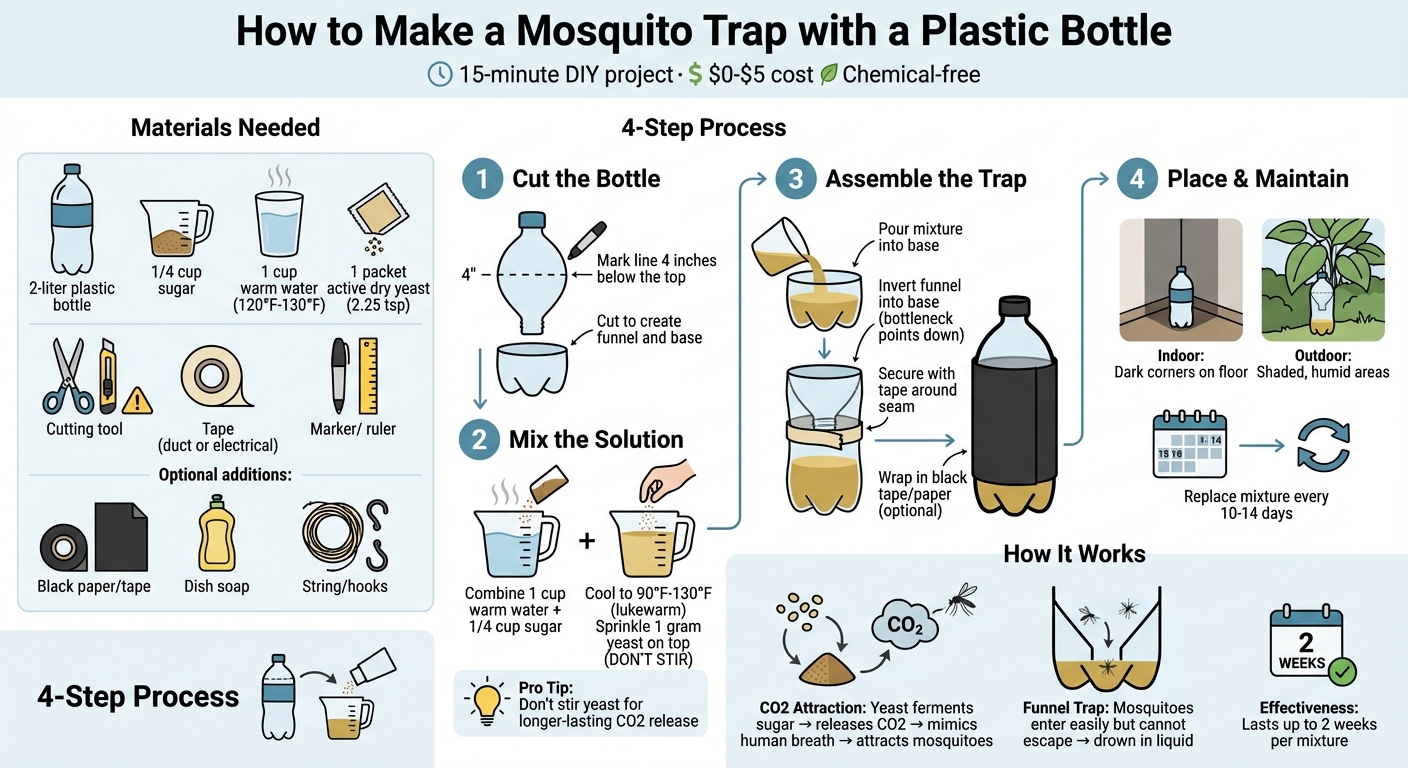
DIY Mosquito Trap Assembly Guide: 4-Step Process with Materials
How to Make a Plastic Bottle Mosquito Trap
sbb-itb-0bbb908
Materials and Tools You'll Need
Now that you know the mechanics of the trap, it’s time to gather everything you’ll need to get started. Pay special attention to the type of bottle you use - a 2-liter plastic soda bottle with a curved grip near the top works best. That natural indentation helps the inverted funnel stay in place securely.
Required Items
Here’s what you’ll need:
- Sugar: 1/4 cup (brown or white). Brown sugar might work slightly better due to its impurities, which can make the mixture more appealing.
- Warm water: 1 cup, heated to 120°F–130°F to activate the yeast.
- Active dry yeast: One packet (2.25 teaspoons).
- Cutting tools: A box cutter or scissors to ensure a clean cut.
- Tape: Duct tape or electrical tape for sealing the bottle halves and keeping CO₂ from escaping through gaps.
- Marker and ruler: To mark a straight line about 4 inches below the bottle's lid for accurate cutting.
- Pot and stove: To heat the water to the right temperature.
- Measuring tools: Measuring cups and spoons for precision.
Once you have these items on hand, you’ll be ready to start assembling the trap, or you can simplify your pest control with a Monthly Pest Remedy Kit.
Optional Items
For better results, consider these extras:
- Black covering: Wrap the trap in black construction paper, tape, or cloth to block UV rays. Mosquitoes prefer darker environments, and this step may also help the yeast mixture last longer.
- String or hooks: If you want to hang the trap in trees or under eaves, these will make placement easier.
- Dish soap: Adding a tablespoon to the mixture can improve effectiveness by breaking the water's surface tension, ensuring mosquitoes drown on contact.
These optional additions can make your trap more effective and durable, especially if you’re using it outdoors.
Step 1: Prepare the Plastic Bottle
Cut the Bottle
Start by marking a line around the bottle, about 4 inches down from the lid. If the bottle has a grip section where it narrows, you can measure just above that point. Use a permanent marker to draw a straight line to guide your cut.
To begin, use a utility or X-Acto knife to make a small puncture in the plastic. Then, switch to rounded scissors to finish the cut - this gives you better control compared to using a knife alone. For thicker bottles, a box cutter with gentle sawing motions works well.
"Use extreme caution cutting the plastic bottle... use a utility knife to create a starter cut for participants, which can then be more easily cut with rounded scissors." - Build a Mosquito Trap Activity Guide, GLOBE Observer
Once cut, you’ll have two pieces: the top section acts as a funnel, and the bottom serves as the base for holding the mosquito attractant mixture. To make the edges safer and neater, trim off about 1–2 mm to remove any splinters.
Safety Tips
Keep these safety measures in mind when handling the cut bottle:
- The edges can be sharp, so always work on a thick cutting board (at least 1 inch thick) to protect your surface and prevent the blade from slipping.
- Keep your non-cutting hand at least 2 inches away from the blade to avoid accidental injuries.
- Handle the cut pieces by their centers to steer clear of sharp edges. If you're working with kids or a group, it’s a good idea to complete the cutting step beforehand to ensure everyone’s safety. This DIY approach is a favorite among our happy customers who prefer chemical-free solutions.
Step 2: Make the Mosquito Attractant Mixture
With your bottle ready, it's time to create the attractant that makes your trap effective.
Mix the Solution
Start by boiling 1 cup of water for 10 minutes. This step removes chlorine from tap water, which can interfere with the yeast's ability to activate. Once boiled, add 1/4 cup of sugar to the hot water and stir until it dissolves completely. Brown sugar is often recommended because it may enhance the trap's appeal.
Allow the mixture to cool until it’s lukewarm, ideally between 90°F and 130°F. To check, dip your finger in - it should feel comfortably warm but not hot.
"Adding the yeast while the mixture is still too hot will kill the bacteria off. Adding when the mixture gets too cold will not activate the yeast." - Cayce Exterminating Company
Once the mixture has cooled, sprinkle 1 gram (about 1/3 teaspoon) of active dry yeast on top. Avoid stirring the yeast - letting it sit undisturbed ensures a slow and steady release of CO2.
"Don't mix yeast! If you do so, the reaction that attracts mosquitoes will NOT last longer." - Filippo (Darthorso), Web Designer and Maker
This fermentation process is the secret behind the trap's effectiveness.
Why This Mixture Works
Fermentation is what powers the trap. As the yeast consumes the sugar, it produces carbon dioxide (CO2) - the same gas humans exhale. Mosquitoes rely on CO2 to detect and locate warm-blooded hosts from afar. Essentially, this trap mimics the signals of a living, breathing animal, making it highly attractive to mosquitoes.
Studies have shown that yeast-generated CO2 traps capture significantly more Anopheles gambiae mosquitoes than traps using industrial CO2. The effectiveness of the mixture can last up to 34 hours after preparation. Even with just a small amount of yeast, the trap remains active for up to two weeks before you need to replace the mixture.
Step 3: Assemble the Mosquito Trap
Now that your attractant mixture is ready, it’s time to assemble the trap. Proper assembly is key to ensuring the trap mimics human exhalation, which is what draws mosquitoes in.
Create the Funnel Structure
Start by pouring the attractant mixture into the bottom half of your bottle. Then, take the top half of the bottle, invert it, and insert it into the base so that the bottleneck points toward the liquid. Make sure the cut edges align securely. The funnel opening should sit above the liquid - if it dips into the mixture, mosquitoes might avoid entering, and the CO₂ circulation could be disrupted.
Secure the funnel in place by wrapping tape around the seam. This not only ensures a tight seal to prevent CO₂ from escaping but also keeps the funnel from shifting.
"The tape will also hold the funnel in place, preventing it from coming off or going farther into the body of the bottle."
– David Day, Cayce Exterminating Company
Black electrical tape works best because it’s flexible and wraps easily around curved surfaces. It also blocks light, which makes the trap more effective. If you don’t have black tape, you can use black construction paper to cover the trap. This will help attract mosquitoes and protect the yeast from UV rays.
Check the Trap
Once the funnel is in place, double-check the seal and overall stability of the trap. Look closely at the taped seam to ensure there are no gaps where CO₂ might escape. The bottleneck should be the only entry and exit point for mosquitoes.
"Close the border with some tape to fix it up and make the cap hole the only way in-out for mosquitoes."
– Filippo (Darthorso), Web Designer and Maker
Place the trap on a flat surface to test its stability. The funnel should stay securely in place and not shift if the trap is moved slightly. Once you’ve confirmed everything is stable and properly sealed, your mosquito trap is ready to be put to use.
Step 4: Place and Maintain the Trap
With your trap set up and the attractant ready, the next step is all about positioning it correctly and keeping it in good working order to ensure it continues catching mosquitoes.
Where to Place the Trap
Indoors, the ideal spot is on the floor in a dark, quiet corner of a room. Mosquitoes are naturally drawn to such areas since they prefer spaces that are dark and undisturbed.
"The critical part... is to deploy the device on the floor in a corner of a room. This is because mosquitoes love to hang out in corners - they are dark and relatively free of desiccating drafts."
– Colin Purrington, Biologist
Outdoors, look for shaded, cool, and humid spots [5, 9]. Areas near bird baths, potted plants, or the shaded corners of your yard are great choices since these are common mosquito hangouts. The yeast mixture in the trap mimics human breath, so placing it in areas where mosquitoes naturally gather enhances its effectiveness. Avoid direct sunlight, as it can reduce the yeast’s ability to produce CO₂. If shade isn’t available, wrapping the trap in black tape or paper can help protect it from sunlight while making it more attractive to mosquitoes.
Trap Maintenance
Once your trap is in place, regular upkeep is essential to keep it working effectively. Plan to replace the attractant every 10–14 days, or sooner if the trap becomes full of dead insects [1, 4]. To stay on top of this, mark the date on your calendar when you first set up the trap.
When it’s time to refresh the mixture, disassemble the trap and rinse all parts with water. After cleaning, prepare a new batch of attractant and reassemble the trap. If the trap fills up with mosquitoes before the two-week mark, empty it and refill it sooner. A full trap won’t attract new mosquitoes, so consistent maintenance ensures the CO₂ production stays steady and effective.
How the Mosquito Trap Works
This mosquito trap relies on basic chemistry to attract and capture mosquitoes. Once assembled, understanding the science behind it can help you use it more effectively.
The Role of CO2
The trap generates CO₂ as its primary lure. When yeast ferments sugar, it releases a continuous stream of CO₂ that rises from the bottle. Female mosquitoes, the ones responsible for biting, are highly attuned to CO₂. They rely on it as a long-range signal to find a blood source, which they need to produce eggs. While heat and scent guide them to their exact target up close, CO₂ is what initially draws them in.
"Mosquitoes, particularly the biting females, are incredibly adept at detecting CO₂, which is a key component of human breath. They use this natural signal to locate their next blood meal." – Termitehow.blog
A typical 10-gram dose of brewer's yeast can keep producing CO₂ for up to two weeks. With the mosquitoes lured in, the trap’s design ensures they can’t escape.
The Funnel Mechanism
The trap uses an inverted funnel to capture mosquitoes once they follow the CO₂ trail. This design creates a one-way entry: mosquitoes can easily fly in through the wide opening, but the narrow exit makes escaping much harder. The hole is placed at the center of the trap, away from the edges where mosquitoes tend to linger.
"The percentage of mosquitoes that fly out again from the trap is ridiculously low." – Filippo (Darthorso), Web Designer and Maker
Trapped mosquitoes, unable to find their way out, eventually fall into the liquid at the bottom and drown.
Conclusion
By reusing everyday household items, this mosquito trap is not only budget-friendly - costing nearly $0 - but also quick to assemble, requiring just 15 minutes of your time. The trap works by releasing CO₂ to attract biting female mosquitoes, while its funnel design ensures they can’t escape.
"Replace the bait mixture every 10–14 days to maintain effectiveness." – Ian Chi, President and CEO, Simple Pest Management
To get the best results, place the trap in dark, humid spots, and refresh the bait mixture every 10–14 days. Pairing this trap with the regular removal of standing water can significantly lower mosquito populations. With consistent maintenance, this simple solution can help keep mosquitoes at bay.
Although this DIY trap is a great way to manage mosquitoes - especially indoors - persistent pest issues may call for extra help. Remedy offers customized pest control kits featuring professional-grade, pet- and child-safe products, along with virtual support to ensure your home stays pest-free.
FAQs
Why isn’t my trap producing bubbles or catching mosquitoes?
If your mosquito trap isn’t bubbling or catching mosquitoes, there might be an issue with the mixture or its placement. Double-check that the sugar and yeast mixture is properly prepared and actively producing carbon dioxide. Also, make sure the trap is positioned in areas where mosquitoes are likely to gather, such as dark corners or near standing water. The right setup and location are crucial for the trap to function as intended.
Can I use different yeast, sugar, or water temperature and still get CO2?
Yes, you can. Fermentation and the production of CO2 depend on yeast activity, which can still function even if you change the type of yeast, sugar, or water temperature. However, these changes might influence how quickly CO2 is produced. To get the best results, use warm water - not hot - to help activate the yeast properly.
How many bottle traps do I need, and how far apart should I place them?
For a small outdoor area, a single bottle trap can do the job if positioned wisely. However, for larger spaces, it's better to set up multiple traps, keeping them spaced about 10 to 15 feet apart. This helps ensure better coverage and improves their overall effectiveness.