


Flies are more than a nuisance on horse farms - they spread diseases like EIA and Pigeon Fever, irritate your horses, and create stress that can lead to health issues. While chemical pesticides are commonly used, they often harm horses and the environment. Natural fly control is a safer, healthier alternative, often managed with a DIY pest control kit. Here’s how you can manage flies effectively:
- Manure Management: Clean stalls daily, compost manure properly, and spread it thinly to prevent breeding.
- Water Control: Remove standing water, fix leaks, and clean troughs regularly to eliminate breeding grounds.
- Biological Methods: Use parasitic wasps to target fly pupae and reduce populations by up to 95%.
- Physical Barriers: Equip horses with fly masks, sheets, and traps to protect them directly.
- Natural Repellents: Apply herbal sprays with essential oils like citronella and peppermint for chemical-free protection.
- Environmental Adjustments: Install fans for airflow, plant fly-repelling herbs like basil and lavender, and improve drainage to reduce moisture.
THE BEST Natural Fly Control For Horses! #spaldinglabs #flypredators #clydesdale #horse #safe
sbb-itb-0bbb908
Types of Flies on Horse Farms
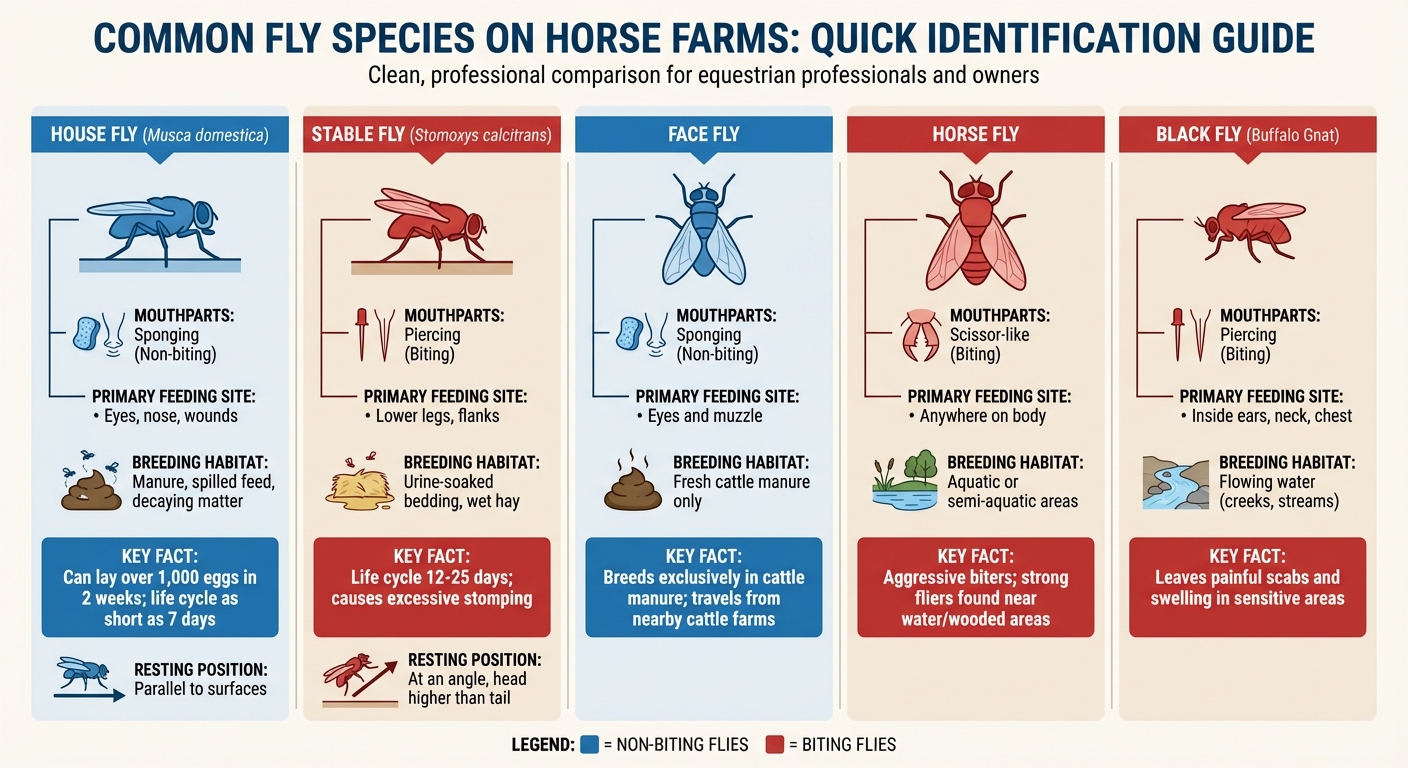
Common Horse Farm Fly Species: Identification and Breeding Habitats Guide
Common Fly Species and Their Effects
Knowing the different fly species on a horse farm helps you tackle them more effectively. House flies (Musca domestica) are the most prevalent non-biting flies. They use sponging mouthparts to feed on secretions around a horse’s eyes, nostrils, and wounds. A single female can lay over 1,000 eggs in just two weeks, and under ideal summer conditions, their life cycle can wrap up in as little as seven days.
Stable flies (Stomoxys calcitrans), on the other hand, are biting pests that go after a horse’s lower legs and flanks. Their piercing mouthparts draw blood, causing horses to stomp excessively, which can lead to hoof damage or leg injuries. A quick way to tell them apart from house flies is their resting position: house flies rest parallel to surfaces, while stable flies rest at an angle with their heads higher than their tails. Dr. Jonathan Larson, an Extension Entomologist at the University of Kentucky, highlights this distinction:
"House flies can carry pathogens; they crawl around in yucky things, pick up pathogens on their body, and can drag those along a horse or on food... Stable flies, on the other hand, are biting pests. They have a really nasty mouth part that can poke through the skin and draw blood".
Face flies are another nuisance, clustering around a horse’s eyes and muzzle to feed on mucus and tears. They breed exclusively in fresh cattle manure, so if you notice them on a horse-only farm, they’re likely traveling from nearby cattle operations. Horse and deer flies are larger, aggressive biters with scissor-like mouthparts that cut through skin to lap up blood. These strong fliers are often found near water or wooded areas. Lastly, black flies (also known as buffalo gnats) target sensitive areas like the inside of ears, leaving painful scabs and swelling that can drive horses to distraction.
| Fly Species | Mouthparts | Primary Feeding Site | Breeding Habitat |
|---|---|---|---|
| House Fly | Sponging (Non-biting) | Eyes, nose, wounds | Manure, spilled feed, decaying matter |
| Stable Fly | Piercing (Biting) | Lower legs, flanks | Urine-soaked bedding, wet hay |
| Face Fly | Sponging (Non-biting) | Eyes and muzzle | Fresh cattle manure only |
| Horse Fly | Scissor-like (Biting) | Anywhere on body | Aquatic or semi-aquatic areas |
| Black Fly | Piercing (Biting) | Inside ears, neck, chest | Flowing water (creeks, streams) |
What Attracts Flies to Horse Farms
Horse farms are a magnet for flies due to the perfect mix of moisture, warmth, and breeding materials. Manure is the main draw - especially when it’s not composted properly or spread thin. A single rotting round hay bale can host up to one million stable flies in a season. Moisture is equally important, as fly larvae thrive in environments with 40% to 80% moisture and temperatures between 70°F and 95°F. Leaky waterers, standing water in old tires or gutters, and muck holes provide ideal conditions for their development.
Spilled feed and decaying vegetation are also major attractants. Grain left on the ground, decomposing round bales, and grass clippings serve as both food and breeding grounds. Even small accumulations of organic matter - like damp stall corners or areas around waterers - are enough to support fly populations. Pinpointing these attractants is key to focusing your control efforts and lays the groundwork for natural prevention methods, which will be discussed in the next section.
Prevention Strategies: Keeping Flies Away Naturally
Manure and Waste Management
The cornerstone of natural fly control is proper manure management. Flies reproduce quickly - house flies can mature in just 7 days, and stable flies in 12 to 25 days. Lee Townsend, an Extension Entomologist at the University of Kentucky, emphasizes:
"A successful fly control program must rely on timely elimination of breeding sites and moisture control."
To disrupt the fly life cycle, clean stalls and paddocks daily. Spread manure thinly - less than 1 inch deep - across pastures to allow the sun to dry it out and kill developing larvae. Stick to the guideline of one horse's manure per five acres to avoid over-saturating the land. If your farm lacks sufficient space, composting is essential. A properly managed compost pile generates enough heat to kill fly eggs and larvae, while smaller, cooler piles can become breeding grounds.
When choosing bedding, opt for wood shavings or sawdust, as straw tends to absorb urine and creates the moist environment flies love. Don’t forget to clean under rubber mats in stalls and trailers regularly, as these areas trap damp organic material. Store grain and supplements in sealed, rodent-proof containers, sweep up spilled feed daily, and promptly remove decaying round bales. With manure and waste under control, the next step is managing water sources to further reduce fly breeding grounds.
Maintaining Clean Water Sources
Water management plays a key role in fly prevention. Stagnant water can breed mosquitoes in just 5–7 days, even in small amounts. To combat this, scrub water buckets weekly and clean large troughs every 3 to 4 days to eliminate algae and debris.
Repair any leaky faucets or waterers right away, as these leaks create "muck" - a mixture of water, manure, and feed - that provides a perfect environment for flies. Place waterers in well-drained areas, away from feeding sites, to prevent spilled water from mixing with waste. Remove or overturn unused buckets, barrels, and old tires that can collect rainwater. For items that can’t be removed, drill drainage holes to prevent water buildup. Effective water management, combined with thorough sanitation, makes it harder for flies to thrive.
Sanitation Practices for Stables and Pastures
Sanitation is the backbone of any fly control plan, as highlighted by UMass Amherst. Use elevated feeders for hay and grain instead of feeding directly on the ground. This prevents feed from mixing with manure and moisture, which can attract flies.
In pastures, keep grass trimmed short around barns to reduce resting spots for adult flies and to help the ground dry faster. Interestingly, only about 5% of stable flies are actually found on horses - the majority rest on nearby structures like fences and walls. Keeping these surfaces clean and dry significantly reduces fly habitats. Additionally, dispose of all trash in sealed, rodent-proof containers with tight-fitting lids.
Natural Fly Control Methods
Biological Controls: Fly Predators and Parasitic Wasps
Parasitoid wasps, often sold as Fly Predators® or Fly Eliminators, are a natural way to manage fly populations. These wasps target fly pupae by laying their eggs inside. When the larvae hatch, they consume the developing fly, effectively stopping it from maturing into an adult. Two common genera, Muscidifurax and Spalangia, are particularly effective, though their success can vary depending on the climate. Keep in mind, these wasps only address future fly populations by attacking pupae - they won’t reduce the number of adult flies already present.
To complement these biological efforts, physical barriers can provide immediate relief from flies.
Physical Barriers: Fly Masks, Sheets, and Traps
Physical barriers offer instant protection for horses. Fly masks, lightweight fly sheets, and leg wraps shield horses from flies during turnout. Additionally, sticky traps and baited perimeter traps help draw flies away from the animals. It’s essential to inspect all protective gear daily for cleanliness and damage.
Allison Bailey, an ANR Agent with the University of Georgia Extension, emphasizes the importance of these tools:
"Physical barriers offer another layer of pest control... Fly masks, sheets, and leg wraps provide horses with direct protection during turnout but should be checked regularly for damage."
In a Cornell University study spanning three years, the Epps Biting Fly Trap was shown to eliminate an average of 1 pound of biting flies daily. Regularly cleaning masks is also crucial to avoid eye irritation.
Natural Repellents: Herbal Sprays and Essential Oils
Natural repellents, such as herbal sprays, add another layer of defense against flies. Essential oils like citronella, peppermint, lavender, eucalyptus, tea tree, and catnip are safe and effective in repelling flies. Research highlights that a blend of catnip oil, paraffin wax, and soy can deter bloodsucking flies by up to 99%. Neem oil, known for its azadirachtin content, disrupts insect growth, while apple cider vinegar is believed to make a horse’s blood less appealing to biting flies.
A 2024 University of Minnesota study demonstrated the effectiveness of a homemade citronella spray (12 oz distilled white vinegar, 4 oz Avon Skin-So-Soft, 1 oz citronella oil, and 12 oz water). This spray reduced tail swishes from 46 to 36 per minute and shoulder twitches from 33 to 23 per minute over six weeks.
For best results, apply natural sprays 3 to 4 times daily, especially after rain or heavy sweating, as their effectiveness diminishes faster than synthetic alternatives. When applying near sensitive areas like the eyes and nostrils, use a cloth for precision, and always test a small area first to ensure your horse doesn’t react negatively to the oils.
Environmental Changes for Long-Term Fly Control
Adjusting your farm's environment can make it difficult for flies to thrive and reproduce. When paired with biological and physical control methods, these changes tackle infestations at their source. By addressing the root causes, these environmental strategies add an extra layer of defense against flies.
Using Fans and Ventilation to Reduce Flies
Flies are weak fliers, so even a small amount of airflow can keep them at bay. Installing fans in your barn creates an environment where flies struggle to function. Lee Townsend, Extension Entomologist at the University of Kentucky College of Agriculture, highlights this approach:
"Placing fans that direct a downward and outward airflow at the entrance of enclosed barns can also keep flies from entering the building."
For the best results, use agricultural-grade barn fans, as household box fans may not hold up to the demands of a barn environment. Position these fans at barn entrances, and add ceiling and exhaust fans to maintain a steady air barrier that deters flies. Proper ventilation is also critical since horses release between 1 and 1.5 gallons of water into the air daily, creating moisture that attracts insects.
Moisture Control and Drainage
Flies and mosquitoes depend on moisture to breed, so eliminating stagnant water is a key step in long-term pest control. Mosquito larvae need about 10 days in standing water to hatch, while flies can develop from egg to adult in just 7 days during summer conditions.
To manage moisture, regularly replace water in troughs and remove standing water from containers. Install gutters and downspouts on buildings to prevent water from pooling near foundations. Fill in deep ruts in paddocks where water collects, and fix leaky waterers and hoses to avoid creating muddy areas where maggots thrive. If manure cannot be removed immediately, cover the piles with heavy, dark plastic to trap heat and kill fly larvae.
Planting Fly-Repellent Vegetation
Landscaping can also play a role in keeping flies away. Certain herbs and flowers act as natural repellents due to their strong aromas. Basil, lavender, catnip, and rosemary are particularly effective. For example, catnip contains nepetalactone, which deters mosquitoes, while lemon balm has citronellal, a common ingredient in natural repellents.
Plant basil, catnip, or lavender near barn doors and windows to discourage flies from entering. Place rosemary or rue around water troughs to repel moisture-loving insects. Marigolds can be grown near manure storage areas to help mask odors and deter pests. To manage invasive plants like mint and catnip, grow them in pots and occasionally crush the leaves to release their oils. Finally, maintain mowed buffer zones around pastures to shift breeding areas further away.
Using Remedy Kits for Horse-Safe Fly Control
Natural fly management often starts with environmental changes and biological controls, but our customized pest control kits are here to take it a step further. These kits combine professional-grade tools with your existing methods to create a safe and effective defense against flies. Below, we’ll break down what’s inside the kit and how to use it.
What's Included in Remedy Kits for Fly Control
Our kits rely on a three-part strategy to tackle flies at different stages of their life cycle - all without using harsh chemicals. The centerpiece? Parasitic wasps from the Pteromalidae family. These tiny, gnat-like insects are harmless to humans, horses, and pets - they don’t sting or bother animals. What they do is target fly pupae found in manure and damp organic material, stopping flies before they even hatch. Research shows that regular use of these wasps can cut stable fly populations by 75–95%.
Also included are botanical fly sprays made with essential oils like geraniol, citronella, peppermint, and lemongrass. These sprays disrupt flies’ sensory receptors without leaving toxic residues behind. They’re biodegradable, so there’s no risk of contaminating water or harming pollinators. Unlike synthetic pesticides, which can kill helpful insects and irritate horses’ respiratory systems, these sprays use food-grade ingredients that are safe for children, pets, and livestock.
How to Apply Remedy Kits on Horse Farms
To get ahead of fly season, start releasing the parasitic wasps in early spring as soon as the ground thaws. Focus on the key fly breeding areas on your farm, such as manure piles and damp spots. Paired with regular manure cleanup, this can reduce fly populations by about 50%.
For the botanical sprays, apply them to barn surfaces, doorways, and other fly-prone areas. Avoid spraying directly on horses unless you’ve tested for sensitivity first. Reapply the sprays after rain or heavy cleaning for best results. These sprays work well alongside physical barriers and ventilation systems, as flies struggle in moving air. Together, they create a stronger line of defense.
Regular Shipments and Support
To ensure uninterrupted protection, we ship fresh batches of fly predators every 3–4 weeks during fly season, which typically runs from late spring to early fall. This schedule helps maintain consistent control, eliminating the gaps that often happen with manual chemical treatments. Shipments are tailored to your local climate and fly activity, so you’re always covered during peak breeding times.
Need help fine-tuning your fly control strategy? Our virtual support team is ready to assist. They can help identify pests, adjust predator release schedules, or recommend changes to your application sites. If fly numbers spike, they’ll guide you in adapting your plan, ensuring your farm stays protected all season long.
Year-Round Maintenance Plan for Fly Prevention
Keeping flies at bay requires a year-round approach that adjusts with the seasons. A good plan blends prevention, treatment, and environmental management, ensuring your efforts align with changing weather and fly activity levels.
Seasonal Adjustments for Fly Control
Spring: Get a head start before flies become active. Once temperatures hit 45°F for three consecutive days, begin feed-through control and introduce biological measures to curb fly populations early. These steps work well with natural control methods and remedy kits.
Summer: Fly populations often peak during July and August, so this is the time to step up your efforts. Increase manure removal frequency, use physical barriers like fly masks and sheets, and clean water troughs every 3–4 days to disrupt breeding cycles. Keep an eye on shaded areas under your horse’s belly, as stable flies often shift their feeding spots during the hottest months.
Fall: As temperatures drop, face flies tend to seek shelter in barns. After the first hard freeze, deworm your horses to target any remaining larvae. Also, seal barn gaps to prevent flies from overwintering indoors.
Winter: This is the time to review your previous methods and manage manure piles effectively. Properly managed piles can generate enough heat to kill diapausing pupae, reducing fly populations for the next season.
Regular Monitoring and Adjustments
Consistent monitoring plays a key role in staying ahead of fly problems. Simple tools like white index cards placed on rafters or eaves can help track fly activity. If you notice more than 100 spots on the cards or your jug traps catch over 250 flies weekly, it’s time to ramp up control measures.
Behavioral signs in your animals - like excessive tail swishing, skin twitching, head tossing, or hoof stomping - can also indicate that your current repellents aren’t cutting it. When you see these signs, increase the frequency of applications or add extra controls to your routine.
To make things easier, consider using a subscription service for fly control supplies. These services provide reminders for reapplication and offer virtual support to help you fine-tune your strategy. With kits starting at under $30 (including free shipping and options to skip or pause shipments), you’ll always have what you need without the hefty costs of professional services.
Conclusion
Keeping flies under control on your horse farm doesn’t have to mean relying on harsh chemicals or endless spraying. By combining smart practices like proper manure management with natural solutions such as parasitic wasps, you can tackle flies at every stage of their life cycle. For example, regular use of parasitic wasps has been shown to drastically reduce stable fly populations, while botanical repellents with citronella can cut horsefly landings by over 90%.
The advantages go far beyond just fewer flies buzzing around. Natural methods eliminate exposure to synthetic pesticides that can irritate skin, strain respiratory systems, and even affect the nervous systems of both horses and humans. Plus, these approaches help protect beneficial insects that play a huge role in managing pests naturally - contributing billions annually to pest control. Choosing natural options also helps prevent water contamination and soil damage, making it a win for the environment and your horses’ overall well-being.
Fewer flies mean less stress for your horses. It reduces behaviors like constant stomping and head shaking, which can lead to injuries, and even lowers stress indicators like blood cortisol levels, heart rates, and rectal temperatures. On top of that, you decrease the risk of diseases, including those tied to Equine Infectious Anemia and summer sores.
To make natural fly control simple and effective, we’ve developed our Remedy kits. These kits include professional-grade, horse-safe products delivered every 3–4 weeks, along with virtual support to guide you through the fly season. By combining these tools with natural strategies, you get a reliable, sustainable solution designed specifically for horse farms.
This approach ensures a healthier, more comfortable environment for your horses - without the need for constant chemical use.
FAQs
When should I start releasing parasitic wasps each year?
Releasing parasitic wasps at the beginning of fly season - typically in spring - can help manage fly populations effectively. The best timing can vary based on your location, but starting early gives these natural predators a head start in controlling flies throughout the season.
Where should I place fly traps for the best results?
To tackle fly problems effectively, position fly traps in areas where flies tend to congregate the most. These spots often include barn walls, ceilings, and areas near manure piles. Other prime locations are stalls, entryways, and shaded or sheltered zones since flies are naturally attracted to such environments. For the best results, make sure traps are placed correctly and are maintained regularly. This approach helps keep fly populations in check and disrupts their breeding cycles.
How can I tell which fly species is causing my horse’s stomping?
Pay close attention to your horse’s behavior and surroundings to figure out which type of flies are causing trouble. For instance, house flies typically breed in manure piles and decaying organic material, while stable flies are known for biting areas like the legs and belly. On the other hand, filth flies and biting midges are often linked to stagnant water or areas with overgrown grass. Observing details like the flies’ size, activity patterns, and behavior will help you choose the right methods to manage them effectively.