


Humidity directly affects pest activity, making your home more vulnerable to infestations. Moisture-dependent pests like cockroaches, silverfish, booklice, and termites thrive in damp environments, especially when indoor humidity exceeds 60%. High humidity not only helps pests survive but also accelerates their reproduction and nesting. Additionally, damp conditions encourage mold and fungi growth, which serve as food sources for many pests.
To prevent pest problems using a DIY pest control kit:
- Maintain indoor humidity levels between 30% and 50% using dehumidifiers and proper ventilation.
- Fix leaks and seal gaps to eliminate hidden moisture sources.
- Monitor humidity with a hygrometer, and adjust for seasonal changes.
- Clean up standing water and areas prone to dampness, like basements and crawl spaces.
Booklice Are a Moisture Warning: Simple Fixes That Actually Work
sbb-itb-0bbb908
How Humidity Affects Pest Behavior
Pests rely on moisture to survive. Because insects are ectothermic, they can't regulate their body temperature or water levels internally. They constantly lose water through respiration - breathing via small pores called spiracles - and through their outer shells. This is why they actively seek out humid environments to avoid dehydration, which can be fatal.
This need for moisture shapes their behavior. Pests follow "moisture gradients", a term experts use to describe how they sense and move toward humid areas. These areas often include bathrooms, kitchens, basements, and spaces near plumbing or wall voids.
High Humidity and Pest Reproduction
Humidity doesn’t just help pests survive - it also fuels their reproduction. Many pest eggs require specific moisture levels to develop properly. High humidity allows larvae and nymphs to grow faster, reducing the time needed to reach reproductive maturity. This means pests can produce more generations in a year, leading to rapid population increases.
Humidity is also critical for molting. During this process, pests shed their exoskeletons to grow. Moisture softens the cuticle, making molting easier. In dry conditions, molting failures are common, often killing juvenile pests before they can reproduce.
| Pest Species | Humidity Requirement | Impact on Reproduction |
|---|---|---|
| Silverfish | >75% Relative Humidity | Eggs fail to hatch entirely below 75% |
| German Cockroaches | 70%–80% (Optimal) | Achieve fastest reproduction rates |
| Booklice | 60%–80% | Thrive in mold-rich environments |
| Mosquitoes | High Humidity + Standing Water | Larvae develop in stagnant water |
Beyond speeding up reproduction, humidity also impacts how pests move and where they establish their nests.
How Humidity Affects Pest Movement and Nesting
Humidity influences more than just pest lifecycles - it also affects their movement and nesting strategies. Moisture softens materials like wood, cardboard, and insulation, making it easier for pests like termites, carpenter ants, and rodents to penetrate. This is why damp, decaying wood is far more attractive to wood-destroying pests than dry wood.
There’s also a ripple effect. According to Cornell University, moisture often leads to wood rot and fungus growth, which attract primary pests like ants and silverfish. These pests, in turn, draw predators such as spiders and centipedes. Damp conditions also cause organic materials to break down and clump together, creating nesting material that pests can easily use. Meanwhile, mold and mildew, which flourish in humid environments, provide food for pests like booklice, silverfish, and mold mites. This creates a self-sustaining ecosystem where multiple pest species can thrive simultaneously.
Pests That Thrive in High-Humidity Conditions
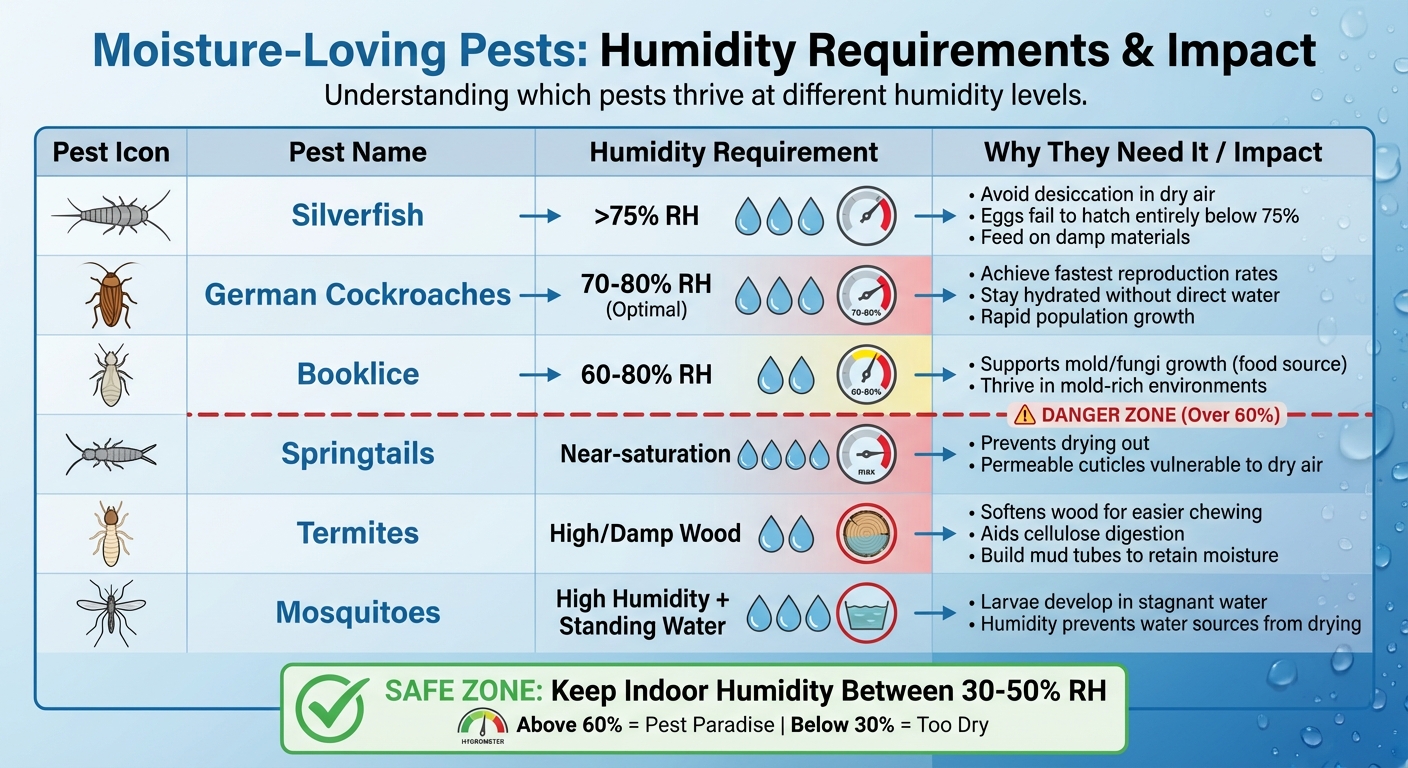
Humidity Requirements and Impact on Common Household Pests
Humidity plays a big role in shaping pest behavior by providing the moist environments many pests depend on to survive. When indoor humidity exceeds 60%, it creates the perfect setting for moisture-loving pests to thrive. Let's take a closer look at some of the most common pests that flourish in these damp conditions.
Moisture-Loving Pests: A Closer Look
Termites are one of the most notorious pests linked to humid conditions. They are drawn to damp wood because it softens the material, making it easier to chew. Subterranean termites, in particular, build mud tubes to retain moisture while traveling between their nests and food sources. The damage caused by termites is staggering, costing billions of dollars annually, especially in high-moisture environments where wood decays faster.
Cockroaches are experts at taking advantage of humid environments. They can stay hydrated without direct water sources, which allows them to thrive in places like leaky kitchens, poorly ventilated bathrooms, and other damp areas. Once they establish themselves, their populations can grow rapidly, becoming a serious issue that may require a Monthly Pest Remedy Kit to manage effectively.
Mosquitoes rely on standing water to breed, and high humidity helps prevent these water sources from drying out. While they're primarily outdoor pests, humid indoor spaces near entry points can attract them, especially when water pools or accumulates.
Silverfish are nocturnal pests that need at least 75% relative humidity to survive. They feed on damp materials like paper, fabric, and adhesives, often leaving behind yellow stains and small holes in wallpaper, bookbindings, or stored clothing.
Carpenter ants are another pest drawn to moisture. They target damp or rotting wood, which is easier for them to excavate and use for nesting. Other ant species are commonly found near areas with leaky plumbing.
Rodents are surprisingly affected by humidity as well. Moisture softens building materials like insulation and wood, making it easier for mice and rats to gnaw through and gain access. Basements and crawl spaces with high humidity are often prime spots for infestations.
Other pests that thrive in humid environments include booklice, which need 60%–80% relative humidity to support the mold they eat, and springtails, which require near-saturation conditions to avoid drying out. Additionally, centipedes and millipedes rely on high humidity because their permeable cuticles make them vulnerable to drying out in drier air. If you spot springtails or silverfish near plumbing fixtures, it could indicate a hidden leak within walls or floors.
Here’s a quick overview of the humidity needs for some common moisture-dependent pests:
| Pest Type | Humidity Requirement | Why They Need It |
|---|---|---|
| Silverfish | >75% RH | Avoid desiccation in dry air |
| Booklice | 60%–80% RH | Supports mold/fungi growth (their food source) |
| Cockroaches | 70%–80% RH | Helps with hydration and reproduction |
| Springtails | Near-saturation | Prevents drying out due to permeable cuticles |
| Termites | High/Damp Wood | Softens wood and aids cellulose digestion |
How to Control Humidity and Prevent Pests
Managing indoor humidity doesn’t have to be complicated, and most methods can be done without professional help.
Methods to Lower Indoor Humidity
To maintain a comfortable and pest-free home, aim for indoor humidity levels between 30% and 50%. Pamela Turner, a Professor and Extension Housing Specialist at the University of Georgia, emphasizes:
"Keep the indoor humidity below 60% relative humidity, ideally between 30% and 50%."
Here’s how to keep humidity in check:
- Use a dehumidifier: These devices are essential in areas where humidity regularly exceeds 60%. Refrigerant models work by condensing moisture, while desiccant models use absorbent materials to draw water out of the air. Make sure to empty the reservoir frequently to avoid attracting pests like drain flies.
- Ventilate properly: Exhaust fans are a must in rooms prone to moisture, like bathrooms and kitchens. Run them during use and for 20 minutes afterward to clear out steam. Also, set your AC fan to "auto" to prevent it from adding to indoor humidity. As Allison A. Bailes III, PhD, points out:
"The AC fan set to 'On' causes indoor relative humidity to increase."
- Fix leaks quickly: Even small leaks can create damp areas that pests love. Insulate cold-water pipes with foam sleeves to stop condensation. Misha Kollontai of Consumer Reports advises:
"If you are seeing condensation anywhere unexpected, that's a sure sign that your humidity is too high."
- Seal air leaks: Cracks around windows, doors, and utility openings allow humid air to sneak in. Use caulk for small gaps and expanding foam for larger ones. The incense test can help you find leaks - hold a lit stick near windows and doors; if the smoke shifts, you’ve found a gap.
- Manage crawl spaces and basements: Lay a plastic vapor barrier over dirt floors to stop moisture from rising. If you add ventilation, use 1/4-inch hardware cloth to keep rodents out while maintaining airflow.
- Address outdoor moisture: Clean gutters regularly and ensure downspouts direct water at least 10 feet away from your home. Grade the soil so it slopes away from the foundation, and keep an 18- to 36-inch vegetation-free zone around the house to limit moisture buildup.
Prevention Steps for Pest Control
Pests thrive in damp conditions, so reducing moisture is a powerful way to disrupt their habitat. However, for effective pest control, you also need to eliminate food sources and seal entry points.
- Keep food sealed and clean up spills: Crumbs and open containers attract pests. Store food in airtight containers and avoid leaving dirty dishes overnight.
- Seal cracks and gaps: Close off entry points around the foundation, utility lines, doors, and windows. These small openings not only let in pests but also contribute to higher indoor humidity.
- Clean water-collecting appliances: Regularly empty and clean refrigerator drip pans, dehumidifier buckets, and air conditioner condensate pans. Even small amounts of standing water can become breeding grounds for pests.
If pests persist despite your efforts, consider using pest control kits designed for specific issues. These kits include professional-grade products that are safe for pets and children, along with simple instructions. They allow you to handle the problem without needing outside help.
Finally, watch for signs of pests. The presence of insects like springtails, booklice, or silverfish often indicates hidden moisture problems or leaks that need immediate attention.
Tracking and Maintaining Humidity Levels
Keeping an eye on humidity levels is a simple yet effective way to prevent pest problems caused by unnoticed spikes in moisture.
Using Humidity Monitors and Reading Results
A hygrometer is your go-to tool for measuring indoor humidity. Digital hygrometers tend to be more accurate, with a margin of ±5%, compared to analog models, which have about ±10% accuracy. Plus, they're affordable - a basic digital model usually costs less than $20 at most hardware stores.
For the best results, place the hygrometer in a central spot, away from areas like kitchens or bathrooms where moisture levels can temporarily rise. Aim to keep the relative humidity in your home between 30% and 50%. Anything above 50% can encourage mold growth and attract pests. As Ryan Osterkamp, Owner of Quality Comfort, explains:
"High humidity in your home creates an ideal environment for mold and bacteria to thrive... It can also lead to structural damage, such as warped wood and peeling paint."
The Environmental Protection Agency (EPA) offers similar advice:
"Keep relative humidity between 30% and 50%... Humidity levels above 60% may allow mold to grow."
If you don't have a hygrometer, try the ice cube test. Fill a glass with water and ice, and wait five minutes. If heavy condensation forms on the outside of the glass, your home likely has high humidity. Minimal condensation suggests drier air.
These readings help you make adjustments as needed, which is especially useful when seasonal changes affect indoor humidity.
Adjusting for Seasons and Regular Inspections
Seasonal shifts can significantly impact your home's humidity. For example, heating systems in winter tend to dry out the air, while summer heat often increases indoor moisture levels. Regular monitoring ensures you can respond to these changes effectively, keeping your pest prevention efforts on track. Use the table below as a guide to adjust your indoor humidity based on outdoor temperatures:
| Outdoor Temperature (°F) | Maximum Indoor Humidity |
|---|---|
| +20°F to +40°F | 40% |
| +10°F | 30% |
| 0°F | 25% |
| -10°F | 20% |
| -20°F or lower | 15% |
Make it a habit to check your hygrometer weekly, particularly during spring and summer when pests like cockroaches and ants are more active. Pay special attention to moisture-prone areas such as basements, crawl spaces, and under sinks, even if the rest of your home feels dry.
Keep an eye out for warning signs like condensation on windows, musty smells, peeling paint, or warped wood. These could indicate that high humidity is already creating a favorable environment for pests. If you spot these issues, review your dehumidifier settings, inspect for leaks, and confirm that exhaust fans are venting properly to the outdoors rather than into spaces like the attic.
Digital hygrometers with features that track daily highs and lows can be particularly useful. They can help you identify patterns, such as humidity spikes that coincide with pest activity or hidden moisture sources.
Conclusion
Managing humidity is one of the smartest ways to stop moisture-loving pests before they become a problem. By keeping your indoor relative humidity between 30% and 50%, you create an environment where pests like silverfish, booklice, and springtails struggle to survive. This strategy addresses the core issue rather than relying on temporary fixes, offering a more effective long-term solution.
High humidity is essential for many pests to live, reproduce, and access food. For example, silverfish require humidity levels above 75%, while booklice thrive in conditions between 60% and 80%. By keeping the air drier, you're not just making your home less inviting - you’re actively disrupting their ability to multiply.
Using a hygrometer to monitor humidity levels, alongside practical measures like dehumidifiers, fixing leaks, and improving ventilation, puts you in control of your home's environment. As Blackhill Restoration aptly states:
"A house that breathes is a house that repels pests. Keep it dry, keep it clean, and they'll have no choice but to check out".
Humidity control is a year-round safeguard. Whether it’s winter heating that dries out the air or summer’s moisture that attracts pests, maintaining balanced levels protects both your home and your family. Check humidity weekly - especially during spring and summer when pest activity peaks - and address any moisture issues immediately. This routine not only simplifies ongoing maintenance but also strengthens other pest control efforts.
For those looking for a comprehensive solution, we offer customized kits featuring professional-grade, pet- and child-safe products. These kits include step-by-step instructions and virtual support to help you identify and address specific pest issues in your home. By adopting these strategies, you’re not just reducing pest infestations - you’re also protecting your home and your family’s well-being.
FAQs
What’s the fastest way to tell if high humidity is causing my pest problem?
The fastest way to determine if humidity is behind your pest problem is to inspect damp spots in your home, such as bathrooms, basements, or areas around leaky pipes. Pests like cockroaches, mosquitoes, and termites are notorious for thriving in moist conditions. To get a more precise idea, consider using a hygrometer to measure indoor humidity. If the reading is above 70%, it’s a strong indicator that the environment is favorable for pest activity.
Why do pests show up in bathrooms and basements first?
Bathrooms and basements are often the first places pests show up. Why? These spaces tend to have high humidity, poor ventilation, and moisture from water fixtures or leaks - conditions pests love. Common culprits like cockroaches, silverfish, and drain flies are drawn to the damp environment. Plus, structural issues like cracks or gaps around plumbing make it easy for pests to sneak in. To keep them out, focus on reducing humidity and repairing any leaks.
How low should I set indoor humidity without causing comfort issues?
Maintaining indoor humidity between 30% and 50% is a smart way to keep pests at bay while ensuring your home feels comfortable. If humidity drops below 30%, you might notice issues like dry skin or irritation in your airways. On the upside, lower humidity can discourage pests. Striking the right balance not only helps safeguard your home but also creates a more pleasant space to live in.