


Reading pest control product labels is critical for safe, legal, and effective use. Labels provide essential details like toxicity levels, protective gear requirements, application instructions, and environmental precautions. Misusing these products can harm people, pets, and wildlife, and may even violate federal law. Here's what you need to know:
- Signal Words: Words like "DANGER" or "CAUTION" indicate toxicity levels. Always choose the least toxic option when possible.
- EPA Registration Numbers: Ensure the product is approved for safety and legality by checking for this number.
- Ingredients: Active ingredients target pests, while inert ingredients support the formula. Both can carry risks.
- Safety Warnings: Follow precautions to protect yourself, others, and the environment. Use required protective gear and adhere to re-entry intervals.
- Proper Use: Check the label for specific pests, application rates, and storage/disposal instructions to avoid accidents or contamination.
Understanding these labels isn't just about compliance - it's about protecting your health and ensuring effective pest control. Follow the label closely, and if overwhelmed, consider pre-measured DIY pest control kits for easier application.
How To CORRECTLY Read Pesticide Labels | By Ally Safety
sbb-itb-0bbb908
What's on the Front Label
The front label is your go-to source for understanding how to use pest control products safely, effectively, and legally. It provides key details about the product's purpose, functionality, and regulatory approval.
Brand Name and Product Type
The brand name is often the first thing that grabs your attention. It's the name manufacturers use to market their product, like Roundup or Sevin. But here's the catch: similar brand names can contain completely different active ingredients. On the flip side, products with the same active ingredients might be sold under entirely different names. So, don’t rely solely on the brand name when choosing a product.
Right below the brand name, you'll find the product type, which explains what the product is designed for - whether it's an insecticide for specific insects or a herbicide for controlling weeds and brush. This is crucial because using the wrong product can be both ineffective and illegal. For example, a product labeled exclusively for termites cannot legally be used to treat fleas.
As Penn State Extension puts it, "The label is the manufacturer's main way to give the user information about the product." Always double-check that the product type matches the pest issue you're dealing with, or consider a Quarterly Pest Remedy Kit for professional-grade solutions.
Once you've confirmed the product type, the next step is to look at the EPA Registration and Establishment Numbers.
EPA Registration and Establishment Numbers
In the U.S., every pest control product must have an EPA Registration Number. This number confirms that the Environmental Protection Agency has reviewed the product's scientific data on its health and environmental impacts and approved it for sale. If a product doesn’t have this number, it might be illegal - or worse, unsafe.
The registration number format looks something like this: 264-458. The first part identifies the manufacturer, while the second part specifies the product itself. This number is especially critical in emergencies, as poison control centers or medical personnel will need it if someone is exposed to the product.
You'll also see an EPA Establishment Number on the label. This number pinpoints the manufacturing facility where the product was made. It’s useful for tracing the product’s origin if there are any quality or safety concerns.
Before purchasing, always ensure these numbers are present. As the EPA states, "U.S. laws require EPA to register all pesticides." If you can’t find an EPA number, it’s safer to avoid the product altogether.
Reading Ingredients and Toxicity Levels
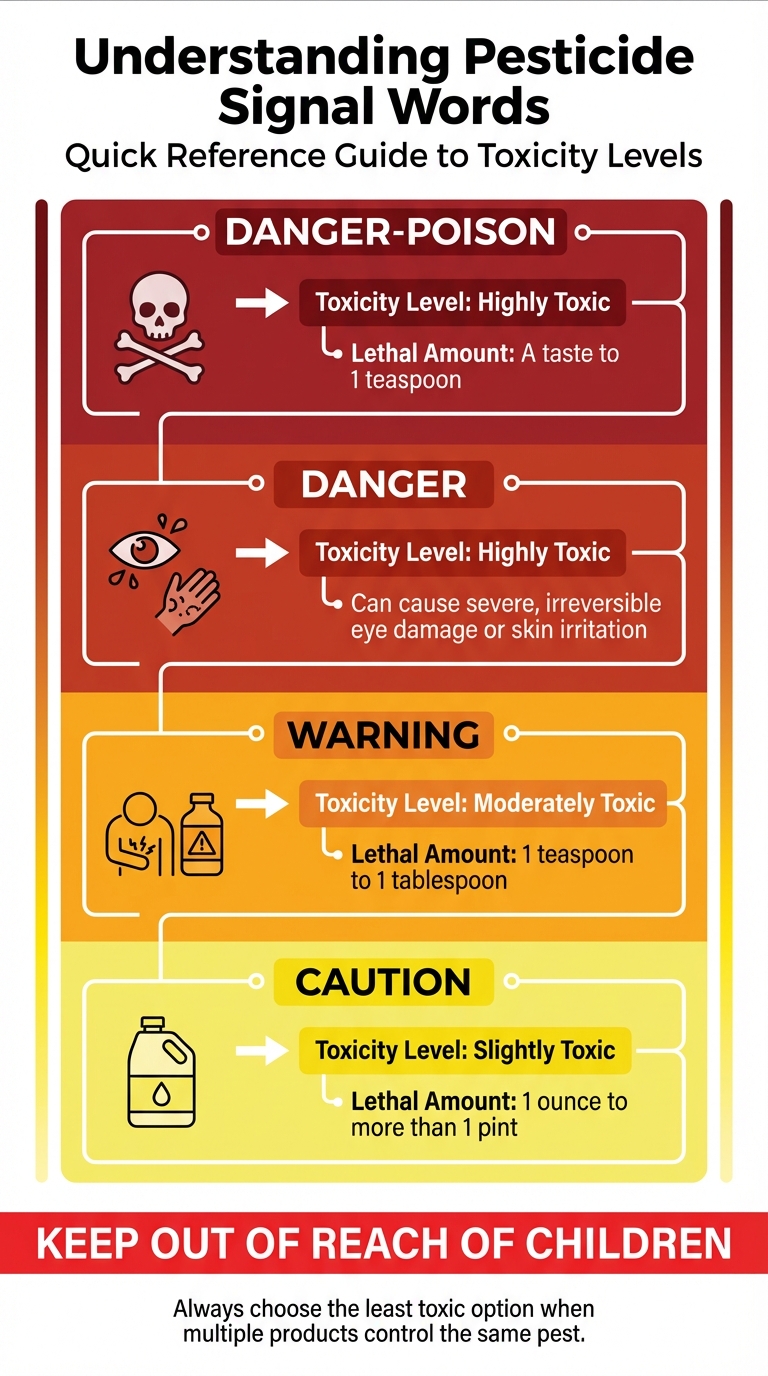
Pesticide Signal Words and Toxicity Levels Guide
When evaluating pest control products, understanding the ingredients and their toxicity is just as important as checking the front label and EPA registration numbers. Once you've verified the EPA numbers, dive deeper into the product's composition and its potential risks.
Active and Inert Ingredients
Pesticide products are made up of two main types of ingredients: active and inert. Active ingredients are the ones that actually target and manage pests. As the National Pesticide Information Center explains:
"Active ingredients are the chemicals in pesticide products that kill, control, or repel pests".
The label must include each active ingredient, either by its common or chemical name, along with its percentage by weight.
Interestingly, active ingredients often make up less than 10% of the product. The remaining 90% or so consists of inert ingredients, which, despite their name, are not necessarily harmless. These components play supportive roles, such as helping the product stick to surfaces, extending its shelf life, or acting as carriers or solvents. However, while active ingredients are listed individually, inert ingredients are usually grouped together as a total percentage because their specific identities are often considered trade secrets.
It’s important to note that inert ingredients can also carry risks. According to the EPA:
"An inert ingredient generally is any substance (or group of similar substances) other than an active ingredient that is intentionally included in a pesticide product".
Some of these substances may cause irritation to the skin or eyes, or even increase the absorption of active ingredients through your skin. To understand these potential hazards, always review the "Precautionary Statements" section on the label, even though the inert ingredients themselves might not be named.
Once you’ve reviewed the ingredients, the next step is to examine the signal words that indicate the product's toxicity levels.
Signal Words and What They Mean
Signal words provide a quick reference to the product's acute toxicity, which is determined by how harmful it may be through oral, dermal, or inhalation exposure. The University of California IPM highlights:
"Signal words indicate the short-term (acute) toxicity of the product to humans and other mammals. They are based on the overall oral, dermal, inhalation toxicity and skin or eye irritation of the pesticide's active and inert ingredients".
Here are the four main signal words, along with their associated toxicity levels and estimated lethal amounts:
| Signal Word | Toxicity Level | Estimated Lethal Amount |
|---|---|---|
| DANGER-POISON (with skull and crossbones) | Highly Toxic | A taste to 1 teaspoon |
| DANGER | Highly Toxic | Can cause severe, irreversible eye damage or skin irritation |
| WARNING | Moderately Toxic | 1 teaspoon to 1 tablespoon |
| CAUTION | Slightly Toxic | 1 ounce to more than 1 pint |
Penn State Extension offers practical guidance:
"If two products will control the same pest, signal words can help you choose the least toxic chemical to control the pest".
If you have multiple options, selecting a product labeled CAUTION instead of one marked WARNING or DANGER can lower the safety risks significantly. Additionally, nearly all pesticide labels prominently display "KEEP OUT OF REACH OF CHILDREN" above the signal word. This is a mandatory warning, as children are particularly sensitive to these chemicals .
Safety Warnings and Precautions
After reviewing active ingredients and signal words, it’s time to focus on the safety warnings that protect you, your loved ones, and the environment. These warnings aren’t just suggestions - they’re essential for safe use and compliance with federal law. As the EPA emphasizes:
"It is a violation of Federal law to use this product in a manner inconsistent with its labeling."
By understanding these warnings, you can avoid accidental poisoning, keep pets safe, and minimize harm to the environment.
Risks to People and Animals
The "Precautionary Statements" section on the label outlines potential hazards to humans and pets, including how the product might enter the body - through ingestion, skin contact, inhalation, or eye exposure.
In case of accidental exposure, the label provides First Aid Instructions, so keep both the product label and the National Poison Center Hotline (1-800-222-1222) easily accessible.
Pay attention to the re-entry interval, which tells you how long to wait before letting children or pets back into treated areas. This precaution is crucial when the product is at its most concentrated and poses the highest risk.
Lastly, check the label for required personal protective equipment (PPE) to further reduce exposure risks.
Required Protective Equipment
The label specifies the minimum PPE needed, typically found in the "Precautionary Statements" or "Hazards to Humans and Domestic Animals" sections. While you can always add extra protection, the listed items are non-negotiable.
For example, mixing concentrates usually requires more protection than using ready-to-use sprays. The label will specify materials like chemical-resistant or waterproof gloves made from nitrile, butyl, or neoprene. Avoid gloves made of leather or canvas, as these can absorb chemicals and are nearly impossible to clean.
Clemson University offers this practical advice:
"Pesticide contamination often happens when people remove their gloves to open a container, wipe away sweat, adjust their equipment, etc. After handling pesticides, always wash your gloves thoroughly BEFORE taking them off."
In addition to personal safety, the label also includes guidance to prevent harm to the environment.
Environmental Warnings
The "Environmental Hazards" section highlights risks to non-target species, including honeybees, fish, birds, and endangered plants. It also provides precautions to protect water bodies like ponds and rivers. For instance, products highly toxic to bees will include warnings against applying them near blooming plants where bees are active.
To prevent pesticide drift or runoff, follow label instructions carefully. Avoid spraying in windy conditions and clean equipment thoroughly to prevent contamination. Proper waste disposal is also critical for protecting soil and groundwater. By adhering to these environmental warnings, you can help safeguard non-target species and reduce unintended harm.
How to Use, Store, and Dispose of Products
Check the "Directions for Use" section on the product label. This section outlines how to apply the product correctly, store it safely, and dispose of it responsibly.
Application Instructions
The "Directions for Use" section specifies the pests and locations the product is intended for. For instance, a product labeled for azaleas should not be applied to an annual flower bed.
You'll also find the exact application rate and frequency on the label. These limits are designed to prevent crop damage and reduce environmental risks. For antimicrobial products like disinfectants, pay close attention to the contact time. Surfaces need to stay wet for the full duration (often 10 minutes) to ensure they effectively kill germs.
If you're using the product on edible plants, look for the Pre-Harvest Interval (PHI), which tells you how many days to wait between the last application and harvesting. The label also includes the Restricted Entry Interval (REI), which indicates how long people and pets should stay out of treated areas. Be sure to review any attached booklets for detailed instructions.
After using the product, follow the storage and disposal guidelines carefully to stay compliant.
Storage and Disposal Rules
Improper storage or disposal is a violation of Federal law. Always keep products in their original containers with the labels intact. Never transfer pesticides into soda bottles or food containers - this is a leading cause of accidental poisoning. Store these products in their original containers in a locked, ventilated area, away from children, pets, food, and medicine.
For household products, the label may recommend wrapping the container in newspaper before throwing it away. Non-aerosol containers should be triple-rinsed by filling them one-quarter full with water, shaking, emptying, and repeating the process three times. Once rinsed, puncture the container to ensure it cannot be reused before discarding it. For aerosol cans, replace the cap and discard them in the trash without puncturing or burning them. If you have leftover pesticide that you can't use, contact your State Pesticide or Environmental Control Agency for proper disposal guidance.
| Container Type | Disposal Action (Household Use) |
|---|---|
| Non-aerosol bottles, cans, jars | Triple-rinse, puncture to prevent reuse, discard in trash |
| Aerosol products | Replace cap, discard in trash; do not puncture or incinerate |
| Bags (paper or plastic) | Empty completely into application equipment, discard in trash |
How Remedy Kits Make Label Reading Easier
Navigating pesticide labels can feel like deciphering a foreign language. Between mixing ratios, application rates, and safety warnings, it’s easy to get overwhelmed. That’s where our Remedy kits step in - they simplify everything.
When you sign up, we use your zip code and home size to determine exactly how much product you need and how often you’ll need it shipped. This means no more guessing at complicated "Directions for Use" tables or trying to measure concentrated chemicals. Our system tailors everything to your local climate and pest concerns, so you get what you need, when you need it.
The kits are customized for the pests you're dealing with. Instead of comparing endless bottles on a store shelf, just let us know your pest problem, and we’ll send the right product. Not sure what pest you’re dealing with? No problem - our pest identification support can help you figure it out. This ensures you’re always using the right product safely and effectively.
With years of expertise behind us, we’ve designed a simple four-step process. Each kit includes pre-measured, ready-to-use products with clear instructions, plus virtual support if you have questions. Want to give it a try? Use code "FREEKIT" at checkout for your first kit free. There are no contracts, so you can pause or skip shipments anytime.
This hassle-free approach takes you from struggling with labels to confidently managing pests in no time.
Conclusion
Grasping the details on pest control product labels isn’t just a good habit - it’s a legal obligation. As the EPA puts it:
"Remember that the label is the law!"
But beyond legalities, taking the time to read labels can protect your loved ones, pets, and the environment from unnecessary risks. It also helps guarantee that the product you’re using is effective for your specific pest problem.
These labels are more than just instructions - they’re a step-by-step guide. From mixing ratios to application safety, they outline everything you need to know. Labels specify the product’s purpose, recommended protective gear, proper application rates, and even how long to wait before re-entering treated areas. In emergencies, having access to the EPA registration number and first aid instructions can be a lifesaver.
Pay close attention to signal words, which indicate the product's toxicity level. This helps ensure you handle each product with the care it requires. As Brad S. Freseburg from the University of Missouri explains:
"To the buyer or user, the label is the main source of information on how to use the product correctly, legally and safely"
If labels feel overwhelming, we offer a simpler solution. Our pre-measured, ready-to-use kits are designed to take the guesswork out of pest control. They make application straightforward and safe, offering professional-level results without the complexity. And if you’re unsure about identifying a pest or how to apply the product, our virtual support is just a click away.
At the end of the day, pest control labels are there to protect you and help you succeed. Whether you choose to tackle the process yourself or let us simplify it for you, understanding those labels is key. It’s the difference between a safe, effective pest control experience and costly mistakes. By mastering label reading, you’re taking an important step toward a pest-free home.
FAQs
What’s the difference between the EPA registration number and establishment number?
The EPA registration number is a unique identifier that shows which company registered a pesticide and the sequence in which it was submitted to the EPA. On the other hand, the establishment number pinpoints the exact facility where the product was manufactured. These numbers play a crucial role in tracking products and ensuring they meet safety and regulatory requirements.
How do I pick the safest product when labels list different signal words?
To pick the safest option, pay attention to the signal word on the product label. Products marked with "Caution" are the least toxic, making them the safest choice. If "Caution" products aren't available, opt for those labeled "Warning" instead of "Danger," as they indicate lower toxicity levels. Always read the label thoroughly to understand specific hazards and follow safety instructions carefully before using the product.
What should I do if the label’s directions feel too complicated to follow?
If the directions on the label seem confusing, don’t skip over them - they contain crucial safety and usage details. Take a moment to go through them thoroughly. If anything remains unclear, reach out to your local extension office or consult a professional for advice before proceeding. It’s important to fully understand the instructions to ensure the product is used safely and correctly.