


Ever wonder why pests seem to follow the seasons? Changes in temperature, daylight, and moisture control when pests emerge, reproduce, and seek shelter. Warmer weather speeds up their activity, while cooler months push them indoors or into dormancy. Here's what you need to know:
- Spring: Rising temperatures wake pests like ants and termites, kicking off their foraging and swarming activities.
- Summer: Heat accelerates reproduction for mosquitoes and cockroaches, but extreme heat may drive some pests indoors.
- Fall: Cooler weather prompts rodents, spiders, and stink bugs to invade homes for warmth.
- Winter: Many pests hibernate, while others, like rodents, stay active indoors.
Modern homes with climate control can disrupt these natural cycles, making year-round pest management crucial. Seasonal strategies - like sealing entry points in fall or managing moisture in summer - help keep pests at bay. Whether using natural remedies or a DIY pest control kit, timing and tailored solutions are key to effective pest control.
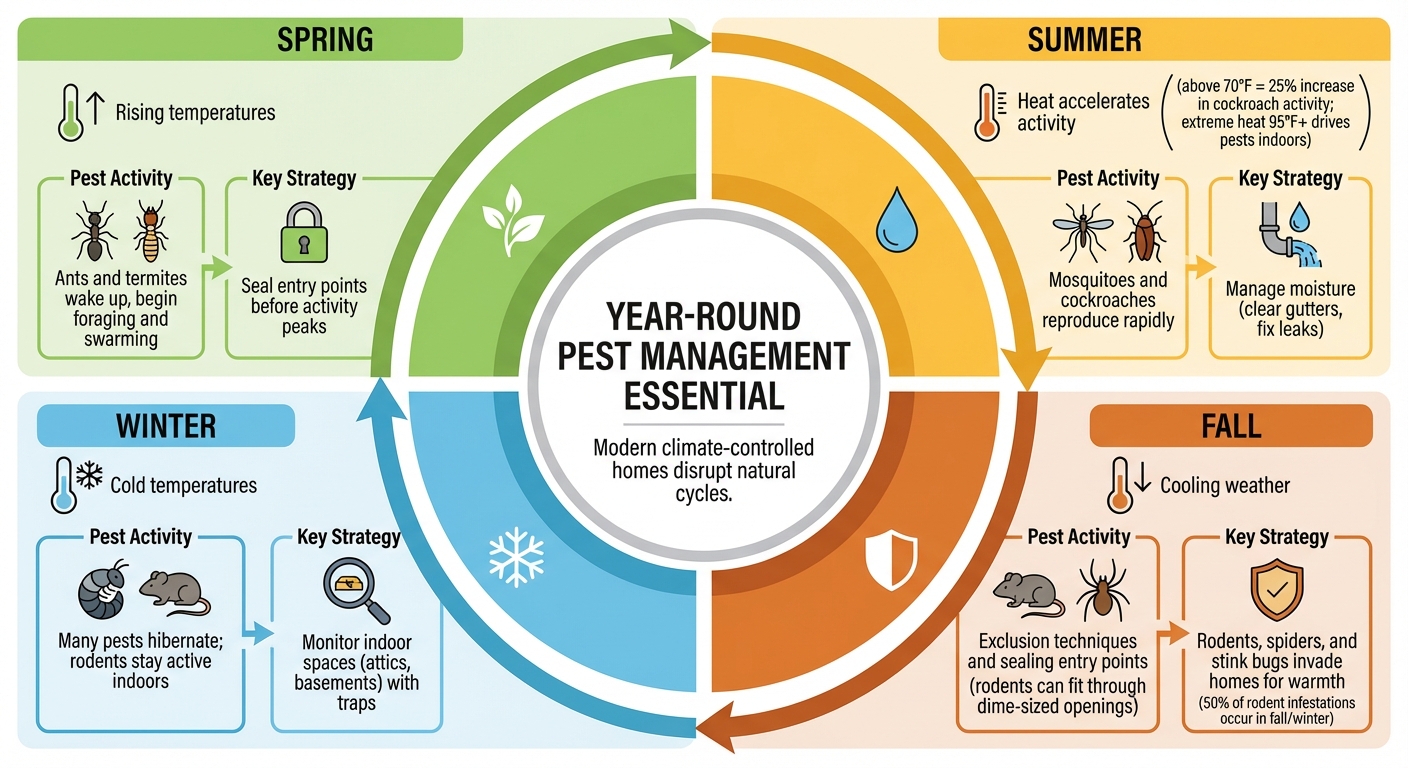
Seasonal Pest Activity and Control Strategies Throughout the Year
1. How Pest Life Cycles Change with Seasons
Effectiveness Across Seasons
Pest control methods need to adapt as the seasons change because temperature shifts directly impact pest behavior and how they respond to treatments. For example, summer is prime time for pests like cockroaches and mosquitoes. Their metabolism speeds up in the heat, making them more susceptible to certain treatments. However, when temperatures soar above 95°F, these pests often retreat indoors to cooler areas like basements or crawl spaces, requiring a different approach.
In contrast, winter brings a slowdown. As temperatures drop, many pests enter a dormant phase. Redi National explains:
As temperatures drop in the fall and winter, many pests enter a dormant state, hibernating until conditions are more favorable.
This dormancy reduces their metabolic activity, which can make some chemical treatments less effective during colder months.
Adjusting to Seasonal Shifts
Seasonal transitions also bring notable changes in pest behavior, requiring tailored prevention strategies. In spring, warming temperatures lead to a surge in pest activity, with termites swarming to start new colonies. Fall, on the other hand, sees pests like rodents, spiders, and stink bugs seeking warmth indoors to survive.
To tackle these seasonal shifts, pest control efforts must be precise, often requiring a quarterly pest remedy kit. In spring, sealing entry points becomes a priority to block pests before their activity peaks. During fall, exclusion techniques are essential to keep pests from migrating indoors. Summer strategies often center on managing moisture, such as clearing gutters and fixing leaks, which can be supplemented with a monthly pest remedy kit, while winter efforts focus on monitoring indoor spaces like attics, where pests might hide.
sbb-itb-0bbb908
2. Remedy DIY Pest Control Kits

Effectiveness Across Seasons
Our DIY pest control kits are specifically designed to handle the challenges that come with seasonal changes. For instance, when temperatures soar above 95°F, chemical treatments can evaporate up to 60% faster, reducing their effectiveness. On the flip side, in temperatures below 50°F, contact insecticides take much longer to penetrate pests' bodies. To tackle these challenges, our kits include product formulations tailored to your location and the time of year.
With just your zip code and a few details about your home, we customize a plan to address the seasonal pest issues unique to your area. Factors like your home's square footage and the number of floors ensure you get the exact amount of product needed. As we like to say:
Just provide your zip code along with a few more details and we'll curate a custom monthly plan for your needs and location. It's so simple you'll wonder why you paid for pest control services in the past!
Seasonal Adaptations
Our kits are designed to evolve with the seasons, targeting pests based on their activity patterns. In spring, for instance, you'll find baits to tackle emerging ant colonies and termite monitoring stations to catch swarms early. Summer kits shift focus to pests like mosquitoes and cockroaches, which thrive in humid conditions. As fall rolls in, the emphasis moves to sealing entry points, a crucial step since nearly 50% of rodent infestations occur during fall and winter. Winter kits include indoor rodent traps to address pests seeking warmth inside your home.
Ease of Implementation
Each kit comes with clear, step-by-step instructions for treating common pest hotspots, such as entryways, foundation perimeters, and cracks. The products are safe for homes with pets and children, making them a practical choice for families. Treatments reach their full effectiveness within 10 days and can last for several months. Plus, our virtual support team is available to help identify pests and answer any questions about using the products, so you're never left figuring things out on your own.
Seasonal Pest Prevention: Tips for Every Time of Year
Pros and Cons
When deciding between natural pest remedies and customized DIY kits, it’s essential to consider how each approach fits into the seasonal patterns of pest behavior. Let’s break down the advantages and limitations of each method to help you make an informed choice.
Natural remedies - like vinegar, essential oils, and diatomaceous earth - are particularly effective in the spring and early summer when pest activity starts to ramp up. These solutions are non-toxic, safe for kids and pets, environmentally friendly, and inexpensive since they rely on everyday household items. However, their gentler action might struggle against larger infestations or deeply rooted colonies.
"DIY sprays and baits typically eliminate visible ant foragers, but not the colony itself. Disturbing a nest can also cause colonies to split and form new satellite nests."
– American Pest
On the other hand, customized DIY kits feature professional-grade formulations tailored to address pests at all life stages, offering residual protection lasting several months. These kits shine in the fall and winter when rodents and other pests invade homes seeking warmth. Considering rodents can spread over 35 diseases, targeted solutions become crucial during these colder months. The trade-off? DIY kits require precise timing for application and come with a higher initial cost compared to natural remedies.
Here’s a side-by-side comparison to make things clearer:
| Feature | Natural Methods | Customized DIY Kits |
|---|---|---|
| Best Seasons | Spring/Summer | Fall/Winter for structural exclusion and nest elimination |
| Safety | Non-toxic and environmentally friendly | Professional-grade but safe for pets and kids when used correctly |
| Effectiveness | Moderate; ideal for prevention but less reliable for large infestations | High; targets colonies and creates lasting barriers |
| Cost | Low; uses common household products | Moderate; higher upfront cost than natural remedies |
| Application | Requires frequent reapplication and monitoring | Takes full effect in 10 days, with protection lasting several months |
This comparison highlights how seasonal needs should guide your pest control strategy. For example, termites alone cause an estimated $5 billion in property damage annually, often in hidden areas where surface treatments fall short. Matching the right method to the right season can make all the difference.
Conclusion
Our research highlights how adjusting pest control methods to match seasonal changes is key to maintaining effective protection. Shifts in weather significantly influence pest behavior: warmer spring temperatures speed up breeding cycles, while fall encourages rodents to squeeze into homes through openings as small as a dime. During summer, cockroach activity increases by 25% when temperatures exceed 70°F. Meanwhile, winter either sends pests into hibernation or drives them indoors seeking warmth. These seasonal patterns make it clear that pest control strategies must evolve throughout the year.
"A year-round pest control plan helps interrupt that cycle. Regular inspections detect early signs of activity, while preventive treatments create barriers that stop pests from re-establishing themselves."
– American Pest
Pests don’t take time off. Termites, for instance, remain active 24/7 all year long. Under optimal summer conditions, certain cockroach species can develop from egg to adult in just 37 days. Even in the quiet of winter, pests can multiply unnoticed, preparing for a surge when temperatures rise again.
This is why consistent, adaptable protection is so important. At Remedy, we’ve designed our DIY pest control kits to provide year-round solutions that adjust to seasonal changes. These professional-grade kits are safe for pets and children and tailored to your specific pest issues and home environment. Whether it’s sealing entry points in the fall, addressing spring moisture, or applying heat-resistant treatments in the summer, our kits offer the right tools at the right time. With easy-to-follow instructions and virtual support, we ensure you’re equipped to handle pests no matter the season.
FAQs
Why do pests show up at the same times each year?
Pests tend to show up around the same time each year because seasonal shifts - like changes in temperature, humidity, and rainfall - set the stage for their survival and growth. Warmer spring weather, for instance, wakes many pests from winter dormancy, sparking breeding and colony-building activity. These patterns aren't random; they're closely linked to the pests' life cycles and how they respond to environmental cues.
How does my home’s HVAC affect seasonal pest activity?
Your HVAC system can play a surprising role in seasonal pest problems, especially during colder months. Small gaps in ducts, vents, or filters can act as open doors for pests like mice, cockroaches, and even bed bugs. Once inside, the warm environment your system provides can make it an inviting spot for these unwelcome guests.
To keep pests at bay and ensure your HVAC system runs smoothly, regular maintenance is key. This includes sealing gaps, inspecting and replacing filters, and thoroughly cleaning ducts. These steps not only help prevent infestations but also maintain your system's efficiency. Plus, routine checks can help you spot early signs of pest activity, minimizing risks as the seasons change.
When should I seal entry points to prevent fall and winter pests?
As fall rolls in and temperatures start to dip, pests such as mice, rats, cockroaches, and spiders begin searching for warm indoor spaces to settle. To avoid unwelcome guests, it's smart to seal up entry points before winter fully sets in. Taking these precautions early can save you from dealing with infestations when pests are at their most persistent.