


Ants invade homes by following invisible scent trails made of pheromones. These trails help ants navigate to food and water sources while recruiting others from the colony. To stop them, you need to disrupt their chemical communication system. Here's how:
- Use Vinegar: A 1:1 mix of white vinegar and water erases pheromone trails. Spray it on ant paths and entry points, then wipe clean.
- Soapy Water: Dish soap and water kill ants on contact and remove scent residues.
- Essential Oils: Peppermint or tea tree oil mixed with water acts as a natural repellent.
- Baking Soda Bait: Combine baking soda with powdered sugar to attract and eliminate ants.
- Diatomaceous Earth: Sprinkle food-grade DE along entry points to physically block and kill ants.
- Chalk Lines: Drawing chalk lines disrupts ant trails temporarily.
For lasting results, seal cracks, clean up food crumbs, and consider using DIY ant barrier kits to treat colonies directly. Regular application and combining methods will help keep your home ant-free.
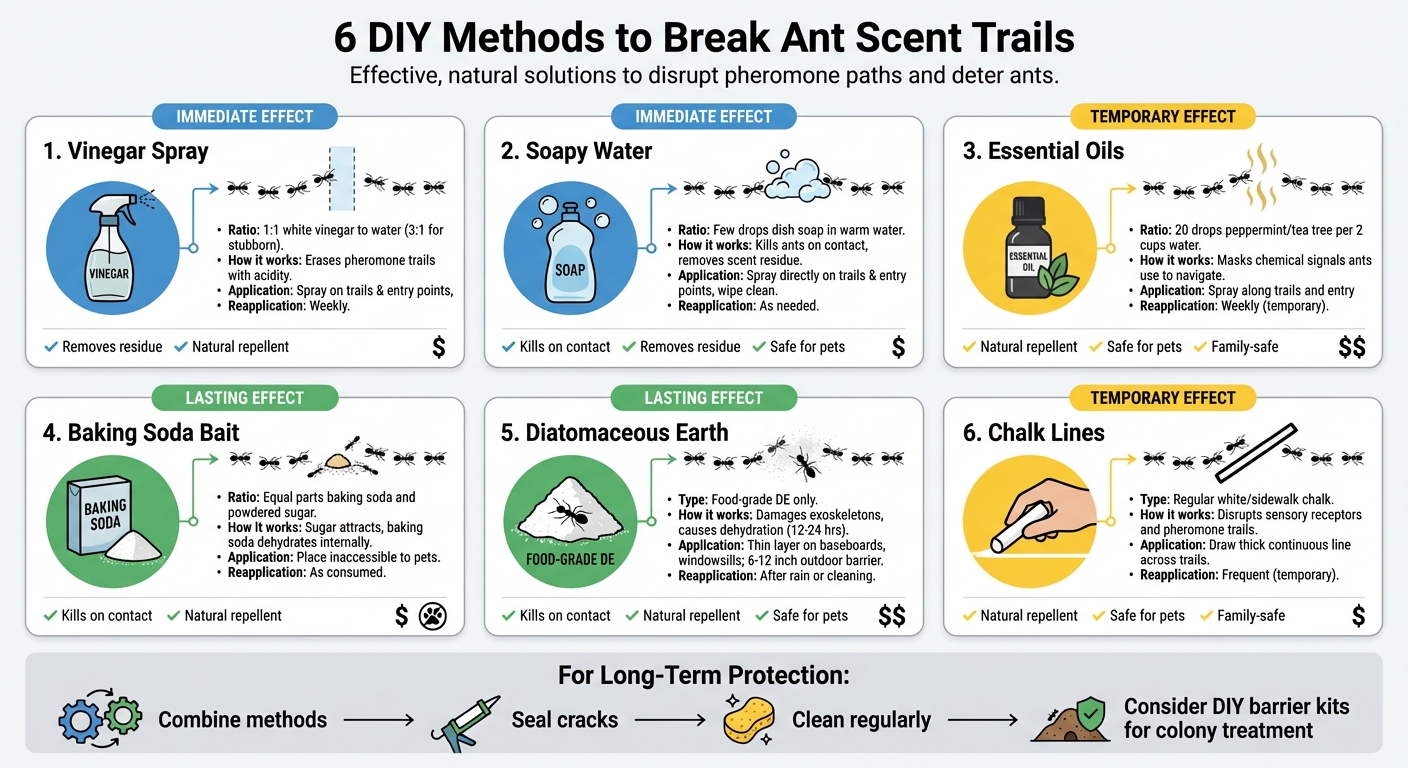
6 DIY Methods to Break Ant Scent Trails: Effectiveness and Application Guide
Ways To Clean An Ant Scent Trail 🧧
sbb-itb-0bbb908
Materials You'll Need
To effectively neutralize ant pheromone trails, you'll need a handful of common household items. These materials are not only easy to find but are also safe for families and pets while disrupting ant pathways.
White Vinegar and Dish Soap
White vinegar is a powerful tool for tackling ant trails. Its strong scent and acidity help mask the pheromones ants use to navigate. As Penn State University explains:
Vinegar can be used to eliminate these chemical trails. This makes it hard for ants to find that food source, and they eventually return to the colony until another chemical trail can be followed.
Opt for white vinegar instead of apple cider vinegar. The sharper scent of white vinegar is more effective, while the sweetness of apple cider vinegar might attract ants instead.
Liquid dish soap serves a dual purpose. Mixed with water, it kills ants on contact by breaking down their exoskeletons, causing dehydration. Plus, it cleans surfaces, removing any lingering pheromone residue to prevent further trails.
Baking Soda and Essential Oils
Baking soda works in a unique way. When combined in equal parts with powdered sugar, the sugar lures ants, while the baking soda reacts with their internal acids. David Price, an Associate Certified Entomologist at Mosquito Joe, explains that this reaction dehydrates ants and ultimately kills them. For pet owners, ensure these baits are placed in areas inaccessible to your furry friends.
Essential oils like peppermint, tea tree, eucalyptus, and clove are natural repellents that ants avoid. A simple spray can be made by mixing 20 drops of peppermint oil with 2 cups of water. However, if you have cats, avoid using cinnamon-based solutions. As OPC Pest Services cautions:
Be careful if you have cats, though, as cinnamon can disrupt their digestive system.
Tools for Application
Here are some handy tools to help you apply these solutions effectively:
- Spray bottles: Glass bottles are ideal for vinegar and essential oil mixtures as they resist residue and won't react with acidic liquids.
- Cotton balls: Soak them in vinegar or essential oils to block entry points.
- Cleaning cloths and paper towels: Perfect for wiping down surfaces.
- Vacuum cleaner: Useful for removing crumbs and debris that could attract ants.
- Caulking gun and caulk: Seal cracks around windows, doors, and baseboards to stop new trails from forming.
With these materials and tools, you'll be well-prepared for the next steps in managing ant trails effectively.
How to Break Ant Scent Trails
With the right tools, you can stop ants from following their invisible paths by targeting their chemical communication directly.
Vinegar Spray Method
Combine white vinegar and water in a spray bottle. Use a 1:1 ratio for general cleaning or a stronger 3:1 vinegar-to-water mix for stubborn trails. Spray the solution directly on ant trails and areas of activity, then wipe the surface with a cloth to remove lingering pheromones. To prevent ants from returning, spray around baseboards, windowsills, and doorways regularly. Reapply weekly for the best results. (Avoid using vinegar on grout or other surfaces sensitive to acid to prevent damage.)
If vinegar isn't your preference, soapy water is another effective option.
Soapy Water Application
Add a few drops of liquid dish soap to warm water in a spray bottle. Spray this solution directly onto ant trails and entry points, then wipe the area clean to remove the pheromone residue. Pest Control Specialist Thomas Matthews explains that soapy water effectively disrupts the chemical signals ants rely on. For delicate surfaces, follow up with a damp cloth to remove any soapy residue, then dry the area thoroughly. Repeat this process whenever ants reappear.
Essential Oils and Spices
For a more natural approach, mix a few drops of peppermint or tea tree oil with water in a spray bottle, adding a splash of rubbing alcohol to help blend the oils. Spray this mixture along ant trails and entry points. These essential oils work by masking the chemical signals ants use to navigate, but their effects fade over time, so reapply weekly.
To create a physical barrier, sprinkle ground cinnamon, black pepper, or cayenne pepper directly onto active trails. While these natural repellents can help, Western Exterminator cautions:
Peppermint oil may deter ants, but you'll only be ant-free temporarily.
Long-Term Protection with Remedy DIY Kits
Quick fixes like vinegar sprays and essential oils can disrupt ant trails, but they often need frequent reapplication. That’s where our DIY kits come in - they provide continuous protection by addressing the problem at its source and keeping ants from returning to key entry points.
These kits combine professional-grade ant barriers and targeted baits to stop infestations effectively. The ant barriers create a protective chemical perimeter around your home's foundation, windows, doors, and other vulnerable areas. Meanwhile, scout ants bring the bait back to the nest, targeting the entire colony and preventing the formation of new scent trails.
To ensure long-lasting results, we offer quarterly shipments to replenish chemical barriers that naturally wear down over time. This consistent treatment blocks new colonies from establishing themselves. Plus, our kits include tips for sealing higher entry points, like cracks above ground level, where ants often sneak in.
Each kit comes with detailed instructions and access to virtual support to help with pest identification and treatment. And here’s something special for new customers: use code FREEKIT at checkout to get a discount on your first kit.
Here’s what one of our customers, Jen Y., had to say:
Our ant, bug & spider problems were out of control this summer. After trying multiple store solutions, this kit finally solved the issue.
More Ways to Keep Ants Away
In addition to chemical methods, physical barriers can be a great way to stop ant trails in their tracks.
Using Diatomaceous Earth
Diatomaceous earth (DE) is a fine powder that kills ants by damaging their exoskeletons, leading to dehydration within 12–24 hours. It's important to use food-grade DE - not pool-grade - because pool-grade DE is chemically treated and unsafe for use around people or pets. A single bag of food-grade DE costs about $10–$20 and is enough to cover both indoor and outdoor areas.
For indoor use, sprinkle a thin layer along baseboards, windowsills, under sinks, or directly on ant trails. A duster or even a salt shaker works well for precise application. Outdoors, create a 6- to 12-inch barrier around your home’s foundation, doorways, and windows. Keep the layer thin, as ants may avoid thick piles by walking around them. Since DE is only effective when dry, you'll need to reapply after rain or cleaning. Because it works mechanically rather than chemically, ants cannot develop resistance to it. For cleanup, use a shop vac to avoid clogging regular vacuum filters.
"This fine, powdery substance kills ants by drying them out, not poisoning them, which makes it safe to use around pets and kids." – Wesley Wheeler, Pest Control Expert
Drawing Chalk Lines
Chalk - whether it's standard white blackboard chalk or sidewalk chalk - creates a temporary barrier by disrupting the ants' pheromone trails. It interferes with their sensory receptors, making it harder for them to follow one another. To use, simply draw a thick, continuous chalk line across ant trails or around areas you want to protect. For best results, wipe down existing trails with vinegar or soapy water first to eliminate residual pheromones.
"The powder disrupts the ants' ability to pick up on the scent of other ants. In many cases, the ants won't cross the chalk line and will backtrack a bit, trying to pick up on the scent trail left by preceding ants." – Kathy Adams, DIY Contributor
While chalk is a quick and easy solution, it’s temporary and requires frequent reapplication, especially after rain or windy conditions. Avoid using "ant chalk" or "Chinese chalk", as these unregulated products often contain harmful toxins like deltamethrin or cypermethrin. Stick to regular, non-toxic chalk, which you can find at office supply or craft stores. Though temporary, this method works well when combined with other treatments like liquid repellents.
Conclusion
You can tackle ant scent trails using simple household solutions. A mix of 50/50 vinegar and water or soapy water effectively disrupts the pheromone "road map" that ants rely on to navigate your home. Pair these quick fixes with natural barriers like diatomaceous earth or chalk lines to stop ants in their tracks before they become a bigger issue.
The secret lies in combining immediate actions with long-term prevention. Regular cleaning removes chemical signals, while sealing cracks and storing food in airtight containers eliminates the attractions that draw ants in the first place. Without these temptations, the colony will naturally move on to easier pickings.
To enhance your efforts, you might consider customized DIY kits. These kits include professional-grade, family- and pet-safe products tailored to your specific ant problem and location. They create a protective barrier around your home and target colonies directly at their source. Plus, new customers can use the code FREEKIT at checkout for a discount.
For lasting results, make sure to reapply treatments consistently, especially after rain or near entry points. Most DIY methods are safe for families and pets, but always follow the instructions provided with each product.
FAQs
How do I find where ants are entering?
To figure out where ants are sneaking into your home, pay close attention to their movement and follow their trails. These trails will often guide you to entry points such as cracks, gaps in walls or floors, unsealed holes, or spots near plumbing and utility openings. Once you trace the ants back to their source, you can pinpoint the entry point and take steps to block it, reducing the chances of future infestations.
Why do ants keep coming back after I clean?
Ants tend to come back because their scent trails, created by pheromones, linger even after cleaning. These trails act like a roadmap, guiding other ants to the same location. Simply wiping down surfaces might not completely erase these trails. Plus, if the nest is close by, cleaning alone won’t solve the issue. To keep ants from returning, you need to break their trails and tackle the root cause of the infestation.
When should I use a bait instead of a spray?
When you're aiming to wipe out an entire ant colony, baits are your best option. These work by attracting ants, which then carry the poisonous substance back to their nest, ensuring colony-wide control. Baits are particularly effective when ants are actively searching for food or water.
On the other hand, sprays are ideal for quick fixes. They can kill visible ants on the spot or temporarily break up their trails. However, sprays aren't as effective when it comes to completely eradicating a colony.