


If you’re dealing with ants, ant baits can be one of the most effective ways to eliminate entire colonies, including the queen. Here’s what you need to know upfront:
- Initial Results: Ant activity may increase in the first 24–48 hours as ants discover the bait and recruit others.
- Noticeable Reduction: You’ll typically see fewer ants within 3–7 days.
- Complete Elimination: Most colonies are eradicated within 1–3 weeks, depending on size and species.
Ant baits work by allowing worker ants to carry a slow-acting poison back to the colony, where it’s shared with the queen and others. Patience is key - avoid using sprays or disturbing the bait stations during this process. Proper placement along ant trails and choosing the right bait type (protein or sugar-based) can significantly improve results.
For larger colonies or multi-queen species, consistent baiting over several weeks may be necessary. Always check and replace bait as needed to ensure effectiveness.
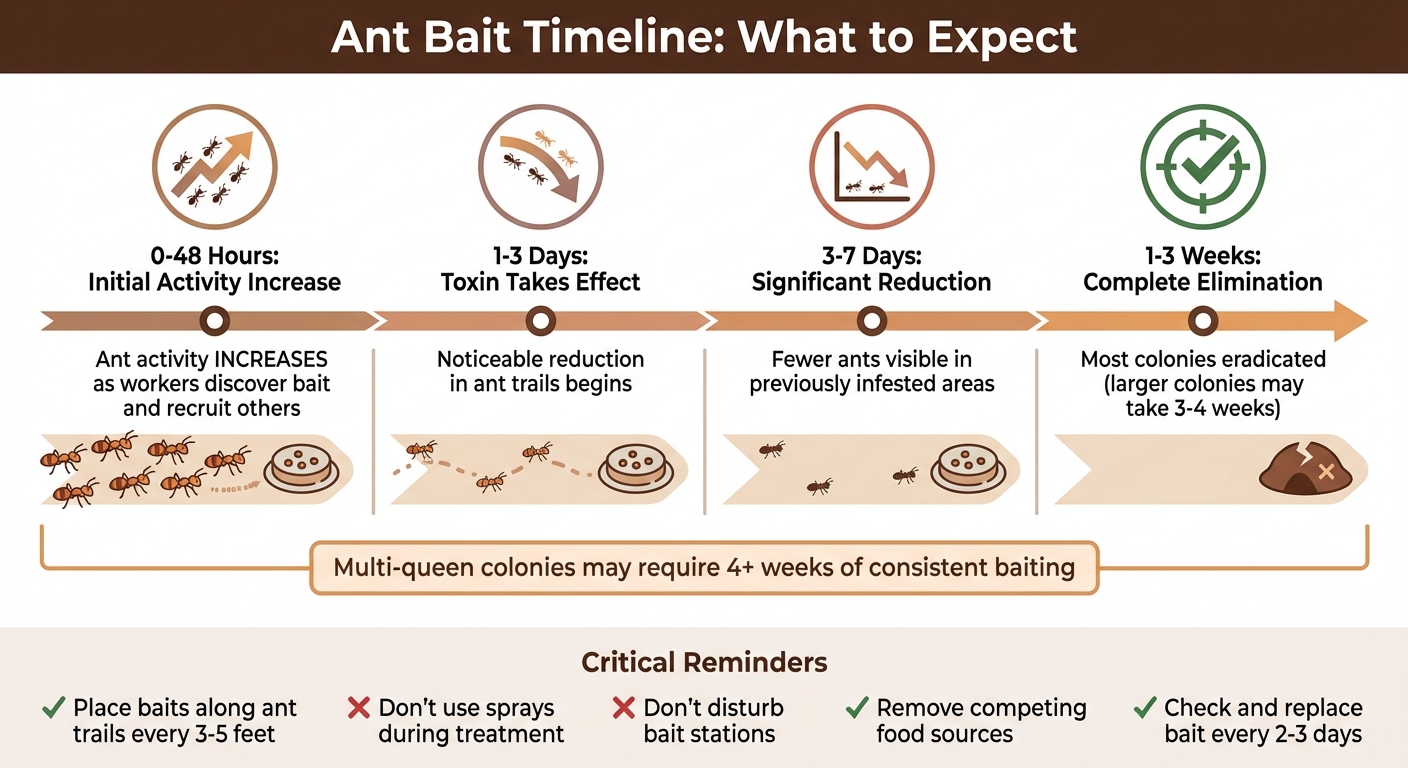
Ant Bait Timeline: How Long Until Results
How Do Ant Bait Stations Work? Maggie's Farm

sbb-itb-0bbb908
How Ant Baits Work
Ant baits take advantage of the way ant colonies naturally share food. Each bait is made up of two key components: a food attractant to lure worker ants and a slow-acting insecticide that allows those workers to carry the poison back to the nest before it starts to work.
The process relies on trophallaxis, the ants' habit of sharing food mouth-to-mouth throughout the colony. When a worker ant finds the bait, it eats some and stores more in its "social stomach" to bring back to the nest. Once there, the worker ant shares the poisoned food with the queen, larvae, and other ants that never leave the nest. This method ensures the insecticide reaches about 80% of the colony, including those hidden from surface sprays. The bait's formula is carefully designed to ensure this distribution works effectively. Let’s look at what goes into these baits and how worker ants play a critical role in spreading the poison.
What's Inside Ant Baits
Commercial ant baits include two main ingredients: a nutritional attractant - like sugar, protein, or grease - and an active insecticide, such as borax, fipronil, or hydramethylnon, which typically makes up 0.5% to 5.4% of the product's weight. This low concentration is intentional. If the poison were too strong, it would kill the foraging ants before they could return to the nest and share it with the colony.
Each active ingredient works differently. Borax disrupts digestion and energy production, while fipronil overstimulates the nervous system. Despite their differences, all these ingredients aim to give worker ants 24 to 72 hours to spread the bait before they show symptoms. This delay is crucial - it ensures that the worker ants can deliver the poison effectively throughout the colony.
How Worker Ants Spread the Bait
Once worker ants bring the bait back to the nest, they distribute it through trophallaxis, feeding the queen, larvae, and other ants. This behavior is what makes ant baits so effective - it reaches colony members that would never come into contact with sprays or traps.
The queen is the primary target. Without her, the colony can't reproduce and will eventually collapse. Some queens can live over 28 years in controlled environments, so eliminating her is critical. Once she consumes the bait and dies, the entire colony loses its ability to sustain itself, leading to its eventual downfall.
How Long Ant Baits Take to Work
The time it takes for ant baits to work depends on factors like colony size, ant species, and the bait's active ingredient. Unlike sprays, which provide immediate but short-term results, baits are designed to eliminate the entire colony, including the queen.
First Signs of Results
In the first few days, you might notice an increase in ant activity around the bait stations. This happens because foraging ants have found the bait and are bringing others to it - a clear indication that the bait is working. Typically, within 1 to 3 days, the toxin begins to take effect, and you'll see a noticeable reduction in ant trails on floors and counters. As the poison spreads through the colony, the initial activity decreases, signaling progress toward full colony elimination.
Complete Colony Elimination
After the initial drop in activity, complete eradication usually takes 1 to 3 weeks. The process hinges on eliminating the queen. Without her, the colony can't produce new ants and will eventually collapse. Gordon Reidy, PhD in Toxicology at PestXpert, explains:
"If the queens are dead, there are no more eggs being laid and so the colony will die (even if some workers survive)".
For super-colonies with multiple queens, consistent baiting over several months may be necessary to achieve control. For example, in December 2023, the Miller family tackled a persistent pantry ant infestation using Terro T300B baits. They placed bait stations along trails and under appliances, noticing an initial surge in activity followed by a steady decline. Within two weeks of consistent use, they achieved full elimination.
Timeline by Active Ingredient
The speed at which baits eliminate colonies also depends on the active ingredient. Here's a breakdown of common ingredients and their timelines:
| Active Ingredient | Expected Timeline | How It Works |
|---|---|---|
| Indoxacarb | 3–10 days | Slow-acting insecticide |
| Hydramethylnon | 7–14 days | Disrupts energy production; slow-acting |
| Borax/Boron-based | 2–10 days | Acts as a stomach poison; may be rejected if too strong |
| IGRs (e.g., Pyriproxyfen) | 1–2 months | Sterilizes queens and prevents larvae from molting |
Insect Growth Regulators (IGRs) take the longest to work because they don't kill adult ants directly. Instead, they disrupt reproduction and larval development. While results take more time, IGRs can be highly effective for long-term control of colonies.
What Affects How Fast Ant Baits Work
When dealing with ants, the speed at which baits work can vary significantly. Two main factors play a role in determining how quickly you’ll see results: the size of the colony and the type of ants. Knowing these details helps manage expectations and reduces frustration if the problem isn’t solved immediately.
Colony Size and Ant Type
For smaller, newly established colonies, results can be quick - sometimes within 1 to 3 days. This is because fewer ants need to be fed, and there’s less competition for the bait. On the other hand, mature colonies with thousands of workers usually take 1 to 2 weeks to collapse, while larger, more intricate colonies may require 3 to 4 weeks and multiple DIY pest control bait stations.
Colonies with multiple queens are especially tricky. If one queen dies, workers can raise new queens from existing eggs and larvae, making complete elimination harder. Single-queen colonies respond more quickly to bait, as the loss of the queen disrupts the colony entirely. However, multi-queen species, like Argentine ants, may require over 4 weeks of consistent baiting to achieve success.
Here’s a quick breakdown of how colony size and complexity affect baiting timelines:
| Colony Size/Type | Estimated Time for Elimination | Requirements for Success |
|---|---|---|
| Small/New Colony | 1–3 Days | Standard bait placement |
| Medium/Mature Colony | 1–2 Weeks | Consistent bait supply |
| Large/Complex Colony | 3–4 Weeks | Multiple bait locations and high volume |
| Multi-Queen Colony | 4+ Weeks | Large bait quantities; may need professional help |
Choosing and Placing Baits Correctly
Proper placement of baits is just as important as the bait itself. Ants rely on pheromone trails to navigate, so placing bait stations along these trails - about every 3 to 5 feet - is essential. Focus on areas near water sources, like sinks, and heat sources, such as appliances, to maximize effectiveness.
To ensure ants are drawn to the bait, remove any competing food sources like crumbs or pet food. Studies show that when colonies are deprived of alternative food for 48 hours, introducing bait can result in a 100% mortality rate.
It’s also crucial to avoid using sprays or strong cleaners near bait stations. These chemicals can repel ants or kill foragers before they can return to the nest, disrupting the bait distribution process. By following these steps, you can improve your chances of eliminating the colony efficiently.
What to Expect During Treatment
Now that you know how ant baits work and the timeline for results, here's what typically happens during the treatment process.
More Ants at First
After setting up bait stations, you might notice an increase in ant activity. This might seem alarming, but it’s actually a good thing! It means the foraging ants have found the bait and are bringing more colony members to it. Ed Dolshun, Vice President of Business Development and Technical Director at Catchmaster, explains:
"The initial increase in activity around the traps is a good sign because it means the ants are taking the bait".
Signs the Bait Is Working
As the poison spreads through the colony, the number of ants will gradually decrease. Over time, you’ll see fewer ants in previously infested areas, and eventually, the activity will stop altogether.
Let the Process Work
It’s tempting to spray or clean up ants you see during treatment, but doing so can interrupt the process. Spraying insecticides kills foragers before they can return to the colony, which means the poison won’t reach the queen or other ants. Similarly, avoid using strong cleaning products near the bait stations, as they can repel ants and discourage them from taking the bait.
Also, resist the urge to move the bait stations once ants have established a trail. Allowing the ants to travel freely between the bait and their nest is crucial for the treatment to work effectively. By following these guidelines and using a quarterly pest remedy kit, you’ll help ensure the colony is eliminated.
How to Get Better Results with Ant Baits
Once you know what to expect during treatment, a few smart tweaks can help you see faster and more thorough results.
Where to Place Baits and When to Replace Them
Set bait stations along active ant trails where you see foragers moving. Focus on entry points like windowsills, door frames, and utility access areas.
For outdoor bait placement, Dr. Dong-Hwan Choe from the University of California, Riverside, highlights the importance of precise positioning:
"Strategic placement of baits is critical to maximize the bait consumption by foraging ants and control of the pest ant populations."
Key spots include the edges where your lawn meets the driveway, tree bases, and around building foundations. These areas often see high ant traffic.
During the first week, check bait stations every 2–3 days. Replace any bait that’s been consumed. If you’re using liquid or gel baits and they dry out, add a few drops of water or swap them out for fresh bait. [8, 17, 19]
Keep a close eye on how the bait stations are performing after setting them up.
Be Patient and Check Progress
You’ll usually start seeing results within 3 days, but complete elimination might take up to 3 weeks. This timeline matches the typical pattern: initial effects in 3 days, with activity dropping significantly between 7 and 14 days. Even after ants seem to disappear, leave the bait in place for another 3–4 days to target any stragglers. If you don’t notice a decrease in activity within 2–3 days after refreshing the bait, it’s time to try a different formula. [6, 12, 8]
Switching bait types can often help if progress slows.
Try Different Bait Types
Ants’ food preferences shift throughout the year. In spring and early summer, colonies tend to favor protein-based baits to support brood development. By late summer and fall, sugar-based baits become more effective.
To figure out what works best, try a quick taste test. Place small amounts of protein (like peanut butter) and sugar (honey or jelly) on an index card near an active trail. See which one attracts more ants and use that type of bait. If ants ignore a commercial bait for an hour, switch to a different one. [6, 17]
| Bait Type | Primary Attractant | Best Season |
|---|---|---|
| Protein Baits | Peanut butter/meat | Spring/early summer |
| Sugar Baits | Syrup/honey | Late summer/fall |
| Liquid Baits | Sugar-based | Year-round for sweet-eating ants |
| Granular Baits | Various | Mainly for outdoor use (e.g., fire ants) |
Wrapping It Up
Ant baits can reduce ant activity in as little as 1–3 days and completely eliminate colonies within 1–3 weeks, depending on factors like colony size, ant species, and how well the bait is placed.
The key to their effectiveness is the bait's slow-acting formula. This allows worker ants to carry the poison back to the colony, spreading it before it starts working. To get the best results, place the baits along active ant trails, remove any other food sources that might compete with the bait, and avoid disturbing the ants while they forage. If you see more ants at first, don’t panic - that’s actually a positive sign that the bait is working and attracting them.
For long-term success, make sure your bait stations are placed correctly and left undisturbed. Check them every few days, and even after you stop seeing ants, leave the bait in place for 3 to 4 more days to ensure the entire colony is wiped out. Keep in mind that ant preferences can change with the seasons, so you may need to switch bait types if activity picks up again.
FAQs
How do I know if ants are eating the bait?
If you spot fewer ants around, see them carrying bait back to their colony, or notice a gradual decline in their activity, it’s a good sign they’re eating the bait. These behaviors show the bait is being taken and distributed within the colony, which plays a key role in addressing the infestation.
What should I do if ant bait isn’t working after a week?
If your ant bait isn’t doing the trick after a week, it’s time to reassess. First, make sure the bait is positioned correctly - right along the ant trails and close to where they’re entering your home. If the ants are ignoring it, replace the bait with a fresh one and double-check that no other food sources are distracting them. Keeping the area clean is key.
Still no luck? It might be time to call in a professional. Ants could be nesting in hard-to-reach spots, or you might need a different treatment strategy to tackle the problem effectively.
How many bait stations do I need for my home?
The number of bait stations required varies based on factors like your home's size, the level of infestation, and the areas where ants are most active. To maximize effectiveness, position bait stations in several spots where ants are commonly spotted. This approach helps ensure broader coverage and better control of the problem.