


Ant colonies function as highly organized systems, where every member has a specific role. Here's a quick breakdown:
- Queen Ant: The central figure responsible for reproduction. She can lay thousands of eggs daily and live up to 30 years.
- Worker Ants: Handle foraging, nest maintenance, and brood care. Their tasks shift with age, from caring for young to venturing out for food.
- Soldier Ants: Defend the colony using their size, powerful mandibles, and alarm pheromones.
- Male Ants: Focus solely on mating during short-lived nuptial flights, dying soon after.
Ant colonies communicate through pheromones, touch, and vibrations, enabling seamless coordination without a central leader. This structure allows them to thrive in various environments and explains their persistence as pests. Understanding these roles is crucial for effective pest control strategies.
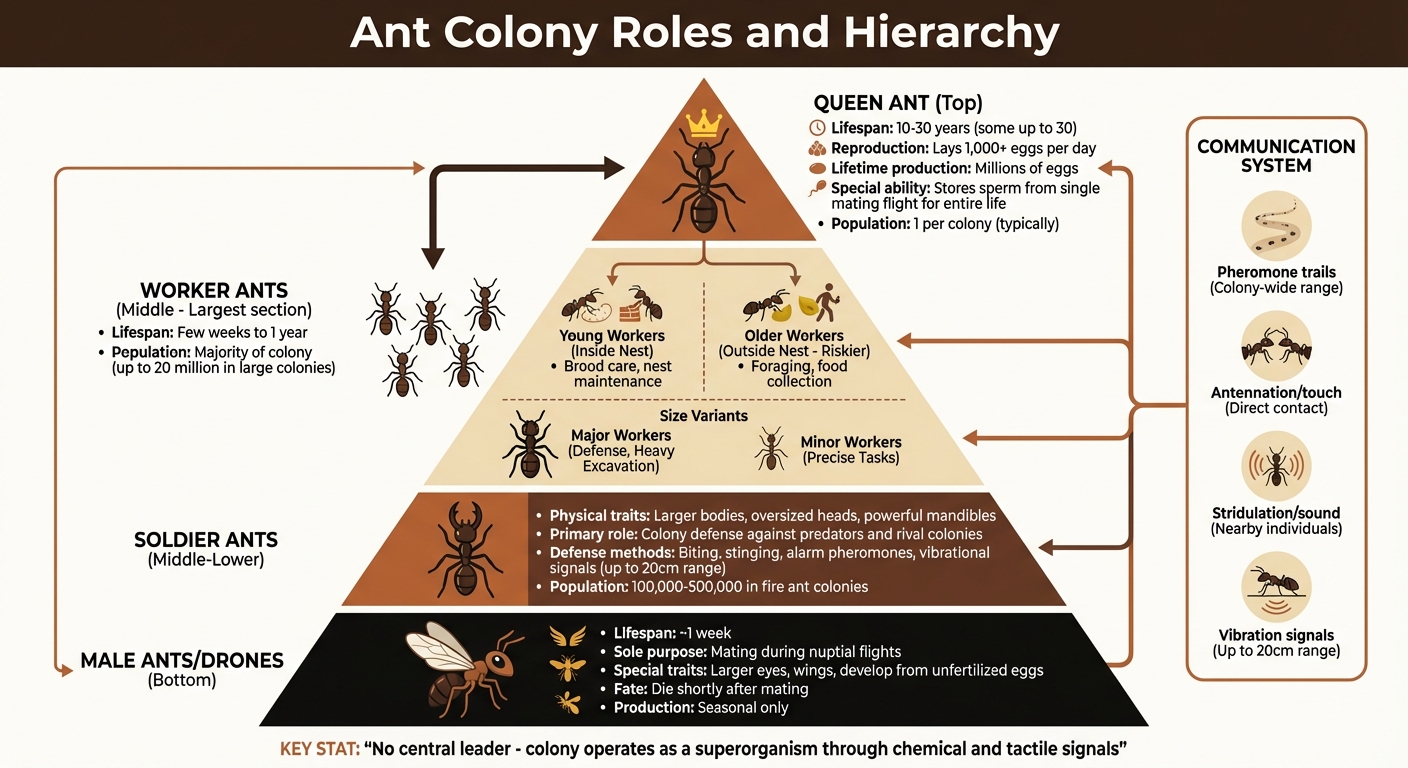
Ant Colony Hierarchy: Roles, Lifespans, and Population Distribution
The Different Roles In An Ant Colony! | BRUMA Ants
The Queen Ant: Leader of the Colony
At the heart of every ant colony is the queen - a figure essential to its survival and growth. Acting as the mother to nearly all members of the colony, her role is both simple and indispensable. Let’s take a closer look at her reproductive duties and the influence she wields.
Reproductive Role
The queen’s primary task is laying eggs, and she does so at an astonishing rate. Fire ant queens, for example, can lay over 1,000 eggs each day. Over her lifetime, a single queen may produce millions of eggs. Remarkably, she achieves this after just one mating flight. During this flight, she collects and stores sperm in a specialized organ called a spermatheca. This stored sperm allows her to fertilize eggs throughout her life, eliminating the need for repeated mating.
Through a process called haplodiploidy, the queen determines the fate of her offspring. Fertilized eggs develop into female workers or future queens, while unfertilized eggs become males.
"The queen's presence and reproductive activity are vital for the colony's health and stability, as her prolific egg-laying ensures a steady supply of new ants to replace those that die and to support the colony's evolving needs."
– Insect Lore
Lifespan and Influence
Queens enjoy a lifespan far longer than the workers in their colony. While workers typically live only a few weeks to a year, queens can live 10–15 years. Some species surpass even this impressive range. For instance, entomologist Hermann Appel documented a Lasius niger queen living 28.75 years in captivity, and Pogonomyrmex owyheei queens in the wild have been known to live for as long as 30 years.
This extraordinary longevity is linked to genetic factors. A 2016 study published in the journal Aging by researchers Eric Lucas, Eyal Privman, and Laurent Keller found that two-month-old Lasius niger queens exhibited significantly higher levels of DNA and protein repair activity compared to workers. This ability to repair biological damage not only extends the queen’s life but also ensures her sustained influence over the colony.
The queen’s impact extends beyond reproduction. Her pheromones serve as chemical signals that communicate her status to the workers. These signals help maintain social order, guiding the workers in their tasks and ensuring the colony operates smoothly.
Worker Ants: The Colony's Backbone
While the queen is responsible for producing new members of the colony, it’s the workers who handle all the day-to-day operations that keep the colony running. These ants make up the majority of the colony and take on every key task needed for survival. Their lives are relatively short, lasting anywhere from a few weeks to about a year.
Worker ants’ duties are often determined by their age and size. Younger workers usually stay inside the nest, focusing on brood care and nest upkeep. As they age, they take on riskier roles, such as venturing outside to forage. In species like carpenter ants and fire ants, worker ants come in different sizes. The larger “major” workers typically handle tasks like defense or heavy excavation, while the smaller “minor” workers are assigned more precise or delicate responsibilities.
Foraging and Food Collection
Foraging is one of the riskiest jobs in the colony, and it’s typically handled by older workers. Scout ants take the lead, venturing out to search for food sources. Once they locate something useful, they return to the nest to recruit other workers to help retrieve it. Scouts don’t just rely on memory - they use pheromones to mark the path to the food. These chemical trails become stronger as more ants follow them, creating an efficient system to guide the colony. When the food is depleted, the trail naturally fades. In some species, like Pharaoh ants, scouts even leave “no-entry” pheromones to signal that a particular route is no longer worth exploring.
Different ant species have developed specialized approaches to foraging. Leafcutter ants, for instance, don’t eat the vegetation they collect; instead, they use it to grow fungus gardens inside their nests. Other ants “ranch” aphids, protecting them in exchange for a sugary substance called honeydew. When faced with prey too large for a single ant to handle, workers team up to take it down.
Once food is brought back to the colony, it’s shared among members through a process called trophallaxis - essentially, one ant regurgitates food for another. In some species, older workers act as both food storage units and poison testers, consuming food first to ensure it’s safe before sharing it with the queen and other colony members.
"The forager population can be divided into a younger group of recruitable workers that wait for scouts to activate them to help retrieve large food finds."
– Walter R. Tschinkel, Department of Biological Science, Florida State University
Nest Maintenance
Worker ants are also the colony’s builders and maintenance crew. Using their powerful jaws, they move soil, leaves, and other materials to construct and expand the nest’s intricate system of tunnels and chambers. As the colony grows, the workers continually enlarge the nest to accommodate the increasing population. Some nests, like those of the red imported fire ant, can house up to 20 million ants.
The nest itself is highly organized. There are chambers for specific purposes: nurseries for the brood, storage areas for food, and a well-protected chamber for the queen, located deep within the nest. Workers also maintain “graveyard chambers” to dispose of dead ants and waste, which helps prevent the spread of disease.
Temperature and humidity are critical for the colony’s survival, and workers actively manage these conditions. They move the brood to areas within the nest that offer the best environment. Some species even construct ventilation systems to keep air circulating through the tunnels. If the nest is damaged, workers quickly repair it to maintain safety and functionality.
Caring for the Young
One of the most vital roles of worker ants is caring for the colony’s young. They tend to the queen’s eggs, larvae, and pupae, ensuring they are fed, groomed, and kept in ideal conditions within the nest. Younger workers are typically assigned to these tasks before transitioning to other roles as they mature. This constant attention not only supports the growth of new ants but also ensures the colony remains strong and capable of replacing workers as needed.
These roles - whether foraging, nest maintenance, or brood care - are the foundation of the colony’s survival and success. Together, the workers’ efforts create a highly coordinated system that keeps the colony thriving.
Soldier Ants: Defenders of the Colony
Soldier ants, a specialized group within the colony, are the frontline defenders against threats. These ants are easy to spot thanks to their larger bodies, oversized heads, and powerful mandibles designed for combat [20,22]. Their massive heads house muscles that enable them to bite, crush, or pierce enemies, making them highly effective protectors.
Ant colonies are under constant threat. Predators, rival colonies, and other intruders pose ongoing dangers. As ASU – Ask A Biologist aptly puts it, "The worst enemy of ants is other ants, not humans." When territories overlap or resources become scarce, neighboring colonies often clash in fierce battles.
Defense Against Predators
When a threat is detected, soldier ants spring into action, using a mix of physical attacks and chemical defenses. They bite, sting, or spray defensive chemicals to ward off enemies. Additionally, soldier ants emit alarm pheromones that rally the entire colony into a coordinated response. Some species, like carpenter ants, even create vibrational signals by banging their heads or abdomens against nest walls - a warning system detectable by nestmates up to 20 centimeters away.
This collective reaction turns the colony into a "superorganism", with each soldier fiercely defending the queen and the brood. In fire ant colonies, which can house between 100,000 and 500,000 individuals, this level of coordination can overpower much larger predators.
Territorial Protection
Soldier ants don’t just respond to immediate threats - they also guard the colony's territory. Patrolling and defending boundaries is a critical part of their role. Many ant species establish clear territorial limits around their nests, and when rival colonies cross these lines, soldier ants engage in intense battles to protect resources like food and nesting sites.
Some species, such as Argentine ants, take territorial defense to an extreme. They’ve formed a global "megacolony", where nests recognize each other as allies, creating a unified super-territory. For most ants, however, territorial defense is a constant and dangerous responsibility, shouldered primarily by the soldier caste. This strategy relies on the colony's ability to work as a cohesive unit, with every ant playing its part to ensure survival.
sbb-itb-0bbb908
Male Ants: Their Role in Reproduction
Male ants, also known as drones, have a singular purpose in life: to mate with virgin queens. Unlike their female counterparts, they don’t contribute to tasks like foraging, defending the nest, or maintaining the colony. Instead, they’re designed for reproduction, equipped with larger eyes and wings to help them locate queens during nuptial flights.
These males develop from unfertilized eggs through a process called haplodiploidy, meaning they carry only one set of chromosomes. Colonies produce males seasonally, usually after reaching maturity and building up enough resources. During nuptial flights, males leave their home colony to mate with queens from other nests, a strategy that ensures genetic diversity. This timing aligns perfectly with the seasonal cycles of male production.
"The ant colony is an almost exclusively female society with the males remaining in the nest only until the time of their first, and invariably fatal nuptial flight." - AntWiki
A male ant’s life is fleeting, typically lasting about a week. After mating, they die shortly thereafter. While their existence is brief, their contribution is critical - queens store sperm in a specialized organ called the spermatheca, allowing them to fertilize eggs for years. For instance, in species like Lasius niger, a queen can sustain her colony for almost 29 years using sperm from just one mating event.
Interestingly, not all ants follow this pattern. In the Cardiocondyla genus, males are wingless and remain within the nest. These males engage in fierce battles with rivals to secure exclusive mating rights with the queen. This intense competition highlights the vital, albeit short-lived, role that male ants play in the reproductive success of their colonies.
How the Colony Hierarchy Works
Ant colonies operate without a central authority. While the queen is vital for reproduction, she doesn’t issue commands. Instead, thousands of ants rely on local cues to work together, forming what’s known as a superorganism - where the colony functions as one cohesive unit, similar to the organs in a single body.
"Despite the title of queen, she does not delegate the tasks to the worker ants; however, the ants choose their tasks based on individual preference." - Arizona State University
The colony’s strength lies in its ability to process individual signals to optimize tasks like foraging and nesting. In 2009, researchers uncovered something astonishing: Argentine ant supercolonies in Japan, California, and Europe were actually part of a single global "mega-colony", where billions of ants coordinated over vast distances. This decentralized system is what allows the various castes to seamlessly work together and tackle challenges.
Cooperation Between Castes
Each caste within the colony has a specific role that contributes to its survival. Workers handle foraging, nest maintenance, and brood care, while soldiers focus on defending the colony. The queen’s sole responsibility is reproduction, and males contribute genetic material during mating flights. Workers also share food through trophallaxis - a process that not only nourishes the queen and larvae but also spreads crucial chemical signals throughout the colony.
Communication is the backbone of this cooperation. Ants rely on pheromone trails to guide their actions. For example, successful foragers strengthen the scent of a trail on their way back to the nest, signaling others to follow it to a rich food source. Once the resource is depleted, the pheromone fades naturally, redirecting the colony’s efforts elsewhere.
Role Flexibility
Even with specialized roles, ants display incredible adaptability, shifting tasks as needed to meet the colony's demands. Through a system called temporal polyethism - where labor is divided by age - young ants stay inside the nest to care for the queen and brood, middle-aged ants handle maintenance work, and older ants take on riskier jobs like foraging outside. This structure ensures that the most vulnerable members are protected, while experienced workers face the dangers beyond the nest.
In polymorphic species, physical traits also influence roles. Larger ants, known as major workers, often serve as soldiers or take on heavy-duty tasks, while smaller minor workers focus on foraging and brood care. When the colony faces threats, the queen can adjust the caste balance by producing more soldiers, and workers can temporarily switch roles to address immediate needs. This adaptability allows colonies - whether they consist of a few hundred ants or over 306 million - to thrive in diverse environments.
Communication and Coordination in Ant Colonies
Ant colonies operate without a central leader, yet they manage to coordinate their activities through a mix of chemical signals, touch, and vibrations. This intricate communication system allows them to tackle challenges as a unified group.
Pheromone Trails
Ants rely heavily on pheromones, which are chemicals produced by glands located in their feet, abdomen, and poison glands. When a foraging ant finds food, it lays down a pheromone trail on the way back to the nest, guiding others to the food source. This system works through feedback loops: as more ants follow and reinforce the trail, the signal becomes stronger. Once the food supply runs out, the trail fades as the pheromones evaporate.
Different ant species have refined this process with unique pheromone strategies. For instance, Pharaoh's ants (Monomorium pharaonis) use three types of pheromones: a long-lasting one to map their foraging routes, a short-lived one to highlight current food sources, and a repellent signal to mark unproductive paths.
Malaysian army ants (Leptogenys distinguenda) take this a step further by using two kinds of pheromones - one for immediate signaling and another for sustained mapping. This dual system creates what researchers call a "group memory", where volatile signals point to immediate opportunities, and more stable ones provide a lasting map.
"The use of several trail pheromones that differ in their persistence provides memory over differing time scales." - Francis L.W. Ratnieks, Professor of Apiculture
Pheromones aren’t just for foraging. The queen’s pheromones play a critical role in maintaining the colony’s social order by influencing larval development into specific castes.
Tactile Signals
Ants also communicate through physical touch. They use antennation - mutual tapping of antennae - to recognize nestmates and share task-related information.
Another tactile method is tandem running, where a successful forager leads a single recruit to a food source, maintaining constant physical contact throughout the journey.
Some ants, like carpenter ants, employ vibrations to communicate. They create drumming signals that can travel up to 8 inches (20 cm) to warn others of danger. Meanwhile, species such as Aphaenogaster albisetosus combine stridulation (a sound-producing behavior) with pheromone release to recruit help for handling large prey.
These tactile and vibrational signals complement chemical communication, ensuring swift and accurate coordination across the colony.
| Communication Method | Primary Function | Range | Example Species |
|---|---|---|---|
| Pheromone Trails | Guiding to food, marking territory, alarm signaling | Colony-wide | Pharaoh's ants, Leafcutter ants |
| Antennation (Touch) | Identifying nestmates, sharing task status | Direct contact | Harvester ants |
| Stridulation (Sound) | Recruiting help for large prey, spreading alarm | Nearby individuals | Aphaenogaster albisetosus |
| Vibration | Warning of immediate danger | Up to 8 in (20 cm) | Carpenter ants |
These methods work together to form a communication network that allows the colony to act as a "superorganism." For example, harvester ants use a foraging strategy similar to computer networks, where an outgoing worker waits for enough returning foragers to signal before venturing out.
"Natural selection will favour communication if it helps nestmates to forage more efficiently." - Francis L.W. Ratnieks, Professor of Apiculture, University of Sussex
Conclusion
Ant colonies are a fascinating example of natural teamwork and organization. Acting as a "superorganism", these colonies rely on a clear division of labor: queens handle reproduction, workers forage and care for the young, soldiers defend, and males focus on mating. Their ability to work together, using pheromones and tactile signals to communicate, allows them to solve complex challenges as a unified system.
This intricate hierarchy also shapes how we approach pest control. As Richard M. Houseman, State Entomology Extension Specialist at the University of Missouri, points out:
"If you only eliminate workers, the queen will produce more and your infestation will return. If you only eliminate the queen, workers will continue to invade your home".
The solution lies in targeting the entire colony.
One effective method is using slow-acting baits. Thanks to a behavior called trophallaxis - where ants share food throughout the colony - these baits spread, eventually reaching the queen and larvae. This approach takes advantage of the ants' natural habits to disrupt the colony from within.
If you're facing an ant problem, avoid using repellent sprays. These sprays can cause species like Pharaoh or Argentine ants to "bud", splitting the colony into multiple nests and worsening the infestation. Instead, focus on a smarter strategy: use effective baits, keep your space clean, and seal up entry points. At Remedy, we provide pest control kits designed to be safe for pets and children, complete with step-by-step instructions and virtual support to help you tackle your ant issue.
Understanding the complexity of ant colonies is key to managing them effectively. By working with their natural behaviors, you can implement strategies that address the root of the problem - eliminating the entire colony for good.
FAQs
How do ants work together without a leader?
Ant colonies operate without a central leader by following simple rules and using chemical communication. Pheromones play a key role in their information-sharing system, helping ants coordinate tasks like marking food trails, signaling danger, or gathering reinforcements. For instance, when a worker ant discovers food, it leaves a scent trail to guide others to the source. The more ants use the trail, the stronger the scent becomes, naturally creating efficient paths for foraging.
In addition to pheromones, ants rely on touch and vibrations to communicate, particularly in dark environments like underground nests. These decentralized interactions enable the colony to function as a "superorganism." Individual ants contribute to larger, organized behaviors, such as building intricate nests, forming bridges, or responding to threats. This self-organizing system allows ant colonies to adapt swiftly and operate smoothly, even when millions of members are involved.
What jobs do worker ants take on as they get older?
Worker ants go through a fascinating shift in responsibilities as they age, a behavior referred to as temporal polyethism. Younger ants usually remain within the safety of the nest, taking care of essential duties like tending to the queen, nurturing the larvae, and keeping the nest in good condition. As they grow older, their roles evolve, and they begin venturing outside the nest to forage for food and other resources. The oldest workers often handle the riskiest jobs, such as sampling food to ensure it’s safe, shielding the colony from potential toxins.
This age-based division of labor keeps the colony running smoothly and spreads out the risks, assigning the most hazardous tasks to those with the most experience.
Why is it important to eliminate the entire ant colony during pest control?
When dealing with ants, it’s essential to target the entire colony, not just the ones you see crawling around. Ants operate with a highly organized hierarchy, and their primary goal is to protect the queen and other reproductive members. Worker ants often act as a frontline defense, testing and even diluting poisons to keep the queen and the colony’s core safe.
If you only go after the foraging ants, you’re essentially scratching the surface. The colony itself will stay intact and continue to grow. To truly solve the problem, pest control efforts need to focus on reaching the queen and dismantling the colony’s structure. That’s the key to achieving long-term results.