


Pests thrive based on weather patterns. Temperature, humidity, and rainfall directly influence their activity, reproduction, and migration. For example, mosquitoes complete their life cycle faster in warmer weather (7 days at 85°F vs. 14 days at 70°F), while cockroaches lay more eggs in humid conditions. By monitoring local weather data, you can predict pest behavior and act at the right time to prevent infestations.
Key Takeaways:
- Temperature: Warmer conditions accelerate pest growth and reproduction.
- Humidity: High moisture levels encourage pests like cockroaches and termites.
- Rainfall: Creates breeding grounds for mosquitoes and displaces pests indoors.
- Tools: Use free services like the National Weather Service or AccuWeather for hyper-local forecasts. Degree-day calculators help predict pest life cycles.
- Action Plan: Set alerts for weather triggers, log pest sightings, and use targeted treatments during vulnerable pest stages.
This weather-based approach reduces pesticide use, saves resources, and improves pest control outcomes. By combining weather insights with precise timing, you can stay ahead of infestations and protect your home effectively.
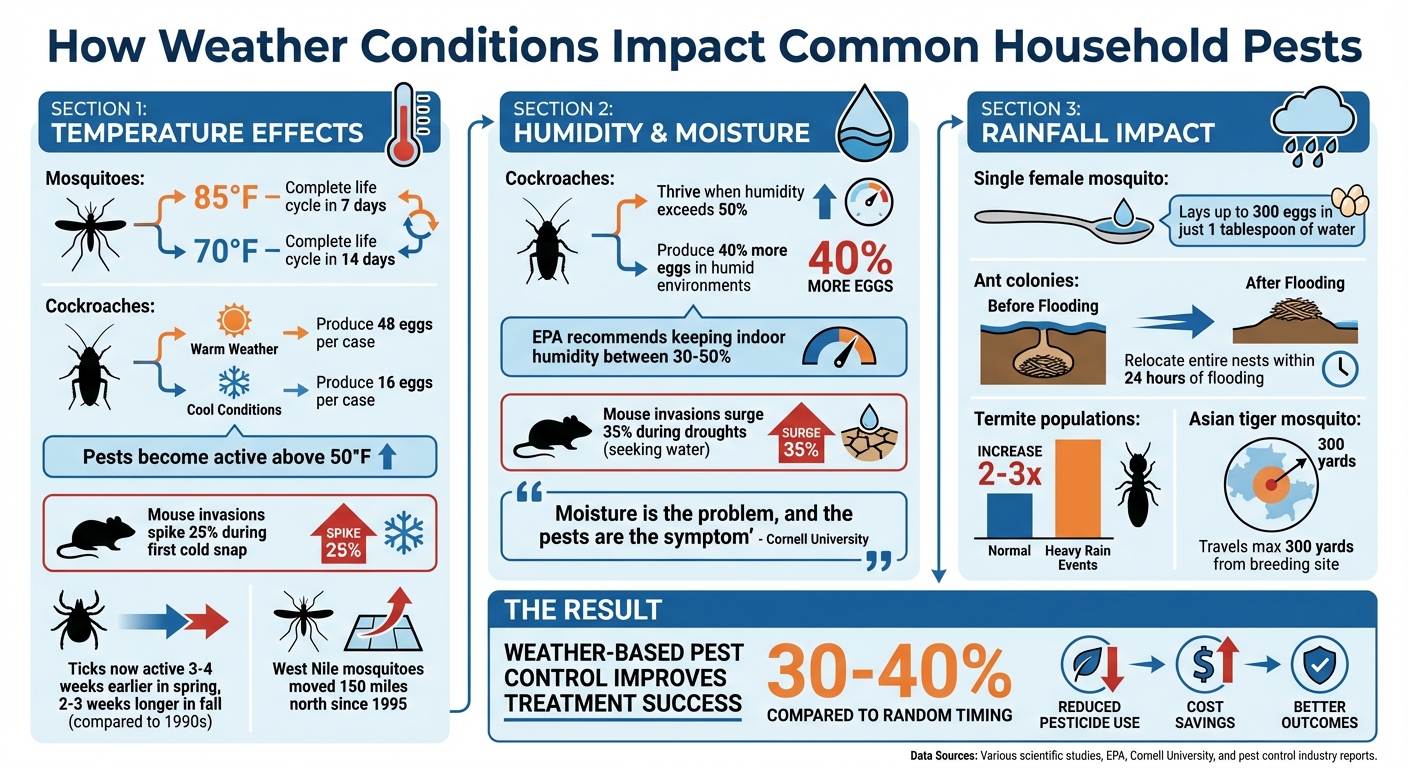
How Weather Conditions Impact Common Household Pests
Cooler Weather Pest Control: Prevention Tips From Arrow Exterminators

Weather Factors That Affect Pest Activity
Understanding how weather influences pest behavior is crucial for predicting and managing infestations. Factors like temperature, humidity, and rainfall play a major role in determining when and where pests become active in and around your home.
Temperature Changes and Pest Behavior
Temperature is like a control knob for pest activity. Many pests rely on ambient temperatures to thrive, becoming active when it climbs above 50°F. Warmer conditions not only increase their activity but also speed up reproduction and shorten their life cycles. For example, cockroaches can produce up to 48 eggs per case in warm weather, compared to just 16 in cooler conditions. Similarly, mosquitoes start buzzing around at 50°F but truly thrive when it’s over 70°F.
Here’s a quick look at the temperature thresholds for common pests:
| Target Insect | Lower Developmental Threshold (°F) | Upper Developmental Threshold (°F) |
|---|---|---|
| Codling Moth | 50°F | 88°F |
| Corn Earworm | 55°F | 92°F |
| Alfalfa Weevil | 50°F | 87°F |
| Black Cutworm | 50°F | 86°F |
| Variegated Cutworm | 45°F | 80°F |
| Armyworm | 50°F | 84°F |
Source: Utah State University
Climate change is also shifting pest patterns. Since 1995, mosquitoes carrying West Nile virus have moved 150 miles further north in the U.S.. Ticks are now active 3–4 weeks earlier in spring and remain a nuisance 2–3 weeks longer in the fall compared to the 1990s. Even rodents are affected - mouse home invasions spike by 25% during the first cold snap as they seek out warmer indoor spaces.
Next, let’s explore how moisture levels impact pest behavior.
Humidity and Moisture Levels
Temperature isn’t the only factor; moisture levels are equally important. High humidity creates ideal conditions for pests to thrive. Many pests, like cockroaches, are particularly drawn to environments where humidity exceeds 50%. To minimize the risk of infestations, the EPA suggests keeping indoor humidity between 30% and 50%.
Moisture’s influence on pests is significant. For instance, cockroaches produce 40% more eggs in humid environments. During prolonged droughts, mouse invasions can surge by 35% as they search for indoor water sources. High moisture also weakens materials like wood and drywall, making it easier for termites to invade.
"Moisture is the problem, and the pests are the symptom." - Cornell University College of Agriculture and Life Sciences
Regional differences highlight how humidity impacts pest seasons. In the Gulf Coast and Florida, mosquito season stretches from February to November, while in New England or the Pacific Northwest, it’s typically limited to May through September.
Rainfall and Standing Water
Rainfall is another major factor influencing pest activity. Heavy rains can create puddles and standing water, which are perfect breeding grounds for mosquitoes. A single female mosquito can lay up to 300 eggs in just a tablespoon of water. The Asian tiger mosquito, for example, rarely travels more than 300 yards from its breeding site, meaning local water sources directly contribute to infestations.
Rain also displaces pests that live underground. When stormwater floods their nests or burrows, pests like rodents and ants seek higher ground - or move indoors. Ant colonies, for instance, can relocate their entire nests, including eggs and larvae, within 24 hours of flooding. Saturated soil from heavy rains can also lead to termite swarms, with populations increasing by two to three times during these events.
"Heavy rainfall events dramatically displace pest populations, forcing them to seek higher ground." - Farmstand App
Step 1: Find Reliable Weather Data Sources
Tracking weather conditions is key to predicting pest activity, and the best part? You don’t need fancy gear to get started. There are plenty of free, trustworthy sources that provide the hyper-local data necessary to anticipate pest issues before they escalate.
Free Tools for Local Weather Monitoring
Start with the National Weather Service (NWS) at weather.gov. As the official weather authority in the U.S., it operates 122 local forecast offices and gathers a staggering 6.3 billion observations daily, producing about 1.5 million forecasts each year. By simply entering your zip code in the "Customize Your Weather.gov" box on their homepage, you can access tailored forecasts specific to your area.
Another excellent option is AccuWeather, which offers tools designed to make pest-related weather tracking easier. Their "MinuteCast" feature provides minute-by-minute precipitation updates, which is ideal for monitoring conditions like standing water after a storm. Their "RealFeel" temperature feature goes beyond basic readings by factoring in humidity and sun intensity - critical details for understanding conditions pests actually experience. If you're monitoring mosquito breeding or termite activity, this level of detail is a game-changer.
For pest-specific insights, explore university IPM (Integrated Pest Management) portals, such as UC IPM from the University of California. These platforms often include degree-day calculators, which use temperature data to map out the development stages of pests. Additionally, the High Plains Regional Climate Center provides historical and current temperature data tailored for degree-day modeling.
For even more precise readings, consider setting up a personal weather station.
Using Personal Weather Stations
If you’re looking for hyper-local accuracy, a personal weather station is a fantastic option. These stations provide site-specific data, capturing subtle microclimate variations that broader forecasts might miss. Even within a few miles, temperatures can differ significantly, and having your own station eliminates much of the guesswork.
A basic option is a max-min thermometer, which records daily high and low temperatures. These are available in both digital and mercury formats. For more advanced monitoring, consider sensors like biophenometers, which calculate degree days in real time. Keep in mind, though, that these devices typically cost between $300 and $1,000.
When setting up your station, place it in a shaded area away from direct sunlight. Be sure to calibrate the equipment at the start of each season and take readings consistently at the same time each day - mid-morning or late afternoon works best.
Many personal weather stations can even sync with platforms like AccuWeather, allowing you to combine your hyper-local data with professional forecasts. This integration helps you identify patterns and set up alerts, which will be essential in the following steps.
Step 2: Track Weather Triggers for Specific Pests
Once you've identified your weather data sources, the next step is figuring out how temperature influences pest development. Unlike humans, insects are ectothermic, meaning their growth and activity depend on the surrounding temperature rather than the calendar. For instance, a warm spring can bring pests like mosquitoes out weeks earlier than expected, making degree days (DD) a much more accurate predictor than simply relying on dates. Let’s dive into how degree days work and why they’re so important.
Understanding Degree Days (DD)
Degree days measure the "physiological time" insects need to develop through their life stages. Essentially, this method tracks the heat accumulation necessary for pests to grow and mature. Most landscape pests are modeled using a base temperature of 50°F, which is the threshold below which their development halts.
The calculation is straightforward: Take the average of the day’s high and low temperatures, then subtract 50°F. If the result is negative, it counts as zero. For example, with a high of 68°F and a low of 52°F, the average is 60°F, resulting in 10 degree days for that day. These values are then added up starting from a specific "biofix" date, often March 1 in many areas.
Why does this matter? Consider Logan, Utah: Over three years, the codling moth’s egg hatch varied by 15 days when tracked by calendar (ranging from April 30 to May 15). However, when using degree days, the accumulation consistently hit 220 DD before the first egg hatch. Marion Murray, an Extension IPM Specialist at Utah State University, explains:
"Using degree days to time treatments is more reliable than a calendar date and allows growers to pinpoint a specific treatment date each year".
| Pest | Base Temperature | Key DD Milestone |
|---|---|---|
| Mosquitoes | 50°F | General activity begins |
| Codling Moth | 50°F | 220 DD (first egg hatch) |
| Eastern Tent Caterpillar | 50°F | Active below 100 DD |
| San Jose Scale | 51°F | Crawler stage emergence |
Using Pest Tracking Apps
Tracking degree days manually can be tedious, but digital tools make it much simpler. Apps and online platforms can automate the calculations for you. For instance, NEWA (Network for Environmental and Weather Applications) from Cornell lets you select a local weather station, set a 50°F baseline, and automatically calculates seasonal DD accumulations. Similarly, USPEST.ORG from Oregon State University provides access to over 25,000 weather stations and more than 160 pest-specific models through an easy-to-use Google Maps interface. If you’re in California, UC IPM offers tailored phenology databases and interactive calculators for local pests.
These tools take the guesswork (and math) out of degree days, allowing you to focus on identifying when pests are most active and vulnerable. By turning weather data into actionable insights, you can plan treatments with precision and improve pest management strategies.
sbb-itb-0bbb908
Step 3: Set Up Alerts and Monitoring Routines
Once you've got degree days and tracking tools in place, the next step is to automate your monitoring system. This way, you’ll get alerts whenever conditions are ripe for pest activity. Here’s how to set up precise alerts and keep detailed records to improve your pest control strategy.
Create Threshold Alerts for Pest Triggers
Start by setting alerts based on key environmental thresholds. For instance, humidity levels above 75% and temperatures exceeding 86°F for several days often signal an increase in cockroach, termite, and ant activity. Similarly, a forecast of three days of rain is a red flag for moisture-loving pests like mosquitoes and termites.
Many weather apps allow you to customize alerts, but specialized tools provide even more accuracy. For example, the Network for Environmental and Weather Applications (NEWA) lets you set pest-specific alerts based on growing degree day accumulations. If you're in New Hampshire, texting "UNHIPM" to 866-645-7010 will give you real-time pest warnings tailored to local conditions. Additionally, Wireless Emergency Alerts (WEA) notify you of extreme weather events - like hurricanes or flash floods - that can lead to pest surges. These alerts are highly precise, with a location accuracy of up to 0.1 miles on newer devices.
Here’s a quick guide to weather triggers and how they correlate to pest activity:
| Weather Trigger | Potential Pest Activity | Recommended Action |
|---|---|---|
| High Humidity (>75%) | Cockroaches, Termites, Ants | Inspect damp areas; use dehumidifiers |
| Heavy Rainfall | Mosquitoes, Termites, Rodents | Remove standing water; check for leaks |
| Rising Temperatures | Increased pest reproduction/activity | Seal entry points; set traps |
| Cold Snaps | Rodents seeking indoor shelter | Inspect attic and basement seals |
While alerts are helpful, maintaining records allows you to identify patterns and fine-tune your response.
Log Weather Data and Pest Sightings
Keeping track of weather conditions and pest activity is an effective way to spot trends over time. Use a simple spreadsheet or a notes app to log details like the date, temperature, humidity, rainfall, and any pest sightings. For example, if you notice ants consistently appearing after humidity hits 70% following rain, you’ll know when to act.
Weekly scouting is equally important. Walk around your property armed with a magnifying lens and a white cloth. Shaking branches over the cloth can help you spot tiny pests like mites. Record your findings along with the day’s weather data for a more comprehensive picture. Andy Paterson, a Content Strategist at ClimateAi, highlights the importance of this practice:
"By providing early, accurate, trusted alerts and remediation recommendations, producers can improve yields, operational planning, and reduce input costs".
This method isn’t just for large-scale producers - it’s just as effective for homeowners. Combining automated alerts with detailed logs creates a feedback loop that helps you refine your pest management techniques over time. It’s a proactive way to stay ahead of potential problems while aligning with the Remedy approach.
Step 4: Take Preventive Actions with Remedy Kits
With alerts and logs set up, it’s time to fine-tune pest control measures based on precise weather cues. Remedy helps you turn weather data into a dynamic pest management plan, leveraging real-time insights to ensure treatments are as effective as possible.
Timing Is Everything
For pest control to work, timing treatments with specific weather events is key. For instance, after heavy rains, applying larvicides to standing water can stop mosquito larvae before they mature into pupae. Similarly, when high humidity alerts pop up, deploying baits right away targets pests during their most active periods.
As temperatures drop, your strategy should shift. The first significant autumn temperature drop is a signal to seal cracks and gaps, as this is when rodents and stink bugs start seeking indoor shelter. For landscape pests, like the codling moth in Logan, UT, egg hatching is reliably triggered at 220 degree days, regardless of the date on the calendar.
Adapting to Local Weather Patterns
Beyond timing, tailoring your pest control to local weather trends takes your efforts to the next level. Remedy kits are designed with regional pests and weather conditions in mind. For example:
- In the Southwest, where fall temperatures remain mild, kits include scorpion and spider barriers.
- In the Midwest, where sudden cold snaps drive pests indoors, kits come with professional-grade sealing products to block entry points before the first freeze.
Each kit includes high-quality, pet- and child-safe products, along with detailed instructions on when and where to use them based on your local conditions. Plus, Remedy offers ongoing support to help you adapt as weather patterns change throughout the season, keeping you ahead of pest activity at all times.
Step 5: Evaluate and Adjust Your Pest Control Routine
With alerts and logs set up, it’s time to evaluate your pest control efforts and fine-tune your timing and tactics.
Track Pest Risks and Results
Once you’ve implemented weather-based pest control, it’s crucial to track the results to identify what’s working and what needs improvement. Keep a detailed log that includes dates, weather conditions, and pest activity. After each treatment, reflect on its effectiveness: Did it achieve the desired results? If not, what might have gone wrong? What can you tweak for better results next time? These records will help you determine whether your treatments are hitting pests during their most vulnerable stages. Even with weather-based timing taking out much of the guesswork, regular scouting is still a must.
"Records can help you manage landscape plant problems during the current growing season, evaluate management methods, and predict problems in the future." – Penn State Extension
Use simple techniques like a strike test - tap branches over a white sheet of paper or check the undersides of leaves - to spot early signs of pest activity. Assess any visible damage and weigh it against acceptable thresholds, keeping in mind that not every pest sighting calls for immediate action.
These steps help you refine your approach, and that’s where our virtual support becomes invaluable.
Get Long-Term Support with Remedy
Our virtual support is designed to help you keep improving your pest control strategy over time. Remedy offers expert assistance in identifying pests and adjusting your methods as weather patterns shift throughout the season. Plus, our regular shipments ensure you’re always stocked with professional-grade, pet- and child-safe products, ready to act when weather alerts indicate it’s time.
Microclimates - shaped by factors like mountains, lakes, or urban heat islands - can make pest control tricky. That’s why our team is here to help tailor your strategy to your specific location. As you build your monitoring log over multiple seasons, you’ll start to see patterns that help you make more accurate predictions. With our ongoing guidance and product shipments, you can turn weather data into a reliable, long-term pest control plan that evolves with your local conditions.
Conclusion
Weather data transforms pest control into a precise and effective strategy. By keeping tabs on temperature, humidity, and rainfall patterns, you can predict when pests are most likely to appear and target them during their weakest life stages. This approach can boost treatment success rates by 30%-40% compared to random timing. Not only does this reduce the use of unnecessary chemicals, but it also safeguards your family and pets while cutting costs on labor and materials that might otherwise be wasted. This strategy forms the backbone of a smarter pest control routine.
By combining weather monitoring with our tailored kits, you ensure that treatments are applied exactly when needed. Matching products to your local weather trends helps you hit pests during their most vulnerable moments. For instance, sealing up entry points before the first frost or treating mosquito breeding areas when standing water reaches 45°F keeps you ahead of common infestations.
"Keeping track of weather, and specifically daily temperatures, can help you fine tune the timing of pest management activities, contributing to significant savings in costs of labor, materials, and plant injury." – Amy Papineau, Landscape and Greenhouse Horticulture Extension Field Specialist
With regular shipments of pet- and child-safe products, you'll spend less time reacting to pest problems and more time preventing them. No need for strangers entering your home or paying for generic quarterly treatments that don’t align with your local pest activity.
Start tracking your local weather - we’ll take care of the rest. With the right data, products, and timing, you can turn weather patterns into your most reliable pest control ally. By acting on weather insights, you create a pest prevention plan that is effective, efficient, and always one step ahead.
FAQs
How can I use weather data to prevent pest problems at home?
You can predict pest activity by keeping an eye on daily high and low temperatures and calculating growing degree days (GDD). GDD tracks the accumulation of heat over time, making it a useful tool for forecasting when pests - like certain insects - are likely to hatch, emerge, or become active. Since each pest species has its own temperature thresholds for development, monitoring these can help you stay one step ahead in managing infestations.
By comparing your local GDD data to pest activity benchmarks, you can time your pest control measures more effectively. For example, you can apply treatments before pests become a bigger problem. If you're looking for an easy and proactive solution, the Remedy DIY Pest Control Kit might be worth considering. It provides professional-grade, pet- and child-safe products tailored to your specific pest issues and home needs.
How can I use weather data to predict and prevent pest problems?
Weather data can be an incredibly useful resource for predicting pest activity and staying a step ahead of potential infestations. By keeping an eye on conditions like temperature and moisture levels, you can anticipate when pests are most likely to appear and take action at the right time.
Tools such as degree-day calculators and pest calendars are particularly helpful for this. These tools track seasonal heat accumulation and align it with pest life cycles. For instance, degree-day trackers can pinpoint key moments in a pest's development, like when eggs are about to hatch or adults are emerging. Additionally, localized weather dashboards provide real-time updates from nearby stations, helping you adapt your pest prevention strategies to your specific environment.
When you pair these weather insights with Remedy pest control kits, you can apply treatments at just the right time, giving your home the best possible protection.
How can tracking degree days improve pest control timing?
Tracking degree days offers a smart way to predict when pests hit specific life stages, such as hatching or becoming adults, by analyzing accumulated daily temperatures. Instead of relying on calendar dates, this method calculates the heat units pests need to develop, providing a much more precise approach.
Take this example: if a pest becomes vulnerable at 150 growing degree days (base 50°F), you can time your pest control efforts - like applying a Remedy DIY pest control kit - exactly when they’re most susceptible. This targeted timing not only boosts effectiveness but also cuts down on pesticide use, saves money, and aligns your actions with the pest’s natural growth cycle.
Using real-time weather data alongside degree-day calculations keeps you one step ahead of pest issues. It’s an efficient way to protect your home and family while keeping environmental impact to a minimum.