


Non-toxic pest control products are a safer alternative to chemical pesticides, especially for households with children, pets, or those sensitive to chemicals. While they may not act as quickly or last as long as chemical options, they can still work effectively when used correctly and consistently. These products rely on natural ingredients like essential oils, diatomaceous earth, and neem oil, which target pests through physical, biological, or repellent mechanisms. They are biodegradable, safer for beneficial organisms, and less likely to cause resistance in pests.
Key Takeaways:
- Non-toxic products are ideal for prevention and early infestations.
- They are safer for humans, pets, and the environment but require frequent reapplication.
- Best results come from combining methods, such as Integrated Pest Management (IPM), which focuses on long-term prevention and tailored solutions.
If you're looking for a safer way to manage pests, non-toxic solutions can work well, especially when part of a broader strategy.
Are pet friendly pest control products as effective?
What Are Non-Toxic Pest Control Products?
Non-toxic pest control focuses on using natural ingredients, biological agents, and preventive strategies instead of relying on synthetic chemicals. This method prioritizes safety for families while effectively managing pests. Unlike synthetic pesticides - such as organophosphorus and carbamates - non-toxic options are derived from plants, essential oils, and minerals. These alternatives are more selective, helping to safeguard beneficial organisms like pollinators. For instance, studies reveal that less than 1% of applied pesticides actually reach their intended pests, with the rest dispersing into the environment. Additionally, synthetic pesticides can linger in the environment for decades, whereas non-toxic solutions are biodegradable and leave no harmful residues. This is particularly important given the alarming statistic of over 160,000 pesticide poisoning cases reported annually in Europe. Below, we explore the key ingredients that define these safer pest control options.
Common Ingredients in Non-Toxic Products
Non-toxic pest control products often rely on natural ingredients with proven effects against pests. Here are some of the most commonly used:
- Essential oils like peppermint, eucalyptus, lavender, rosemary, and thyme are known to repel pests with their strong scents.
- Diatomaceous earth works by damaging the exoskeletons of pests, ultimately leading to their dehydration.
- Neem oil disrupts pest life cycles, preventing them from reproducing.
- Biological controls include introducing natural predators like ladybugs, lacewings, or nematodes, as well as microbial agents such as Bacillus thuringiensis (Bt).
- Boric acid harms pests by damaging their midguts, causing them to starve.
- Insecticidal soaps, made from potassium salts of fatty acids, break down the protective waxy coatings of soft-bodied insects.
How They Work Against Pests
Non-toxic products tackle pests through three main mechanisms:
- Repellents: Natural scents create environments that pests avoid.
- Physical Barriers: Tools like mesh, netting, or heat treatments block pests from entering spaces.
- Mechanical Action: Ingredients like diatomaceous earth physically harm pests. Its microscopic, sharp edges are deadly to insects but harmless to humans. As Ameya Gondhalekar, Sapp Associate Professor of Urban Entomology at the University of Florida, points out:
"If you can see a layer of it with your naked eye, then it's likely too much. You need microscopic quantities."
The scientific community has shown increasing interest in botanical pesticides. Research articles on the topic have grown from less than 1% in 1989 to over 40% by 2010. This shift highlights a broader recognition that pests are less likely to develop resistance to non-toxic methods, such as physical barriers or biological controls, compared to traditional chemical treatments.
Non-Toxic vs. Chemical Pest Control: A Comparison
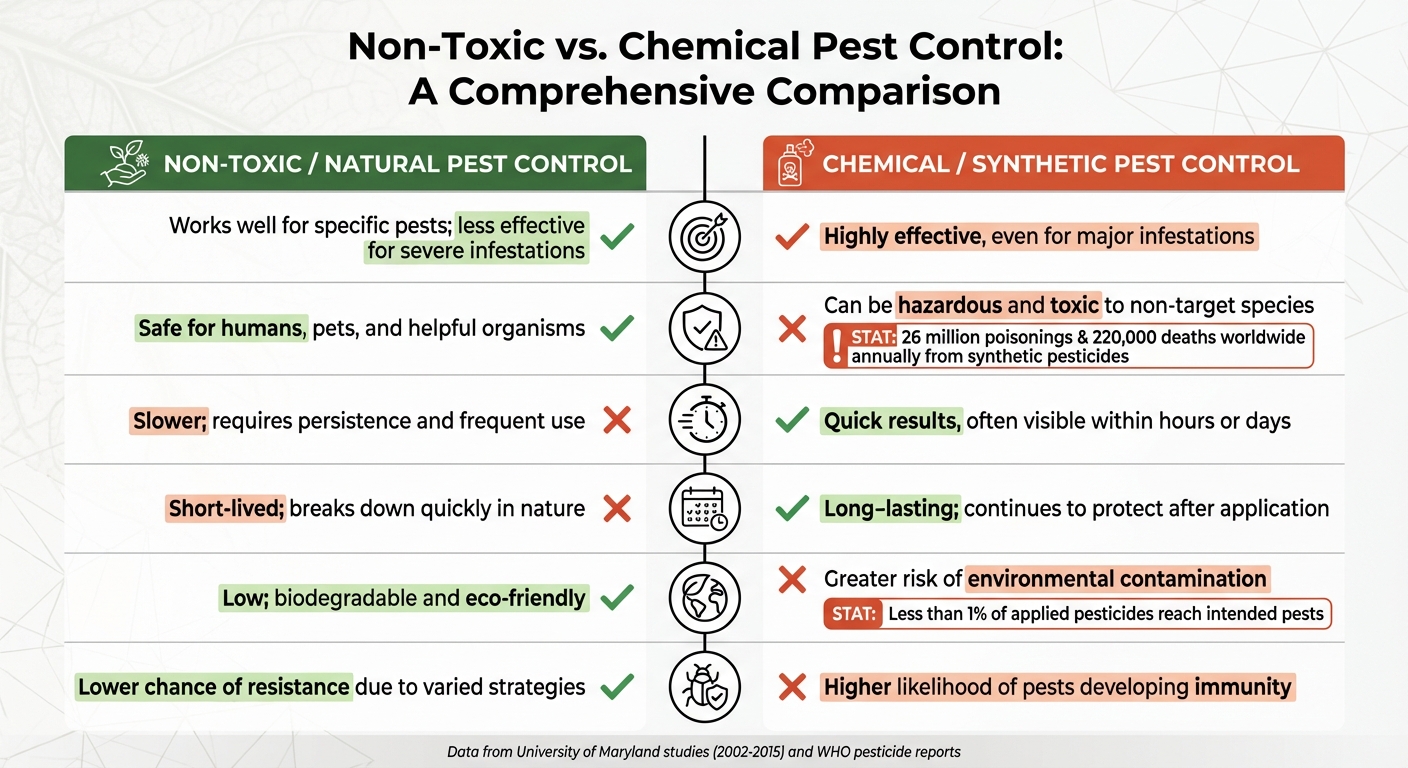
Non-Toxic vs Chemical Pest Control: Safety, Effectiveness & Environmental Impact Comparison
Chemical pest control works quickly, often delivering results within hours or days. On the other hand, non-toxic methods emphasize safety and minimizing harm to the environment, though they tend to act more slowly. For severe infestations, chemical solutions are undeniably effective but come with serious health risks. In fact, synthetic pesticides are associated with approximately 26 million poisonings and 220,000 deaths worldwide each year. Non-toxic treatments often require repeated applications, especially after rain or irrigation, which can make them less convenient.
Another key difference lies in how long the protection lasts. Chemical treatments typically provide longer-lasting results, while non-toxic options degrade faster under natural conditions, necessitating more frequent reapplication. With growing concerns about health and environmental contamination, these distinctions are especially important for homeowners weighing their options.
Additionally, pests can develop resistance to synthetic chemicals over time, making them less effective. Non-toxic methods, particularly biological controls that use diverse strategies, are less likely to lead to resistance. In some cases, natural solutions - like beneficial insects or nematodes - can even target pests in hidden areas that chemical sprays might miss. Understanding these contrasts helps highlight the strengths and weaknesses of each approach.
Pros and Cons of Each Approach
| Factor | Non-Toxic / Natural Pest Control | Chemical / Synthetic Pest Control |
|---|---|---|
| Effectiveness | Works well for specific pests; less effective for severe infestations | Highly effective, even for major infestations |
| Safety | Safe for humans, pets, and helpful organisms | Can be hazardous and toxic to non-target species |
| Speed | Slower; requires persistence and frequent use | Quick results, often visible within hours or days |
| Residual Action | Short-lived; breaks down quickly in nature | Long-lasting; continues to protect after application |
| Environmental Impact | Low; biodegradable and eco-friendly | Greater risk of environmental contamination |
| Pest Resistance | Lower chance of resistance due to varied strategies | Higher likelihood of pests developing immunity |
Effective Non-Toxic Methods That Work
Let’s dive into some proven non-toxic pest control methods. These approaches offer effective solutions without relying on harmful chemicals, making them safer options for homes and gardens.
Essential Oils and Natural Repellents
Essential oils work by creating a sensory barrier that confuses pests and masks the scents that attract them. For example, peppermint oil is particularly effective against spiders, mice, and ants, while tea tree oil helps deter ants, and citronella keeps mosquitoes at bay. However, these oils evaporate quickly - usually within 2–3 hours outdoors - so frequent reapplication is necessary.
"It's important to take into consideration many things that influence its effectiveness, including the formulation, concentration, how it's applied, and what specific insects or arthropods you're hoping it repels." - Kait Chapman, Extension Educator of Urban Entomology, University of Nebraska-Lincoln
To use essential oils effectively, mix 10–20 drops of your chosen oil with a cup of water and a few drops of dish soap to emulsify. Apply this mixture around windows, doors, and baseboards. Indoors, reapply every few days, while outdoor applications may need refreshing every 1 to 3 hours due to UV exposure. For a longer-lasting option outdoors, cedarwood oil can remain effective for up to 60 days when applied to porous surfaces like wood or stone.
Diatomaceous Earth
Diatomaceous earth (DE) offers a chemical-free way to eliminate pests by targeting their exoskeletons. This fine powder, made from fossilized aquatic organisms, causes insects to dehydrate and die on contact. Unlike chemical pesticides, pests cannot develop resistance to DE, as it works through a physical mechanism.
Homeowners have reported reductions of 70% to 90% in ant and roach activity within two to three weeks of consistent use. For best results, apply a thin, almost invisible layer of food-grade DE using a shaker or bellows. It’s crucial to keep the powder dry, as moisture renders it ineffective, so reapply after rain or cleaning. This method is safe for indoor use around pets and children, as long as food-grade DE is used.
Neem Oil and Biological Controls
Neem oil works in two main ways: it suffocates pests on contact and disrupts their growth by interfering with the larvae and egg stages. It also makes plants unappealing to pests, discouraging them from laying eggs. A study conducted by the University of Maryland between 2002 and 2015 found that a neem-based product containing 4.5% azadirachtin (Neemix) reduced pest populations by an average of 46.1%, particularly targeting larvae like those of Mexican bean beetles and Colorado potato beetles.
When using neem oil, focus on thoroughly coating the undersides of leaves, as this is where pests often hide. Targeting larvae and immature pests significantly boosts its effectiveness.
Biological controls, on the other hand, involve introducing natural predators or pathogens to manage pest populations. For instance, releasing ladybugs can cut aphid numbers by 80% to 95% in home gardens. Timing is key - release them during the cooler hours of the morning or evening for the best results. Another great option is Bacillus thuringiensis (Bt), a naturally occurring bacterium that specifically targets certain pests while leaving beneficial insects unharmed.
These methods demonstrate how natural solutions can be both effective and sustainable, offering targeted pest control without harmful side effects.
sbb-itb-0bbb908
Effectiveness and Limitations of Non-Toxic Products
Non-toxic pest control methods can deliver strong results, but they come with certain compromises. Field trials conducted between 2002 and 2015 revealed that these products reduced pest populations by 46.1% to 73.9%, depending on the specific product and type of pest involved. While effective, their performance varies widely.
One notable drawback is their slower action compared to chemical alternatives. Natural products tend to break down quickly when exposed to sunlight or rain, which means they often need to be reapplied more frequently to maintain effectiveness. Additionally, most non-toxic options rely on direct contact or ingestion to work, so thorough application is critical - especially to target pests hiding in hard-to-reach areas.
When Non-Toxic Products Work Best
Non-toxic pest control methods shine when used as a preventive measure. They’re particularly effective in the early stages of an infestation. For example, addressing a small ant problem in your kitchen or spotting a few aphids on your tomato plants early on can help prevent the situation from escalating. Acting quickly is key.
Certain pests respond especially well to specific natural solutions. A University of Maryland study found that Entrust provided over 75% control for pests like flea beetles, Colorado potato beetles, and cabbageworms. Similarly, diatomaceous earth works well against ants and cockroaches in dry indoor spaces, while neem oil is effective for soft-bodied insects like aphids and mites - provided it’s applied consistently.
Even with these advantages, there are challenges to keep in mind.
Common Challenges and Misconceptions
One challenge is the slower action of non-toxic solutions, which can lead to misunderstandings about their effectiveness. Many users expect immediate results, but these methods often take days or even weeks to show noticeable reductions in pest populations. This is because they typically disrupt pest growth cycles rather than killing pests outright.
Pest management expert Heidi Hemminger highlights this balance:
"Organic pest control products can be just as effective as chemical pesticides in controlling certain pests... However, when dealing with a severe infestation, it may be challenging to control pests using organic products alone."
Some pests, like thrips, stinkbugs, and cucumber beetles, are particularly difficult to manage with non-toxic methods, often achieving control rates below 30%. Deep-seated problems, such as termite or bed bug infestations, may only be slowed rather than resolved entirely.
Another common misconception is that "natural" automatically equates to being safe for everything. While these products are generally safer for humans and pets, they can still pose risks to non-target species. For instance, around 80% of flowering plants depend on insect pollination, and even natural options like neem oil can harm bee larvae or cause deformities. Timing applications carefully - such as spraying in the evening when pollinators are less active - can help reduce unintended harm.
Integrated Pest Management: Combining Non-Toxic Solutions with Remedy Kits
For homeowners looking for safer yet effective pest control options, combining methods is the way to go. Non-toxic products work best as part of a broader strategy. Integrated Pest Management (IPM) emphasizes long-term prevention by addressing the root causes of pest problems - removing their access to food, water, and shelter - rather than just dealing with infestations as they happen. Research shows that this proactive approach can cut pest-removal costs by a third and reduce pest complaints by up to 90%.
What makes IPM stand out is its multi-layered approach. By using a combination of physical barriers, improved sanitation, and well-timed treatments, you create a system where different methods work together. As Miriam Rotkin-Ellman, Senior Scientist at NRDC, puts it:
"Pesticides can't always eradicate pest infestations because they can't kill them off at every stage of their life cycles."
This highlights the importance of timing and consistency, which are key to making pest control effective. Customized solutions, like remedy kits, take this concept further by tailoring the approach to your specific needs.
How Remedy Kits Improve Non-Toxic Pest Control
Our remedy kits are designed to solve common issues such as inconsistent application and lack of personalization. Here's how it works: when you sign up, we use your zip code to time shipments based on local pest activity and climate. We also calculate the exact amount of product needed for your home’s square footage, eliminating the guesswork.
Each kit includes professional-grade botanical products that are safe for pets and children, customized to target the pests you're dealing with. You let us know what pests are causing trouble, and we tailor the kit to address them. Since every pest requires a different approach, this level of precision is crucial.
Another advantage of our kits is that they help prevent pests from developing resistance - a common problem with traditional pesticides. By alternating between biological, mechanical, and botanical solutions, pests don’t get the chance to adapt. As the NRDC notes:
"Bugs often grow resistant to pesticides. Spray them and they'll just bounce back stronger."
Step-by-Step Guidance with Remedy
To make pest control even easier, we provide step-by-step instructions with every kit. One of the biggest challenges in DIY pest control is knowing when and how to apply treatments. Our straightforward guides, combined with virtual support from experts with over 30 years of experience, ensure you get it right every time.
Not sure what pest you’re dealing with? We’ll help you identify it before you start, so you’re not wasting time or resources. Plus, our regular shipments ensure consistent protection, which is essential for breaking pest life cycles - something a single treatment can’t achieve.
And don’t worry about commitment. There are no long-term contracts, and you can pause or skip shipments whenever you need to.
Conclusion: Are Non-Toxic Pest Control Products Worth It?
Are non-toxic pest control products worth it? Yes - when used properly and as part of a comprehensive approach. The evidence is compelling: organic options like Entrust showed a 73.9% reduction in pest infestations during field trials, while Azera demonstrated 61.7% effectiveness. These products excel in prevention and early pest control efforts.
Non-toxic solutions shine brightest when paired with preventive strategies. As Heidi Hemminger, a pest management expert, explains:
"While there may be some limitations to the effectiveness of organic pest control products, their benefits far outweigh those of chemical pesticides".
This added safety is especially important for households with children or pets.
To build on these advantages, our Remedy DIY Pest Control solution provides a smarter way to tackle pests. We combine professional-grade botanical products with the precision of Integrated Pest Management. This means you get the safety of non-toxic solutions without compromising on effectiveness. Plus, our kits are customized to address your specific pest issues and regional needs - safe for your family, tough on pests.
FAQs
How long does non-toxic pest control take to work?
Non-toxic pest control products typically begin to show results within 24 to 48 hours. That said, completely getting rid of pests such as ants or roaches often takes several days to weeks. This is because these treatments are designed to disrupt breeding cycles and target entire colonies. The timeline can also depend on the type of pest and how severe the infestation is.
Which pests are hardest to control without chemicals?
Bed bugs, cockroaches, and termites are some of the toughest pests to deal with without using chemicals. Their ability to adapt, hide in hard-to-reach places, and resist many do-it-yourself approaches makes getting rid of them a real challenge.
How often do I need to reapply non-toxic treatments?
Non-toxic treatments often require reapplication every few weeks to a few months. The timing depends on things like how active pests are, how long the product lasts, and changes in the season. To keep these treatments working effectively, regular inspections and follow-up applications - usually on a monthly to quarterly basis - are a good idea. This approach helps maintain results and tackles any new pest issues that might pop up.