


Alarm pheromones are chemical signals pests release when they sense danger, triggering immediate reactions like scattering or aggression. These signals are crucial for survival and vary across species, with aphids, ants, and honeybees being common examples. Here's what you need to know:
- How They Work: Pests detect these airborne compounds through sensitive receptors, prompting quick responses to threats.
- Chemical Composition: Alarm pheromones often consist of volatile molecules like monoterpenes or ketones, tailored to each species.
- Practical Use: Synthetic pheromones and genetically modified plants are being studied to repel pests or attract predators for safer pest control.
For example, aphids release (E)-β-farnesene to disperse, while honeybees use isoamyl acetate to rally hive defense. These natural signals inspire non-toxic pest management solutions, offering alternatives to chemical pesticides.
Bug Pheromones: Alarms
sbb-itb-0bbb908
What Are Alarm Pheromones?
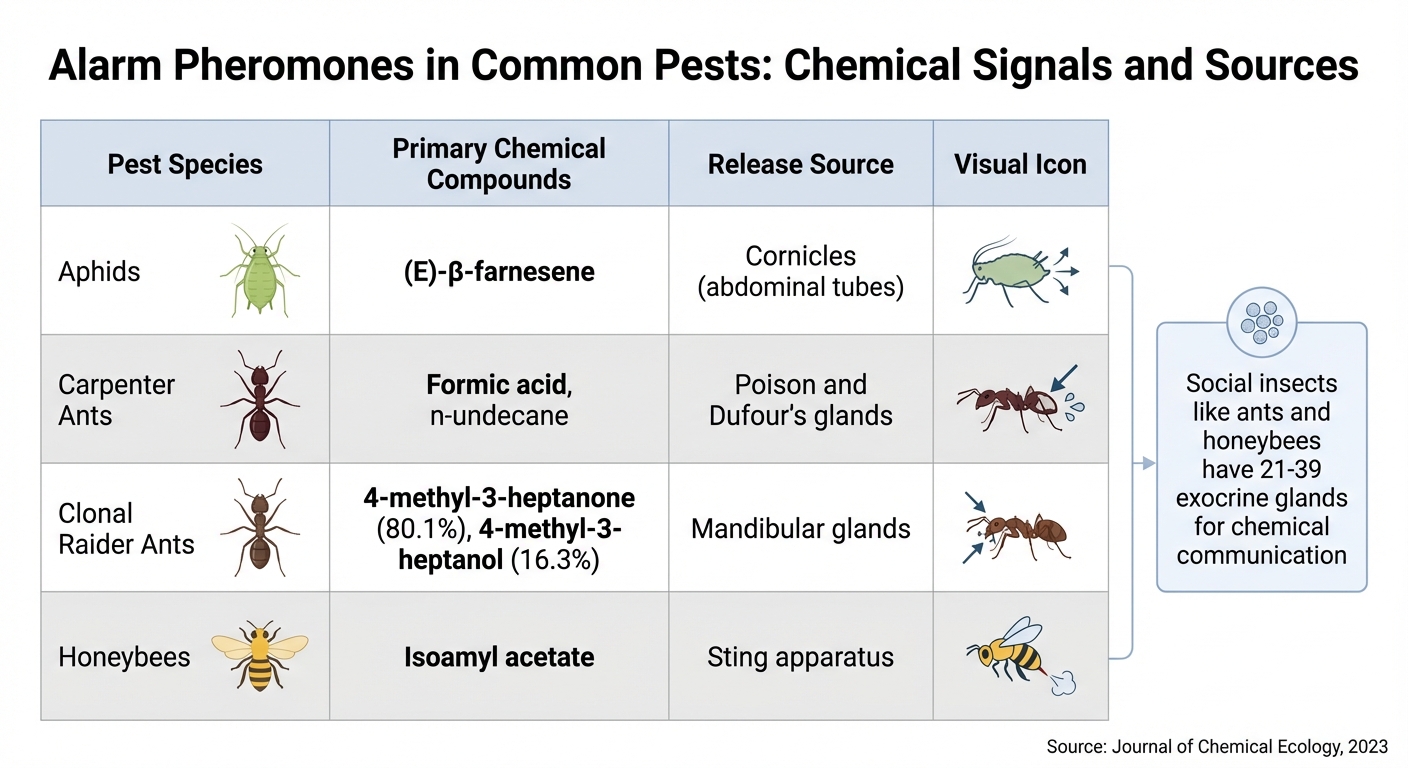
Common Pest Alarm Pheromones: Chemical Compounds and Release Sources
Alarm pheromones are chemical signals that pests release when they sense danger. These airborne compounds spread quickly, warning others of the same species about potential threats like predators or physical harm. Essentially, they act as a chemical alarm, prompting immediate reactions.
The main purpose of these pheromones is survival. When a pest perceives danger, it releases these chemicals from specialized glands. In social insects like ants and honeybees, this can lead to a coordinated defense by the colony. For solitary pests like aphids, it prompts individuals to disperse. This fundamental mechanism forms the basis for understanding the chemical structures and detection processes that drive these responses.
Chemical Makeup of Alarm Pheromones
The composition of alarm pheromones varies by species, but they typically consist of volatile, lightweight molecules that travel quickly through the air. Many belong to chemical families like monoterpenes, sesquiterpenes, ketones, and aldehydes.
Here’s a quick overview of common pests and the primary alarm pheromones they use:
| Pest Species | Primary Chemical Compounds | Release Source |
|---|---|---|
| Aphids | (E)-β-farnesene | Cornicles (abdominal tubes) |
| Carpenter Ants | Formic acid, n-undecane | Poison and Dufour's glands |
| Clonal Raider Ants | 4-methyl-3-heptanone (80.1%), 4-methyl-3-heptanol (16.3%) | Mandibular glands |
| Honeybees | Isoamyl acetate | Sting apparatus |
A recent study published in February 2023 in the Journal of Chemical Ecology examined the clonal raider ant's alarm pheromones. It found that 4-methyl-3-heptanone makes up 80.1% of the total head content, while 4-methyl-3-heptanol accounts for 16.3%. Social insects, like ants and honeybees, have developed intricate chemical systems for communication. For example, formicine ants have up to 39 exocrine glands, while honeybees possess 21. These chemical profiles directly influence the speed and intensity of their alarm responses.
How Alarm Pheromones Work
The volatile nature of alarm pheromones allows pests to detect them quickly, setting off a chain of neural signals. Detection occurs through olfactory receptor neurons located on their antennae. These receptors are incredibly sensitive; for instance, fruit flies can sense alarm-related carbon dioxide at concentrations as low as 0.1%. Once detected, the signal travels to the brain's antennal lobe, where it is processed in structures called glomeruli. In carpenter ants (Camponotus japonicus), workers and queens have around 430 glomeruli, while males have about 215. This difference highlights the females' greater need to process complex social signals. The processed signals then reach decision-making centers, such as the mushroom body, prompting either scattering or defensive behavior. Understanding these behaviors is key when using a DIY pest control kit to manage infestations effectively.
The specific reaction depends on the pest species and the situation. Researchers at Hokkaido University's Graduate School of Life Science discovered:
alarm pheromones alone do not trigger aggressive behavior... [they] sensitize aggressive behavior against a potential enemy... triggered by sensory stimuli associated with the potential enemy.
Examples of Alarm Pheromones in Common Pests
Alarm Pheromones in Bed Bugs
Bed bugs rely on specific chemical signals to communicate danger, and these signals vary depending on their life stage. Adults emit a blend of (E)-2-hexenal and (E)-2-octenal in a 70:30 ratio, while nymphs produce a more intricate mix, including 4-oxo-(E)-2-hexenal and 4-oxo-(E)-2-octenal in a 20:60:15:5 ratio. These chemical cues prompt bed bugs to scatter quickly, seeking safer hiding spots when under threat or stress.
Interestingly, adult males and older nymphs also release alarm pheromones to avoid harm during traumatic insemination when mounted by other males. Additionally, bed bugs react to heat stress by releasing these signals at temperatures between 104–108°F (40–42°C), encouraging evacuation before reaching lethal levels above 109°F (43°C). According to research published in Scientific Reports:
may not be a death indicator but a defense mechanism that acts as a warning signal that a life-threatening situation has been encountered.
The effectiveness of these alarm signals is limited to short distances, with bed bugs responding more strongly at 2 inches (50 mm) than at 4 inches (100 mm). Females under heat stress may release higher concentrations of pheromones, though this response can vary depending on the strain.
Alarm Pheromones in Ants and Aphids
Ants and aphids also use alarm pheromones, but their methods reflect their unique social structures. Aphids, for instance, release (E)-β-farnesene (EBF) from their cornicles when predators strike. This prompts nearby aphids to stop feeding and either walk away or drop from the plant. Unlike social insects, aphids do not amplify the alarm; the signal is not contagious. Once an aphid detects EBF, it flees without releasing more pheromones.
Ants, on the other hand, use alarm pheromones to organize colony-wide behavior. Research in Insect Biochemistry and Molecular Biology highlights two types of alarm responses in ants:
aggressive alarms, which promote aggressive responses to antagonists, and panic alarms, which promote dispersal from a predation threat.
In Atta leaf-cutting ants, a ketone compound serves as the primary alarm pheromone. Response intensity varies among castes, with smaller workers often reacting more strongly than larger ones.
Alarm Pheromones in Stink Bugs and Other Pests
Other pests, like stink bugs, have their own alarm pheromone strategies. The brown marmorated stink bug, for example, uses trans-2-decenal as its primary alarm signal. Some stink bug species, such as Cosmopepla bimaculata, combine defensive secretions with warning odors, signaling their bitter taste or toxicity to potential predators.
Honeybees, meanwhile, have one of the most intricate alarm systems, featuring over 40 compounds. Among these, isoamyl acetate is the key trigger for recruiting other bees and initiating attack behavior.
While these pheromones help protect colonies, they can also backfire. Predators like lady beetles and hoverflies have learned to exploit aphid alarm signals, using them to locate prey. This natural adaptation highlights the potential for developing pest control methods that are both targeted and chemical-free.
How Alarm Pheromones Apply to Pest Control
Pest Control Products Using Pheromones
Alarm pheromones present an alternative way to combat pests without relying on harmful chemicals. These natural compounds trigger automatic behavioral responses in pests, making them hard to ignore. They work primarily in two ways: by either repelling pests from certain areas or attracting natural predators to zones where pests are active.
When used as repellents, synthetic alarm pheromones can keep pests away from crops or buildings. These chemicals cause behaviors like dispersal or panic, creating an invisible barrier that pests instinctively avoid. Unlike traditional pesticides, which rely on toxins, this approach influences behavior, offering a safer, non-toxic solution.
Alarm pheromones also function as kairomones, attracting beneficial insects such as ladybugs, lacewings, and parasitoid wasps. This natural predator activity can help control pest populations. However, their effectiveness depends on environmental factors. For instance, (E)-β-farnesene, a common alarm pheromone, is highly volatile and breaks down quickly. This means precise formulations are necessary to ensure consistent results.
Genetically Modified Plants and Alarm Pheromones
Beyond synthetic options, researchers are exploring ways to make plants produce alarm pheromones biologically. By engineering crops to emit these compounds, scientists aim to create plants that repel pests naturally. Early trials with genetically modified wheat that emits (E)-β-farnesene showed promising lab results, including strong aphid repellence and increased activity from natural predators like parasitoid wasps. However, field tests revealed a key limitation: aphids adapted to the constant presence of the pheromone within three generations.
The issue lies in habituation. Aphids in nature encounter alarm pheromones in short bursts during attacks, not as a constant signal. Initial lab results were encouraging - naive aphids experienced a 60% drop in reproduction when exposed to these modified plants. But once aphids adapted, the repellence effect vanished. Interestingly, while habituation reduced the direct impact of the pheromone, it made aphids more susceptible to predators.
Tailored Solutions for DIY Pest Control
These findings on alarm pheromones and pest behavior have practical applications for homeowners. By understanding how these compounds work, we can craft smarter pest control strategies. While genetically modified plants and synthetic pheromones hold promise, effective pest management still depends on addressing factors like dosage and environmental conditions.
At Remedy DIY Pest Control, we’ve used these insights to develop targeted kits for home use. Our products are safe for pets and children, with stable formulations designed to align with pests' natural behaviors. Each kit is tailored to specific pest problems, offering clear instructions and ongoing support through regular shipments and virtual assistance. This approach bridges scientific research with real-world solutions, making home pest control both effective and accessible.
Conclusion
Alarm pheromones showcase how pests communicate danger and coordinate defensive actions through chemical signals. These compounds spark immediate reactions - like panic dispersal in aphids or aggressive recruitment in ants - highlighting the complexity of pest defense systems. This natural communication framework lays the groundwork for pest control methods that align with nature, offering non-toxic alternatives to traditional pesticides.
Research supports the potential of alarm pheromones in practical pest management. For instance, (E)-β-farnesene can repel aphids, while dose-dependent responses in ants can be used to modify their behavior without harming beneficial insects. As Lindsey E Lopes from The Rockefeller University explains:
Identification of a pheromone that triggers a robust, consistent, and conserved behavior, like the alarm pheromone, provides an avenue to dissect the behavioral and neuronal mechanisms underpinning chemical communication.
These findings translate into effective, science-backed pest control solutions for everyday use. High concentrations of pheromones can repel pests, while lower doses can lure them into traps or toward natural predators. Push-pull strategies, which combine repellents with attractants, offer a chemical-free way to manage pests by applying the right concentration at the right time.
At Remedy, we've embraced these scientific principles to create our pest control solutions. Our kits feature professional-grade formulations designed to work with pests' natural behaviors, ensuring effective, family- and pet-safe results. With easy-to-follow instructions and dedicated support, you can address pest issues confidently - without the hassle or guesswork.
FAQs
Can pests get used to alarm pheromones over time?
Pests might adjust to alarm pheromones over time due to evolutionary forces that refine their ability to detect and react to these signals. However, the precise way this habituation occurs remains somewhat unclear, as there isn't extensive research focused on this specific process. Gaining a better understanding of how pests interact with these pheromones could shed light on their behavior and the inner workings of their colonies.
Do alarm pheromones work indoors as well as outdoors?
Yes, alarm pheromones work effectively indoors. These are volatile organic molecules, meaning they disperse rapidly through the air. This allows them to trigger defensive responses in a colony, whether the environment is inside a building or out in the open.
How are alarm pheromones safely used in 'push-pull' strategies?
'Push-pull' strategies rely on alarm pheromones to manage pests by blending natural repellents (the "push") with attractants (the "pull"). These pheromones work by steering pests away from homes or crops and drawing them into traps. This approach reduces pest populations without relying on harmful chemicals. By tapping into pests' natural communication systems, it lowers risks to humans, non-target species, and the surrounding ecosystem, providing a safer and environmentally friendly pest control solution.