


Delaying pest control can quickly turn a small issue into a costly disaster. Pests reproduce rapidly, hide in hard-to-reach areas, and cause unseen damage to your home. Ignoring early signs or using ineffective DIY methods often leads to skyrocketing repair bills - ranging from $3,000 to $8,000 for termite damage or $2,000 for rodent-related electrical fixes. Acting promptly is key to avoiding these expenses.
Key Mistakes to Avoid:
- Ignoring Early Signs: A single pest sighting often signals a larger hidden problem.
- Letting Pests Multiply: Small infestations grow rapidly and become harder to control.
- Using the Wrong Products: Over-the-counter solutions often fail against advanced infestations.
- Not Fixing Entry Points: Pests will keep returning if gaps or leaks remain unaddressed.
- Waiting Too Long: Delays lead to larger infestations, higher costs, and more complex treatments.
The solution? Take action early. Use targeted treatments, seal entry points, and address root causes to prevent pests from taking over your home. Waiting only makes the problem - and the expense - worse.
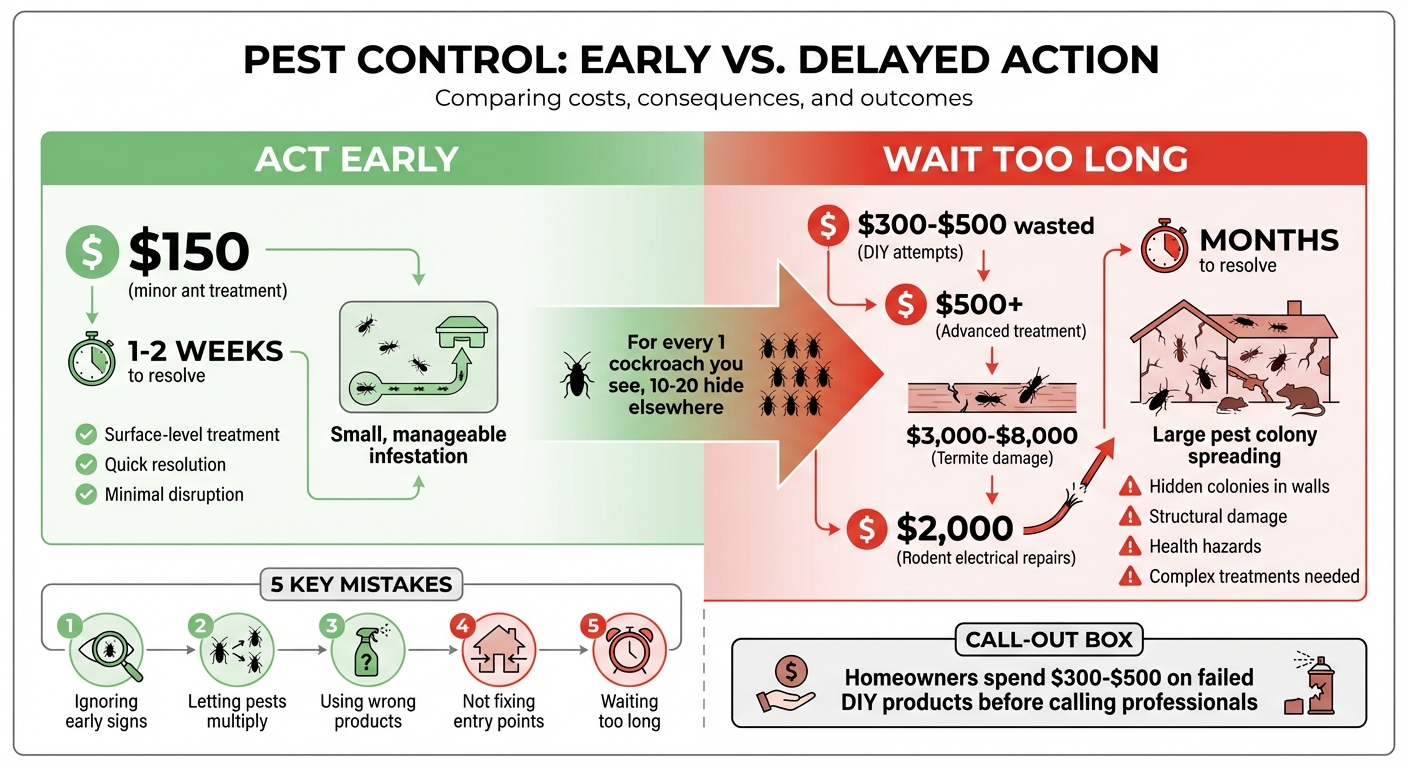
Cost Comparison: Early vs Delayed Pest Control Action
Top 5 DIY Pest Control Mistakes
sbb-itb-0bbb908
Why Homeowners Delay Pest Control
Pest problems often feel like they can wait. Many homeowners treat pest control as just another minor chore, like fixing a squeaky hinge or replacing a light bulb. It’s something they plan to get around to - next weekend, or maybe the one after that.
This "I'll deal with it later" attitude comes from a risky assumption: that the problem isn’t growing. But what you see is rarely the whole story. For example, spotting a single cockroach in your kitchen likely means there are 10–20 more hiding in places you can’t see, like wall voids, under appliances, or in crawl spaces.
Trying to save money can backfire. Many people opt for a $20 DIY pest control kit instead of calling a professional. Eric Ruiz, Co-owner of Bliss Pest Services, shares why this often leads to wasted time and money:
"The average person spends $300-500 on various products before calling professionals. They buy sprays that don't work, traps that catch nothing, and baits that pests ignore".
Retail pest control products are typically watered down to meet safety standards for general use. While safer, they’re often less effective than professional-grade solutions, which have higher concentrations of active ingredients and longer-lasting effects. These DIY attempts often delay the more targeted action that’s necessary to address infestations properly.
Another reason for delays is the hidden nature of the damage. It’s easy to assume everything is fine when you don’t see visible problems. But pests like termites and carpenter ants work silently behind walls, weakening your home’s structure. By the time the damage becomes obvious, repair costs can range from $3,000 to $8,000.
Sometimes, people don’t act until something forces them to. It could be a guest commenting on a strange smell, a family member developing allergies, or finding droppings in a corner. By then, what started as a manageable issue often turns into a full-blown infestation, requiring far more time, money, and effort to resolve. These delays not only allow infestations to grow but also mask the true extent of the problem, making it harder to address effectively.
1. Letting Pests Build Hidden Colonies
Impact on Pest Population Growth
Seeing one cockroach often means there's a hidden colony nearby. This unsettling reality highlights how pests multiply out of sight. Once pests find shelter, their populations grow quickly. If you spot a cockroach during the day, it’s usually a sign that their nest is overcrowded, pushing some into the open. Ignoring this can lead to rapid infestations - and rising costs.
Cost Implications of Delayed Action
Catching a small infestation early can save you a lot of money. For example, dealing with a minor ant problem might only set you back about $150. But if left untreated, that same issue - combined with structural damage - could cost upwards of $500 to fix. Termite damage is even more expensive, often ranging between $3,000 and $8,000, while repairing rodent-chewed electrical wiring can run up to $2,000.
When infestations get out of hand, additional services like air duct cleaning or repairing structural damage might be needed. At that point, you’re not just paying for pest control - you’re looking at significant renovation expenses.
Difficulty of Addressing Root Causes
As costs rise, so does the difficulty of tackling the problem. Pests often retreat to hard-to-reach areas like wall voids, behind heavy appliances, or deep within attic insulation. Standard surface sprays won’t reach these hidden spots, and using foggers from the store might even drive pests further into your home.
Eric Ruiz, Co-owner of Bliss Pest Services, puts it plainly:
"For every cockroach you see, 10-20 hide elsewhere. DIY treatments target visible pests but miss breeding populations in wall voids, under appliances, and in crawl spaces".
This explains why over-the-counter solutions often fall short - they only deal with what’s visible, not the root of the problem.
2. Ignoring Early Warning Signs
Impact on Pest Population Growth
Spotting just one or two pests might seem minor, but it’s often a red flag for a bigger, hidden problem. Pests are experts at multiplying quickly when they find food, water, and shelter. By the time you notice more obvious signs - like strange smells or visible nests - the infestation has likely grown significantly, making it much harder to control.
Joseph L. Kondor from Pestcom Pest Management highlights a commonly overlooked clue:
"One thing people miss a lot is fine sand or soil pushing up through cracks in concrete. That usually means pavement ants are tunneling underneath".
This rapid growth shows why ignoring early signs is a risky gamble.
Difficulty of Addressing Root Causes
Early warning signs often reveal hidden infestations that DIY solutions fail to tackle. For example, small droppings or faint scratching noises hint at larger issues. Spider webs suggest an abundance of other insects nearby, while mouse droppings in the kitchen indicate rodents have already established a pathway. Signs like hollow-sounding wood, mud tubes along the foundation, or discarded insect wings are telltale markers of termite activity.
DIY methods tend to focus on the pests you can see, leaving hidden colonies to thrive unchecked. Spraying or setting traps might give the illusion of control, but it rarely addresses pests nesting in wall voids, beneath appliances, or in the attic. Worse, repeated use of the wrong products can lead to chemical resistance, making professional intervention more challenging - and costly - down the line. Catching these subtle signs early can save homeowners from escalating problems and expenses.
Cost Implications of Delayed Action
Procrastinating on pest control often leads to higher expenses. On average, homeowners spend $300–$500 on DIY solutions before finally turning to a professional. Meanwhile, the risks grow: rodents can spread hantavirus, cockroaches can trigger asthma, and bat guano may lead to histoplasmosis. These health hazards, combined with the mounting costs of unchecked infestations, highlight why ignoring early signs is a costly mistake.
3. Using Wrong Treatments for Advanced Infestations
Dealing with advanced pest infestations is tricky enough, but using the wrong treatments can make the situation spiral out of control.
Effectiveness of Late-Stage Treatments
When infestations reach an advanced stage, DIY solutions often fall short. Over-the-counter sprays and traps might eliminate visible pests, but they rarely address the hidden colonies causing the real problem. As Pest-Ex puts it:
"DIY methods generally treat visible pests, not the nest or colony. For example, spraying cockroaches on the kitchen bench won't touch the hundreds breeding behind your fridge or under the floorboards."
This means not only do the pests remain, but improper treatments can also drive them deeper into less accessible areas, making eradication even harder.
Difficulty of Addressing Root Causes
The wrong treatment doesn’t just waste time and money - it can backfire. Certain chemicals or methods can cause pests to scatter, relocate, or burrow further into hiding. For example, using termite treatments on ants or sugar-based bait on species that crave protein is ineffective and counterproductive. Some ant sprays, instead of eliminating the colony, may cause it to split and relocate, doubling the effort required to control them.
Evo Pest Control emphasizes the importance of a multi-step strategy:
"A single spray cannot control an infestation without supporting steps such as sanitation improvements, structural sealing, moisture reduction, and targeted monitoring."
Without addressing the root causes, pests continue to thrive, and the problem only grows more expensive and complicated.
Cost Implications of Delayed Action
Improper treatments don’t just prolong infestations - they can also lead to significant financial losses. Relying on retail sprays and traps can quickly add up. At around $20 per bottle, repeated purchases may end up costing more than a professional service that tackles the issue at its source. Worse, misuse of pesticides can lead to resistance, making future treatments less effective and far costlier.
The financial stakes are even higher when structural damage comes into play. Termites and carpenter ants, for instance, can cause damage that runs into thousands of dollars by the time it becomes visible. What starts as an attempt to save money can easily snowball into a far more expensive problem.
4. Failing to Fix the Source of the Problem
Difficulty of Addressing Root Causes
Getting rid of the pests you can see is the easy part - figuring out how they got in is the real puzzle. Many homeowners focus on spraying the ants on their counters but forget to investigate how those ants got inside in the first place. This approach misses the bigger issue: the hidden colony that's causing the infestation. As CCR Magazine puts it:
"What starts as a nuisance can evolve into a remodeling project - all because the problem was given time to grow."
The problem often lies in the unseen: cracks in the foundation, gaps around utility lines, leaky pipes, or areas with excess moisture. These entry points create an open invitation for pests. If you don’t seal these gaps or address moisture issues, pests will keep coming back. Ignoring these factors not only allows infestations to persist but also gives pests the chance to multiply quickly.
Impact on Pest Population Growth
When entry points are left unaddressed, pest populations can explode. For example, cockroach egg sacs can hold dozens of future pests, and for every cockroach you spot, there are likely 10 to 20 more hiding out of sight. Termites and carpenter ants are even more insidious - they quietly chew through wooden structures, and by the time you notice sagging floors or warped walls, the damage is already extensive. Without tackling the root cause, these populations grow unchecked, and the consequences become harder - and more expensive - to manage.
Cost Implications of Delayed Action
Letting pests thrive unchecked doesn’t just worsen the infestation - it also drives up repair costs. Skipping early intervention can lead to a vicious cycle of rising expenses. For example, structural damage caused by termites or rodents can easily run into thousands of dollars. What could have been solved with a Quarterly Pest Remedy Kit may balloon into a $500+ repair bill, especially when issues like damaged insulation, air ducts, or structural repairs come into play. Addressing the problem early can save you significant money and headaches down the line.
5. Dealing with Larger, More Difficult Infestations
Scale of Infestation and Control Challenges
Ignoring pest problems early on can turn a manageable issue into a full-blown nightmare. What starts as a small ant trail can quickly spread throughout your home, as pests move through walls and hidden pathways. They won’t stay confined to the areas you initially notice - they’ll expand their territory as their numbers grow, making treatment far more complex.
As infestations progress, pests burrow deeper into your home’s structure. They migrate from easy-to-reach spots, like under sinks, into harder-to-access areas such as wall voids, appliance motors, plumbing routes, and behind baseboards. These hidden nesting sites are nearly impossible to address with basic DIY methods. Early action is key - waiting only makes the problem harder to tackle. As Specter Pest Control explains:
"If you're seeing even one roach during the day, it's a sign that the infestation is growing fast. Roaches are nocturnal - so daytime sightings often mean the nest is overcrowded."
Effectiveness of Late-Stage Treatments
DIY solutions that might work for small infestations often fall short when the problem escalates. Over-the-counter products are typically diluted versions of professional-grade treatments, and repeated use of these weaker chemicals can lead to pest resistance. Worse, improper application can cause pests to scatter, driving them deeper into your home and making them even harder to eliminate.
The financial impact is also worth noting. Homeowners frequently spend $300 to $500 on various DIY products before finally turning to professional help. A professional treatment for a small ant issue might only cost around $150, but letting the infestation grow can push costs to $500 or more - excluding any potential structural repairs. The longer you wait, the more expensive and difficult the problem becomes.
Impact on Pest Population Growth
As infestations grow unchecked, pests reproduce at alarming rates. For example, cockroaches carry egg sacs that can hatch dozens of offspring at a time, and overlapping breeding cycles can quickly escalate the situation. What starts as a handful of pests can multiply into hundreds - or even thousands - before you realize it. At that stage, DIY efforts are unlikely to make a dent.
How Remedy DIY Pest Control Can Help
Pest control delays can lead to serious - and costly - problems. That’s where Remedy steps in, offering a solution designed to handle even the toughest infestations. Whether your pest issue is just beginning or has spiraled out of control, our kits are built to target advanced infestations effectively. Unlike the rows of generic products you’ll find at hardware stores, Remedy provides a tailored approach that eliminates pests without the need for strangers entering your home.
The process starts with precise pest identification. Knowing the difference between carpenter ants and termites or field mice and house mice isn’t just a fun fact - it’s critical. Different pests require specific chemicals, traps, and treatment strategies. Remedy ensures you’re not wasting time and money on generic solutions that may not even work for the pest you’re dealing with. Instead, we help you target the exact species invading your space, setting the stage for effective treatment.
The key to Remedy’s success is tackling infestations at their source. While store-bought sprays might offer quick, temporary relief, our professional-grade products go deeper. They’re formulated with higher concentrations of active ingredients to disrupt the pest lifecycle, eliminate hidden colonies, and address the root cause for lasting results. Eric Ruiz, Co-owner of Bliss Pest Services, highlights the difference:
"The pest control products you find in stores aren't the same quality professionals use. Manufacturers dilute consumer products to meet safety regulations for untrained users."
But we don’t stop at just one treatment. Advanced infestations require ongoing attention, which is why our service includes regular shipments and virtual support. A one-time fix isn’t enough for deeply rooted problems. Remedy kits come with clear instructions, EPA-approved products, and step-by-step application guides to ensure safe and effective use. Plus, our virtual support team is available to help with pest identification and answer any questions as your situation evolves.
Safety is a priority. All our products are safe for pets and children when used as directed, so you can confidently reclaim your home. By addressing the infestation at its origin, Remedy breaks the cycle that delayed action often perpetuates. Whether it’s an expanding ant colony or a mouse problem that’s spiraled out of control, Remedy gives you the tools and guidance to resolve the issue for good - not just cover it up.
Conclusion
Putting off pest control can turn a manageable issue into a full-blown crisis. When pests are left unchecked, they multiply quickly, forming hidden colonies that can cause extensive structural damage, health hazards, and repair costs that can climb into the thousands.
For example, while early treatment might only set you back about $150, waiting too long could push expenses past $500 - and that doesn’t even include the cost of repairing damaged wood, replacing contaminated insulation, or fixing chewed electrical wiring. This stark difference in costs highlights why acting promptly is so important.
Don’t wait until it’s too late. Addressing pest problems early can involve straightforward steps like sealing entry points and keeping an eye on potential trouble spots. But delaying action often means dealing with aggressive treatments, major repairs, and the ongoing stress of a worsening infestation. As CCR Magazine aptly puts it:
"Pest problems rarely solve themselves. Left unchecked, they grow, spread, and affect every part of your home - physically, financially, and emotionally".
The bottom line? Taking action now is the best approach to effective pest control. That’s why we created Remedy - to help you tackle pest issues before they spiral out of control. Our tailored kits include professional-grade products, easy-to-follow instructions, and ongoing support to help you eliminate pests at the source. Start today. The sooner you act, the simpler and more affordable the solution will be.
FAQs
How do I know if one pest means an infestation?
If you spot signs like droppings, gnaw marks, nesting materials, or structural damage, it could mean more pests are lurking. Strange noises, like scratching or scurrying at night, are another red flag. Even just one sighting - especially of pests like mice or cockroaches - might hint at a bigger problem if these clues are present. Taking action quickly can stop the situation from escalating.
What should I do first after spotting pests?
To tackle a pest issue effectively, the first step is identifying the pest and understanding the situation. Getting this part right is crucial - misidentifying the pest can lead to using the wrong treatment, which might even make things worse. Once you know what you're dealing with, inspect your property thoroughly. Look for signs of pest activity, like droppings or damage, and pinpoint possible entry points. From there, apply targeted pest control strategies designed for the specific pest. If the problem persists or feels overwhelming, it might be time to seek professional help or explore customized pest control solutions to handle the issue efficiently.
When is DIY pest control no longer enough?
DIY pest control can sometimes miss the mark, especially when pests are misidentified, infestations are more severe than anticipated, or the chosen treatments simply don’t work. In these cases, calling in a professional is often the best way to address the problem effectively and stop it from escalating further.