


Scorpions are tough to deal with, but prevention is your best weapon. If you live in areas like Arizona or Nevada, where scorpions thrive, these seven tips can help you keep them out of your yard and home:
- Seal cracks and gaps: Scorpions can squeeze through openings as small as 1/16 of an inch. Use caulk, foam, or mesh to block entry points.
- Remove hiding spots: Keep woodpiles, rocks, and debris away from your home, and trim vegetation to reduce shelter options.
- Control moisture: Fix leaks, avoid overwatering, and clean up damp areas to eliminate attractions for insects (scorpions' prey).
- Adjust outdoor lighting: Use yellow or amber bulbs to avoid drawing insects and scorpions near your home.
- Trim vegetation: Keep plants and trees at least 12 inches away from your house to prevent scorpions from climbing.
- Do blacklight inspections: Use UV lights at night to spot scorpions and address problem areas.
- Install barriers: Add door sweeps, mesh screens, and weatherproofing to block scorpions from entering.
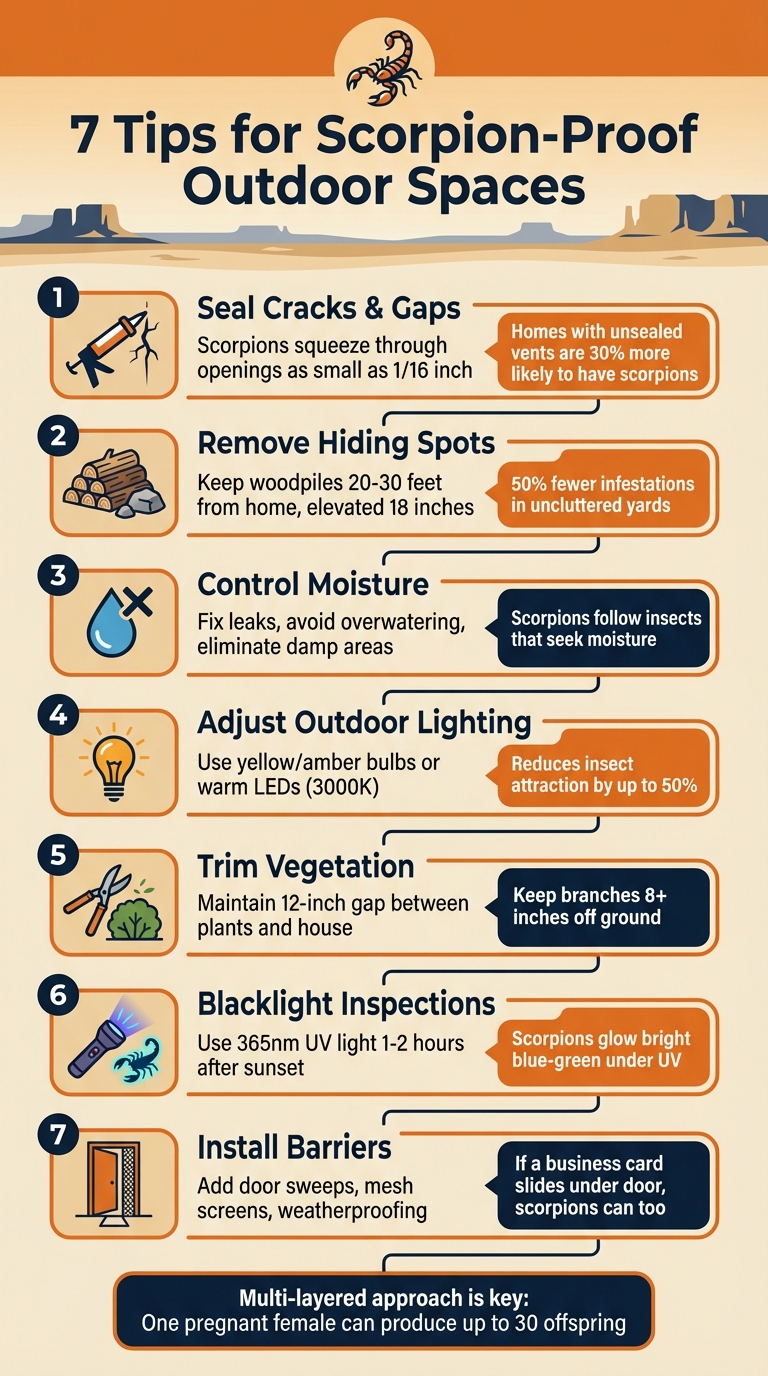
7 Essential Tips to Scorpion-Proof Your Outdoor Spaces
Scorpion safe "safer" Home - pest seal your home - pest control
sbb-itb-0bbb908
1. Seal Foundation Gaps and Entry Points
Scorpions are experts at sneaking into homes, able to squeeze through openings as small as 1/16 of an inch. That means even tiny cracks in your foundation or gaps under doors can become easy access points.
Start by inspecting areas where your foundation meets exterior walls, around utility lines, and along door thresholds. Turn off indoor lights at night and check for light escaping outside - this can help you spot potential gaps.
For small cracks, use exterior-grade silicone or acrylic latex caulk. For larger openings, expanding foam works well. Replace worn weatherstripping and add heavy-duty rubber door sweeps to close gaps under doors. A good rule of thumb: if a business card can slide under your door, a scorpion can too.
Be mindful of weep holes in brick or stucco walls. These holes help with ventilation and moisture control, so avoid sealing them with caulk or foam. Instead, use copper mesh or stainless steel wool to keep scorpions out while maintaining airflow.
Finally, secure vents in areas like the attic, crawl space, roofline, and near the dryer with fine-mesh screens. Research shows homes with unsealed vents are 30% more likely to have scorpions. Taking these steps can significantly reduce the chances of these pests finding their way inside. For ongoing protection, using a DIY pest control kit can help maintain a scorpion-free perimeter.
2. Remove Hiding Spots from Your Landscape
Even a well-kept yard can unintentionally provide scorpions with places to hide. Items like woodpiles, decorative rocks, and yard debris create perfect daytime hiding spots for these pests. Research shows that homes with uncluttered yards experience 50% fewer scorpion infestations compared to cluttered ones. Here’s how you can minimize these hiding places.
Store firewood the right way. Keep woodpiles at least 20–30 feet away from your home’s foundation and elevate them about 18 inches using racks. Storing wood directly against your house not only gives scorpions a place to hide but also attracts the insects they feed on.
Be cautious with decorative rocks and boulders. Materials like river rocks and boulders can trap moisture and create small crevices, especially when placed near walls. These humid spaces are ideal for scorpions to rest during the day. As Anver Pest Control notes:
"Loose stones create dark, humid spaces underneath where scorpions can rest during the day".
To prevent this, consider replacing decorative stones with smooth concrete edging or tightly packed soil. If you prefer to keep rocks, leave at least a 6-inch gap between them and your home’s walls.
Keep storage and plants away from the house. Avoid placing storage items, planters, or cardboard boxes close to your home. Trim bushes so they don’t touch the siding, and get rid of dead palm fronds, which can also provide shelter.
Lastly, when working in your yard, take precautions. Wear long sleeves, pants, heavy gloves, and boots, and use long tongs to handle debris to reduce the risk of accidental contact with scorpions.
3. Reduce Moisture and Eliminate Insect Food Sources
Scorpions don’t just show up without reason - they’re following their next meal. Their favorite snacks, like crickets, roaches, spiders, and beetles, are drawn to moisture, and that’s what ultimately attracts the scorpions. As Brian Magnosi from Kevlar Pest Control puts it:
"A dripping faucet, condensed AC line, or patch of wet garden soil can be an irresistible oasis in the desert."
To keep scorpions at bay, you’ll need to tackle both the moisture and the food sources that lure them in with a Quarterly Pest Remedy Kit.
Fix leaks immediately. Even something as small as a dripping hose bib or a leaky irrigation head can create damp soil near your home’s foundation, which is a magnet for insects and, by extension, scorpions. Repair these issues as soon as you spot them. Redirect air conditioner condensation away from your house, and schedule regular irrigation system checks - especially before summer kicks in.
Water smarter. Overwatering your yard creates the perfect soggy conditions that insects love. Consider switching to drip irrigation systems, which deliver water straight to plant roots without leaving excess moisture on the surface. If you’re using sprinklers, adjust them to water deeply but less often, allowing the soil to dry out completely between watering cycles.
Cut off their food supply. Ben Holland of Scorpion Sweepers emphasizes:
"The best prevention for any pest is eliminating their food source. If a pests' food source is eliminated the pest population will be eliminated quickly."
To make your yard less inviting, bring pet food and water bowls indoors before nightfall, clear away leaf litter and decaying wood, and think about replacing wood mulch - which holds moisture - with gravel. These steps can make a big difference in keeping scorpions out of your space.
4. Use the Right Outdoor Lighting
The type and placement of your outdoor lighting can unintentionally invite insects - and by extension, scorpions - into your space. While scorpions themselves have poor vision, bright white lights attract flying insects, which in turn lure scorpions outdoors. Emma Grace Crumbley, an entomologist with Mosquito Squad, explains:
"Outdoor lights, like patio or deck lights, can attract scorpions to come out of hiding. Consider turning outdoor lights off at night or setting them to an automatic timer."
This makes it important to choose lighting options that are less appealing to bugs.
Opt for yellow or amber bulbs. Switching to yellow or amber bulbs can significantly reduce insect attraction. Warm-white LEDs (around 3000K) are another great choice since they emit minimal UV light, cutting insect attraction by up to 50%.
Relocate lights away from entry points. Moving outdoor lights away from doors and windows can also make a big difference. For instance, shifting a front door light just 10 feet away can dramatically reduce scorpion sightings. Pair this with motion sensors or timers to further limit light exposure and discourage bugs from gathering. Ben Holland from Scorpion Sweepers highlights:
"Moths are attracted to garage and motion lights providing an ample food supply. The driveway is often one of the first spots someone will encounter a scorpion."
For a softer glow that doesn’t draw insects toward your home, low-intensity solar pathway lights are a practical option. They provide enough visibility without turning your foundation into a bug magnet.
5. Keep Vegetation Away from Your Home
A key step in keeping scorpions at bay is managing the vegetation around your home. Overgrown plants can act as bridges, giving scorpions easy access to roofs, siding, and windows.
As Responsible Pest Control advises:
"Trees and bushes trimmed away from the house! Scorpions and many other pests use trees and bushes to get inside."
To block scorpions from reaching your home, maintain at least a 12-inch gap between vegetation and your house. Palm trees, in particular, deserve extra attention. For instance, a neglected Honey Mesquite tree can house dozens of scorpions, while the Arizona Bark Scorpion is known for camouflaging itself against tree bark.
Dense vegetation near your home’s foundation can also create ideal conditions for scorpions by trapping moisture and providing shaded microclimates. To address this, trim the lower branches of shrubs and trees so they’re at least 8 inches off the ground. This makes it harder for scorpions to find shelter.
Consider replacing thick groundcovers like ivy with alternatives such as gravel or widely spaced native plants like yucca, agave, or cacti. These desert-adapted plants don’t offer the cool, shaded spots scorpions seek out.
Eric Palmer from Southwest Exterminators explains:
"By choosing desert-friendly plants and spreading them out, you reduce the amount of shaded, moist areas where scorpions can hide."
Regular trimming also helps by cutting off the food supply. Overgrown plants often attract insects like crickets, roaches, and beetles - favorite prey for scorpions. Keeping your landscaping neat not only removes hiding places but also eliminates the food sources that lure scorpions closer to your home. This approach works well alongside other preventative measures, such as sealing gaps and managing moisture, to create a scorpion-resistant outdoor environment.
6. Conduct Blacklight Inspections at Night
Sealing gaps and maintaining your landscape are essential, but adding targeted inspections can uncover hidden scorpion activity. With a UV blacklight, you can easily spot scorpions in your yard. Thanks to beta-carboline in their exoskeletons, scorpions glow bright blue-green under ultraviolet light, making them stand out in the dark.
The best time to inspect is 1–2 hours after sunset. Aim for nights with a new moon or less than half-full moon, as scorpions are more active when it's darker. For the strongest glow, use a UV light with a 365-nanometer wavelength. This approach works well alongside other preventive measures by helping pinpoint areas with active scorpion activity.
Safety is key during these inspections. Wear closed-toe shoes, long pants, and thick gloves to protect yourself from stings. Carry a white-light flashlight to navigate safely while using the UV light to search for scorpions.
Focus your inspection on areas where scorpions are likely to hide. Walk the perimeter of your property, checking block walls, rock gardens, mulch beds, and foundation cracks. Don’t forget windowsills, porch rails, and decorative pillars. Even if a scorpion is mostly hidden, the glow of a single pincer or tail segment can give it away. If you find one, you can safely remove it using 12-inch tongs or the glass jar method - cover the scorpion with a wide-mouth jar, slide cardboard underneath, and then flip and secure the jar.
Georgia Clubb, an Advanced Scorpion Control Specialist at Seal Out Scorpions, underscores the importance of strategy:
"Success in scorpion control is more about changing the scorpion's path and less about trying to constantly exterminate them".
7. Install Barriers and Weatherproofing
Scorpions are resourceful creatures that can slip through openings as tiny as 1/16 inch. Adding physical barriers and weatherproofing to your home is an essential final step in creating a layered defense system. When combined with proper landscaping and lighting adjustments, these measures help form a comprehensive prevention strategy.
To reinforce your home’s defenses, focus on installing durable barriers. Start by securing all exterior doors with rubber or nylon brush door sweeps. These sweeps should make full contact with the threshold across the entire width of the door. A quick way to test their effectiveness is the business card method mentioned earlier - if a card can slide under the door, the seal isn’t tight enough. Pay extra attention to the door connecting your garage to your living space, as garage door seals tend to wear out quickly, leaving an easy access point for scorpions.
For additional protection, cover attic vents, crawl space openings, and dryer vents with fine-mesh wire screening. This material blocks scorpions while still allowing airflow. Similarly, use copper mesh to seal weep holes in brick or stone exteriors. This keeps scorpions out without compromising ventilation. For smaller gaps around pipes or cables, apply exterior-grade silicone caulk, while larger voids around utility bundles can be filled with expanding foam. These measures help secure vents and other vulnerable areas effectively.
Don’t forget to seal gaps around door frames and windows. Use pliable silicone or rubber weatherstripping to close off these entry points, and replace any worn or cracked material to maintain a tight seal. Foundation cracks should be permanently sealed with concrete filler or mortar to eliminate another common access route.
| Barrier Type | Recommended Material | Primary Target Area |
|---|---|---|
| Door Seal | Rubber/Nylon Door Sweep | Bottom of exterior and garage doors |
| Vent Cover | Fine Metal Mesh | Attic, crawl space, and dryer vents |
| Gap Filler | Silicone Caulk | Utility penetrations (pipes, wires) |
| Weep Hole | Copper Mesh | Gaps in brick veneer or stone siding |
| Foundation | Concrete/Mortar Filler | Cracks in slab or foundation walls |
Conclusion
Getting rid of scorpions isn't about finding a quick fix or relying on a single product. These tough little creatures can survive for months without food and even endure days underwater, which means one-time treatments just won't cut it. The key is combining all seven strategies into a multi-layered plan that tackles their basic needs: food, water, and shelter.
For instance, keeping your yard well-maintained can reduce scorpion infestations by up to 50% compared to cluttered spaces. Pair that with sealing up tiny gaps - some as small as 1/16 inch - and adjusting your outdoor lighting, and you create what experts call a "pest-free buffer". This approach doesn’t just keep scorpions at bay; it also targets their food sources, like crickets and roaches, stopping the cycle before it begins. Remember, a single pregnant female scorpion can produce up to 30 offspring. By going beyond just spraying for bugs, you’re building a solid, long-term defense.
Physical barriers and yard maintenance are the backbone of scorpion control, but they work even better when combined with professional-grade DIY solutions. Custom pest control kits, designed to be safe for pets and kids, can target scorpions and the insects they feed on. These kits provide the powerful treatments you need to reinforce the sealing and landscaping efforts you’ve already put in place. Together, these steps create a lasting shield around your home.
And the benefits don’t stop at pest control. Sealing up entry points can help lower energy bills by keeping your air conditioning or heat inside. Plus, using UV blacklights for regular checks ensures your outdoor spaces stay safe for your family and pets. By implementing all seven tips, you’re not just addressing a scorpion problem - you’re removing the conditions that allowed it to thrive in the first place.
FAQs
What should I do if I keep finding scorpions inside?
If you’re spotting scorpions inside your home, it likely means they’ve found a way in - or worse, there could be an infestation. Start by sealing up any potential entry points. Look for cracks or gaps around windows, doors, utility lines, and your home’s foundation. Use caulk to fill these gaps and install door sweeps to keep them from sneaking in under doors.
Outside, focus on removing places where scorpions might hide. Clear away woodpiles, rocks, and overgrown vegetation near your home, as these are prime hiding spots. If you’re still dealing with scorpions despite your efforts, it might be time to call in professional pest control. They can inspect your home and provide targeted treatment. Regular upkeep and preventative measures are key to keeping scorpions out for good.
How do I scorpion-proof my yard without removing all landscaping?
To make your yard less appealing to scorpions while maintaining your landscaping, focus on eliminating their favorite hiding spots and entryways. Start by sealing any cracks in block walls and clearing away debris. Trim overgrown plants and avoid dense vegetation that can provide cover. Additionally, remove woodpiles or rock piles that scorpions might use as shelter. With these adjustments, you can discourage scorpions without drastically altering your yard's design.
When should I call a pro versus using DIY scorpion control?
If you're dealing with a severe or ongoing scorpion problem - especially one involving venomous species like the Bark Scorpion - it's best to call a professional. Pest control experts are highly recommended for infestations or situations where safety is a concern, as scorpion stings can pose serious health risks. While DIY methods can help with minor issues or prevention, a licensed professional offers effective, long-term solutions and ensures the control process is handled safely.