


Finding pest droppings or trails in your home is a warning sign of a possible infestation. Rodents and insects leave behind specific clues - like droppings, smudges, or tracks - that can help you identify the pest and take action to protect your health and property. For example:
- Rodents: Mice leave rice-shaped droppings (1/8–1/4 inch), while rat droppings are larger (up to 1 inch). Look for greasy marks along walls and footprints in dusty areas.
- Insects: Cockroach droppings resemble black pepper or coffee grounds, while termite frass looks like tiny wood-colored pellets.
- Other Signs: Ant trails, spider webs, or fly spots can also indicate pest activity.
Key Tools for Inspection:
- Gloves, N95 mask, flashlight, and UV blacklight.
- Disinfect droppings with a bleach solution before cleanup to avoid airborne pathogens.
Why It Matters: Pests can spread diseases like Hantavirus or Salmonella and cause costly damage by chewing wires or weakening structures. Early detection and proper cleanup are critical to keeping your home safe and pest-free.
How To Identify Active Pest Trails?
How to Identify Rodent Droppings and Trails
Rodents leave behind telltale signs like droppings, greasy smudges, and tracks that reveal their regular routes between nests and food sources. Here's how to recognize the specific signs left by mice and rats.
Mouse Droppings and Runways
Mouse droppings are small, measuring between 1/8 and 1/4 inch, and resemble tiny dark grains of rice with pointed ends. A single mouse can leave behind 50–75 droppings in one night. These are often found near walls, inside pantries, cabinets, or attics. Fresh droppings are dark and moist, while older ones turn gray or light brown and crumble easily when touched.
Mice rely on their whiskers to navigate, often leaving dark, oily rub marks along baseboards and other vertical surfaces. Fresh marks are soft and will smudge if wiped with a cloth, while older ones become brittle and flake off. In dusty areas, you might also spot footprints ranging from 3/8 to 3/4 inch.
Pro tip: To check for active mouse trails, sprinkle a thin layer of unscented talcum powder or flour along suspected pathways. After 24 hours, use a flashlight to inspect the area for fresh footprints - this simple "dust test" can confirm if mice are currently using the route.
Rats, on the other hand, leave signs that are larger and easier to spot.
Rat Droppings and Tracks
Rat droppings are bigger and more noticeable. Norway rats leave droppings measuring 3/4 to 1 inch long, with a blunt, capsule-like shape. These are often found in basements, garages, or near foundations. Roof rats produce slightly smaller droppings, about 1/2 inch long, which are slender and spindle-shaped with pointed ends. Their droppings are typically found in attics, rafters, or upper shelving areas. Rats produce 40–50 droppings per night, often piling them near food sources or nests.
Rat tracks are more distinct than mouse tracks. Their footprints measure 3/4 to 1 1/4 inches long and often include a "tail drag" mark - a wavy line between the paw prints that's visible in dusty or undisturbed spaces. Like mice, rats also leave greasy rub marks, but theirs are darker and more pronounced.
| Feature | Mouse Signs | Norway Rat Signs | Roof Rat Signs |
|---|---|---|---|
| Dropping Size | 1/8 to 1/4 inch | 3/4 to 1 inch | 1/2 inch |
| Dropping Shape | Rice-like, pointed ends | Capsule-shaped, blunt ends | Spindle-shaped, pointed ends |
| Track Size | 3/8 to 3/4 inch (dots) | 3/4 to 1 1/4 inches | 3/4 to 1 1/4 inches |
| Tail Marks | Rarely visible | Often visible (wavy line) | Often visible (wavy line) |
| Common Locations | Pantries, cabinets, walls | Basements, foundations, sewers | Attics, rafters, upper areas |
| Gnaw Mark Width | 1–2 mm | 3.5–4 mm | 3.5–4 mm |
To spot greasy rub marks or tiny footprints, hold a flashlight at a low angle along baseboards - this trick highlights details that are hard to see in normal lighting. For suspected rat burrows or entry points, try the "paper test": loosely stuff some paper into the opening and check the next day. If the paper has been pushed out or removed, you’ve confirmed active use.
How to Identify Insect Trails and Droppings
Insects leave behind specific signs that can help you figure out where they’re hiding. Ants, cockroaches, and termites each create unique patterns and debris that reveal their presence.
Ant Trails and Debris
Ants rely on invisible pheromone trails laid by scouts to guide the colony. These trails often start as zigzags but straighten over time as more ants refine the path. By observing a wide area, you can trace these trails back to their nest.
Carpenter ants leave behind coarse sawdust, known as frass, near wooden structures. Unlike termites, carpenter ants don’t eat wood; they excavate it, so their frass often contains insect body parts like legs or wings mixed with soil. Watch for small slit-like openings in wood - these "garbage chutes" are clear signs of activity. You might also notice piles of dead ants near windows, which can indicate an infestation inside.
"Locating all nests is the most important and difficult step in controlling carpenter ants." - Colorado State University Extension
Tip: Carpenter ants are most active at night. Use a flashlight to spot their trails after dark. If you suspect a nest, try tapping on wood or wall voids with a screwdriver and listen for faint rustling or clicking sounds - this could be the colony reacting to the disturbance.
Cockroach Droppings and Smears
Cockroach droppings vary depending on the species. Larger cockroaches, like American cockroaches, leave cylindrical pellets with ridges running along their length. Smaller species, like German cockroaches, produce droppings that look like coarse coffee grounds or fine black pepper. These droppings are typically dark brown or black and may appear shiny or sticky.
You’ll often find cockroach droppings in dark, humid places - behind refrigerators, stoves, under sinks, and in cabinet corners. Cockroaches tend to gather around areas with fecal odors, so clusters of pepper-like specks often indicate a main hiding spot. If you’re unsure whether you’re looking at cockroach or rodent droppings, use a magnifying glass to check for the fine ridges unique to cockroach pellets.
Termite Frass and Mud Tubes
Drywood termites leave behind frass - tiny, oval-shaped pellets with six concave sides and rounded ends. These pellets, about 1 millimeter long, often pile up in mounds resembling salt, pepper, or sawdust. The color ranges from light brown to black, depending on the wood they’ve eaten. Look for these piles beneath small "kick-out" holes in wooden structures, such as floorboards, window sills, porches, attics, and crawlspaces.
Subterranean termites, on the other hand, construct mud tubes - pencil-width, cylindrical structures made of soil, wood particles, and termite saliva. These tubes help termites retain moisture as they travel between their colony and food sources. Common places to find mud tubes include foundation walls, crawl space piers, floor joists, and exterior walls.
| Feature | Drywood Termite Frass | Subterranean Termite Mud Tubes |
|---|---|---|
| Primary Material | Digested wood (fecal pellets) | Soil, wood, and saliva |
| Shape | Six-sided capsules with rounded ends | Cylindrical, pencil-width tubes |
| Texture | Hard and dry | Gritty and mud-like |
| Common Location | Beneath exit holes in wood/furniture | Foundations, crawl spaces, walls |
To check for active termites, scrape off a section of a mud tube. If termites rebuild it, you’ve confirmed an active infestation. For drywood termites, tapping on wooden beams and hearing a hollow sound can indicate internal galleries.
Spotting these signs early is key to addressing infestations before they get out of hand.
Other Common Signs of Pest Activity
Beyond the telltale droppings and trails left by rodents and insects, there are other indicators that pests might be lurking around your home. Paying attention to these signs can help you detect infestations early.
Spider Webs and Droppings
Spider webs come in various forms - cobwebs, funnel webs, orb webs, and silken sacs - each pointing to the presence of different spider species. These webs are often found in undisturbed areas like basements, garages, and storage spaces.
Spider droppings, which look like tiny dark specks, are another clue. You’ll typically spot them near active webs. To determine if a web is still in use, check for dust. According to UC IPM:
"Indoors, a web on which dust has gathered is an old web that is no longer being used by a spider because occupied spider webs are maintained for cleanliness to enhance prey capture".
In short, clean webs usually mean the spider is still active.
Fly Spots and Larval Trails
Flies leave behind small dark spots caused by fecal matter and regurgitation. These marks are often found near garbage bins, food prep areas, sinks, and windows.
Another sign of fly activity is the presence of larval trails. Maggots, the pale, legless larvae of flies, measure around 3–10 millimeters and often crawl away from breeding sites like trash, decaying organic matter, or drains when preparing to pupate. Their movement is a clear sign of a nearby breeding ground.
Consider this: a single female house fly can lay up to 900 eggs in her short lifespan of 15–25 days. These eggs can develop into adults in as little as six days. If you see maggots in areas like garbage bins or around compactors, it’s a strong indication of an active infestation that requires immediate attention - cleaning, sealing, and removing breeding sources are crucial steps to address the problem.
sbb-itb-0bbb908
Pest Droppings Comparison Chart
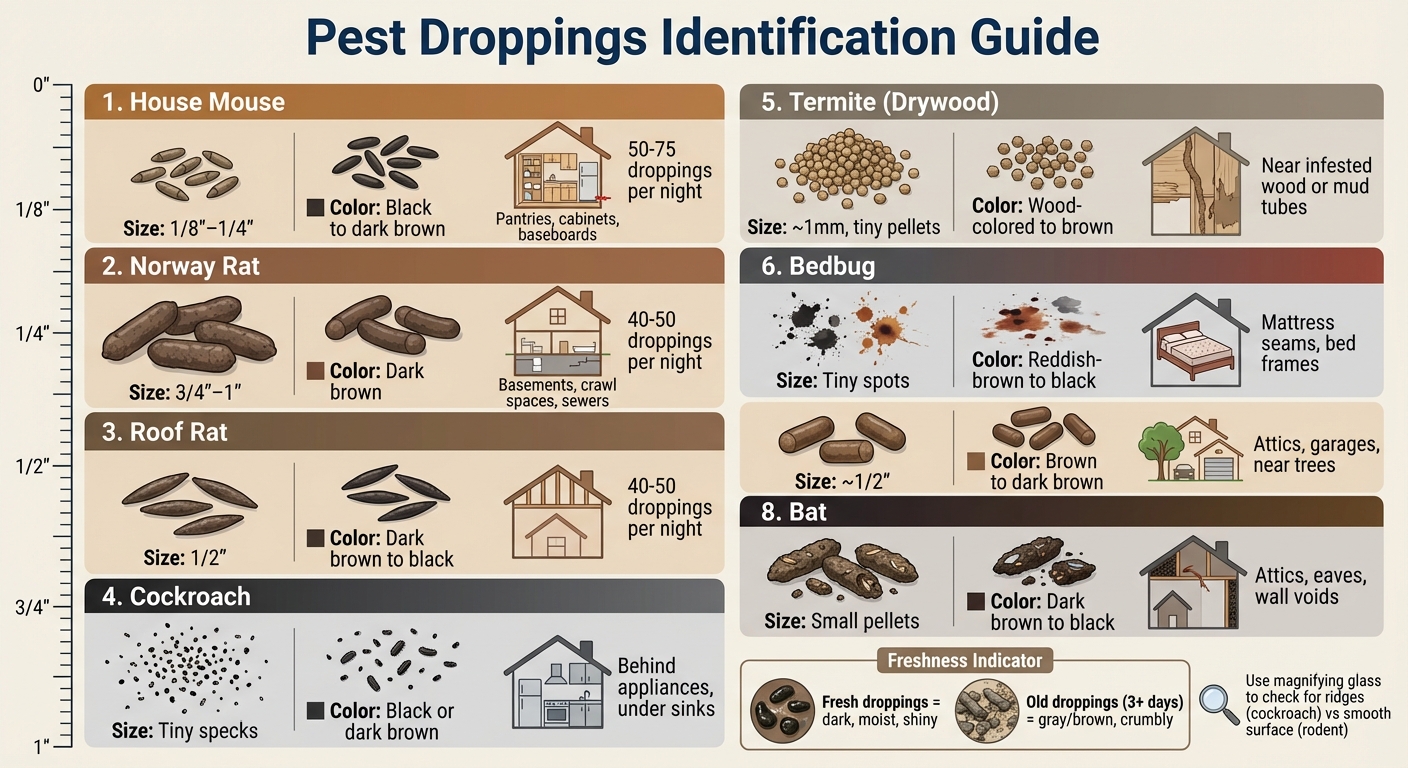
Visual Guide to Common Pest Droppings: Size, Shape, and Location Comparison Chart
The chart below can help you identify pest droppings based on size, shape, color, and where they’re most commonly found.
| Pest Type | Size | Shape | Color | Typical Location |
|---|---|---|---|---|
| House Mouse | 1/8"–1/4" | Cylindrical with pointed ends (rice-like) | Black to dark brown | Pantries, cabinets, baseboards |
| Norway Rat | 3/4"–1" | Thick, sausage-like with blunt ends | Dark brown | Basements, crawl spaces, sewers |
| Roof Rat | 1/2" | Slender, spindle-like with pointed ends | Dark brown to black | Attics, rafters, upper floors |
| Cockroach | Tiny specks | Coarse grounds or pellets with ridges | Black or dark brown | Behind appliances, under sinks |
| Termite | Tiny pellets | Hexagonal and sand-like (frass) | Wood-colored to brown | Near infested wood or mud tubes |
| Bedbug | Tiny spots | Ink-like stains or rust-colored smears | Reddish-brown to black | Mattress seams, bed frames |
| Squirrel | ~1/2" | Cylindrical, smooth with rounded ends | Brown to dark brown | Attics, garages, near trees |
| Bat | Small pellets | Elongated, crumbly with shiny bits | Dark brown to black | Attics, eaves, wall voids |
Freshness is another clue to pest activity. Fresh droppings are typically dark, moist, and shiny. In contrast, droppings older than three days become gray or brown and crumble easily. If you clean up old droppings and find new ones within 24 hours, it’s a clear sign of an active infestation.
For a closer inspection, use a magnifying glass. Cockroach droppings often have vertical ridges, while rodent droppings are smooth and might even contain hair. To tell bat guano apart from mouse droppings, try the crush test: bat droppings crumble into powder and reveal shiny insect wing fragments, while mouse droppings remain hard.
How to Safely Clean Up Pest Droppings
Cleaning up pest droppings needs to be done with care and proper precautions. Rodent droppings, for example, can carry more than 35 diseases, such as Hantavirus, salmonella, and leptospirosis. Begin by ventilating the area - open all doors and windows for at least 30 minutes to help reduce airborne pathogens. Once the space is aired out, follow these safety steps to handle the cleanup process.
"Diseases are mainly spread to people from rodents when they breathe in contaminated air. Don't vacuum or sweep rodent urine, droppings, or nesting materials." - CDC
Start by protecting yourself. Wear gloves and long-sleeved clothing to minimize direct contact. If you're dealing with heavy infestations or droppings from bats or raccoons, go a step further by using an N95 respirator, safety goggles, and disposable coveralls.
Before removing the droppings, spray them thoroughly with a disinfectant or a mixture of one part bleach to nine parts water. Make sure the droppings are fully saturated, and let the solution sit for at least 5 minutes. For areas with significant contamination, extend this time to 10–30 minutes. Afterward, use paper towels to wipe up the droppings and any contaminated materials. Place the waste in a plastic bag, seal it, and then double-bag it before disposing of it in a covered outdoor trash can. Finally, wash your hands thoroughly with soap and water after removing your gloves.
If you feel unsure about any part of the process, our virtual support team is here to help. We provide professional-grade products that are safe for both pets and children, along with clear instructions tailored to your pest issue. This way, you can handle the cleanup with confidence and safety.
Conclusion
Spotting pest droppings and trails early can save you from infestations, health risks, and expensive property repairs.
"The earlier you figure out which insect or critter you're dealing with, the earlier you can intervene and help reduce possible risks to you and your family's health." - Rita Stadler, EarthKind
Catching pest activity in time can prevent major headaches. For instance, rodents are notorious for chewing through electrical wires and damaging insulation, termites can silently weaken the wooden structure of your home, and cockroaches leave surfaces contaminated. Acting fast can help limit these issues.
Once you've identified the problem, make sure to follow the safe cleanup steps outlined earlier to protect both your family and your home.
FAQs
How can I tell the difference between mouse droppings and rat droppings?
When it comes to identifying pests, the size and shape of their droppings can tell you a lot. Mouse droppings are tiny, about 1/4 inch long, smooth, and pointed at the ends. They tend to be lighter in color, ranging from brown to black. Rat droppings, however, are noticeably larger - usually between 1/2 and 3/4 inch long. They’re darker, often deep brown to black, and may have a shiny surface. Observing these differences can help you figure out which pest might be lurking in your home.
What safety steps should I follow when cleaning up pest droppings?
To clean up pest droppings safely, it's essential to take the right precautions. Start by wearing disposable gloves and an N-95 mask or respirator to protect yourself. Make sure the area is well-ventilated by opening windows and doors for at least 30 minutes. Avoid sweeping or vacuuming the droppings, as this can stir up harmful particles into the air.
Next, spray the droppings with a disinfectant, such as a bleach solution (mix 1 part bleach with 10 parts water), and let it sit for about 5 minutes. Use disposable paper towels to carefully wipe up the droppings, then place them in a sealed garbage bag. Once the droppings are removed, clean any hard surfaces with disinfectant and wash your hands thoroughly with soap and water.
For a safer and easier cleanup process, you might want to try a DIY pest control kit from Remedy. These kits come with everything you need, including protective gear and disinfectant, to help you clean effectively and keep your home pest-free.
How can I tell if a pest trail is currently in use?
To figure out if a pest trail is currently active, keep an eye out for fresh evidence such as oily smudges, grease marks, or recently dropped waste. You might also spot new footprints or areas of disturbed, smooth soil near entry points. For the most accurate observations, inspect the area around dusk or at night, as many pests tend to be more active after dark.